Fishing Rigging
The best kayak drift socks
A drift sock slows you to a fishable pace instead of stopping you dead. The size everyone gets wrong is the size, and on a kayak smaller is the answer.
Disclosure: we earn a commission if you buy through the links on this page, at no extra cost to you. It does not change which products we pick or how we rank them. How this site is funded.

The short answer
Quick picks
Ranked for the person outfitting a used boat: what it costs, what it does, and who should skip it. 2 picks.
| # | Product | Best for | Our score | Price |
|---|---|---|---|---|
| 1 |  Lindy Drift Control Drift Sock, 18 inThe smallest size in a proper fishing-brand drift sock, which is the one a kayak actually wants. Lindy Drift Control Drift Sock, 18 inThe smallest size in a proper fishing-brand drift sock, which is the one a kayak actually wants. | A kayak-sized drogue | 8.5 | $24.99View on Amazon |
| 2 |  Lindy Fisherman Drift Sock, 30 inLindy publishes this one for boats up to 20 feet. On a kayak it is a brake, not a trim — buy it only if the 18 does not hold you. Lindy Fisherman Drift Sock, 30 inLindy publishes this one for boats up to 20 feet. On a kayak it is a brake, not a trim — buy it only if the 18 does not hold you. | A heavy boat or real wind | 7.5 | $36.99View on Amazon |
What a drift sock is actually for
A drift sock is an underwater parachute on a rope. It does not hold you in one place — that is an anchor’s job. It slows a wind-driven drift down to a speed you can fish at, and it points the boat consistently while you do it.
That second part is underrated. An unballasted kayak in wind does not drift in a straight line; it slews, presents its side, and swings your casts around with it. A sock dragging behind the boat keeps the stern downwind and turns a chaotic drift into a predictable one.
It is the third option in the hold-still toolkit, alongside an anchor and a stakeout pole, and the comparison of all three is on anchor versus pole versus drift sock. This page is about buying and sizing the sock itself.
How we ranked these
Four criteria, weighted equally and published on how we pick:
- Size match. Whether the published size suits a kayak rather than a bass boat.
- Build. Fabric and coating, and whether the maker states them.
- Retrieval. Whether a dump line is included, because hauling a full sock in by hand is the part people hate.
- Value.
Sizing: why 18 inches, not 30
This is the whole decision, and the sizing guidance published in this category is written for powerboats.
Lindy publishes its 30-inch Fisherman sock for boats up to 20 feet. A kayak is a third of that length and a small fraction of the weight and windage. Fitting a sock sized for a 20-foot boat to a 10-foot kayak does not make you more stable; it plants one end of a light boat and loads a single cleat hard.
The 18-inch sock is the kayak size. It takes enough speed off the drift to fish and still lets the boat move, which is what you want — a drift you cannot control is a problem, but so is a drift that has stopped.
Two honest caveats. Lindy publishes a boat-length rating for the larger sizes and not for the 18, so kayak sizing is an inference from the numbers rather than a published recommendation. And if you fish a heavy, rigged sit-on-top in real wind, the 30 may be the one that actually holds you — at the cost of a much harder pull on the attachment point.
Rig it on a bridle, not a cleat
The mistake that makes drift socks feel useless is tying one to a single point on one side of the boat.
Do that and the sock pulls that corner back, the bow swings across, and you spend the drift correcting. Worse, in current, a boat held sideways is a boat presenting its full length to the flow — the same mechanism that makes side-anchoring dangerous, which we explain on the anchor trolley guide.
Two better options:
- A short bridle from two points — a line from each rear corner meeting at a ring, with the sock on the ring. The pull stays centered and the boat tracks straight.
- An anchor trolley, if the boat already has one. Slide the attachment to the stern and the sock pulls from the end of the boat rather than the side, which is exactly what the trolley exists to do.
Either way, keep a knife where you can reach it. Anything on a rope behind a small boat should be something you can cut free instantly.
Deploying and retrieving it, step by step
A drift sock is simple enough that the whole technique fits in a paragraph, and getting it wrong is what makes people give up on them.
- Set up before you need it. Clip the bridle on while you are still under way, not once the wind has you sideways.
- Throw it downwind of the boat, not upwind. A sock thrown upwind drifts back onto you and tangles.
- Let the line come tight gradually. A sock that snatches loads the attachment point hard and swings the boat.
- Fish. The sock does its work with no further input.
- Retrieve with the dump line. Pull the dump line first so the sock collapses, then bring it in. Pulling on the main line drags a full parachute.
Rinse and dry it before it goes back in a hatch. Coated nylon that sits damp in a sealed compartment for a week comes out smelling like a mistake.
Build the bridle once
The bridle is the part that makes a sock behave, and it takes ten minutes with cord you probably already own.
Run a length of line from a fitting at one rear corner to a fitting at the other, with a ring or a carabiner captured on it. Adjust the length so the ring sits behind the stern when the line is pulled tight. The sock clips to the ring, the load spreads across two points, and the boat tracks straight instead of slewing.
On a boat with an anchor trolley, you already have a better version of this: slide the trolley ring to the stern and clip the sock there. That is the same reason a trolley exists, explained in full on the anchor trolley guide.
Whatever you rig, keep a knife where you can reach it with either hand. Anything on a rope behind a small boat should be something you can cut free in one movement.
The dump line is not optional
A deployed sock full of water is heavy and it does not want to come back. The dump line attaches to the closed end, and pulling it collapses the sock so it comes in empty.
Both Lindy socks here come with one attached. If you are looking at a cheaper sock without one, that is the spec to check — retrieving a full parachute hand over hand from a seated position in a small boat is the reason drift socks end up unused in a hatch.
Fishing behind a sock
The point of slowing a drift is not comfort. It is time over structure.
In a 12 mph breeze an unballasted kayak moves across a flat quickly enough that a jig barely touches bottom before you are past the spot. With a sock out, the same wind gives you a controlled pass: you cover the same water, slower, with the lure in the strike zone rather than skipping over it.
Two habits make it work. Set up upwind of the structure you want to fish and let the drift carry you across it, rather than trying to hold on top of it. And keep the rod on the downwind side, because line angles behind a drifting boat are much easier to manage than line angles under it.
When the drift is finished, retrieve the sock with the dump line before you paddle back upwind. Paddling against a deployed sock is like towing a bucket, which is exactly what you are doing.
When the wind is simply too much
A drift sock has a working range, and it is worth being honest about the top of it.
In light wind a sock is unnecessary; you can fish the drift as it is. In moderate wind it is excellent. In genuinely strong wind, the sock stops being the limiting factor: a light boat with a lot of freeboard gets pushed regardless, the load on your attachment points climbs, and you are managing the boat instead of fishing.
That is the point at which the answer is not more sock. It is a different day, a more sheltered shoreline, or going home — and if you are frequently in that situation, the honest gear answer is rethinking whether the launch you are using suits the wind direction rather than buying a bigger drogue.
When a drift sock is the wrong tool
Three situations where it does nothing useful:
Dead calm. No wind, no drift, nothing for the sock to work against. It is a wet bag you now have to rinse.
When you want to stop. Slowing is not stopping. If the plan is to sit on one piece of structure and work it, you want an anchor or, in shallow water, a stakeout pole — our published anchor picks are on the budget kayak anchor roundup.
Heavy current with obstructions. A sock on a rope in moving water near timber is a snag waiting to happen, and the boat is attached to it.
Two socks, or one bigger one?
Occasionally people run two small socks from a bridle instead of one larger sock. On a bigger boat that is a real technique; on a kayak it is usually more line and more tangle for no gain.
The exception is boat angle. Two socks set at slightly different distances can hold a kayak at a consistent angle to the wind, which matters if you want to cast in one direction all drift. That is a refinement for someone who already drifts a lot, not a starting point.
Storage and rinsing, briefly
A drift sock packs into almost nothing, which is its other advantage over an anchor. Lindy states its socks dry quickly and pack small, and in practice an 18-inch sock rolls into a hatch or the bottom of a crate.
Rinse it after salt water and let it dry before it goes back in the boat. Coated nylon that spends a week damp in a sealed hatch comes out smelling like a mistake, and the coating is what the abrasion resistance depends on. If your tackle storage is already sorted, the box that keeps the rest of it dry is on the kayak tackle box roundup.
What it is tied to matters as much as the sock
A sock in moving water puts a real, sustained load on whatever it is clipped to. On a used boat that is worth a look before the first deployment.
Check the fittings at the stern the way you would check anything you are about to trust: wiggle each pad eye, look for stress cracks in the plastic around it, and replace any fastener that is corroded. A fitting that pulls out under load takes a piece of deck with it.
If the boat has no sound rear fittings, that is a rigging job before it is a drift sock purchase — backing a pad eye properly on a hull you cannot reach inside is covered on the deck rigging guide.
What we would buy
For nearly every kayak, the 18-inch sock. It is the size that matches the boat, it is the cheaper of the two, and it comes with the dump line that makes retrieval a one-hand job.
For a heavy rigged fishing kayak in open water, the 30-inch — with a proper bridle, because a sock rated for boats up to 20 feet will find the weakest attachment point you own.
And if you fish current rather than wind, buy neither. A pole or an anchor holds position; a sock only slows a drift that the wind is driving.
In full
Every pick, in detail
Specs below are the manufacturer's published figures, cited per product. Where a maker does not publish a number, the row says so rather than guessing at it.
#1 · A kayak-sized drogue
Lindy Drift Control Drift Sock, 18 in
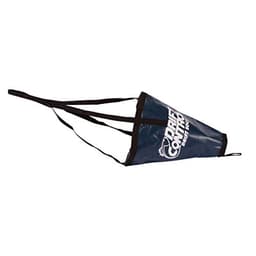
The smallest size in a proper fishing-brand drift sock, which is the one a kayak actually wants.
Published specs
| Size | 18 in |
|---|---|
| Series | Fisherman Series |
| Material | Reinforced nylon, coated for durability and water resistance |
| Retrieval | Dump line attached |
| Design | Tangle-resistant and spin-resistant |
Our score, broken out
- Size match9.0
- Build8.0
- Retrieval8.5
- Value8.5
What it gets right
- 18 inches is the size that slows a kayak rather than stopping it — the bigger socks in this range are sized for boats several times a kayak's weight.
- The dump line is included, which is what collapses the sock for retrieval instead of hauling a full parachute back by hand.
- It packs into nothing and dries fast, so it lives in a hatch rather than on the deck.
What it gets wrong
- Lindy publishes a boat-length guide for the larger sizes and not for this one, so kayak sizing is left to you.
- A drift sock only works with wind or current to pull against. On a dead-calm pond it does nothing at all.
- It needs a bridle or a cleat to attach to, and a sock tied to one point on one side will slew the boat sideways.
Who should skip it
Skip it if you fish moving current rather than wind drift. A stakeout pole or an anchor holds position; this only slows you down.
#2 · A heavy boat or real wind
Lindy Fisherman Drift Sock, 30 in
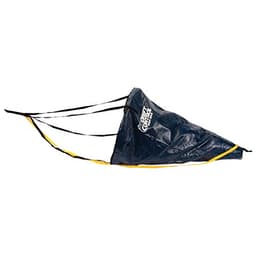
Lindy publishes this one for boats up to 20 feet. On a kayak it is a brake, not a trim — buy it only if the 18 does not hold you.
Published specs
| Size | 30 in |
|---|---|
| Published for | Boats up to 20 ft |
| Series | Fisherman Series |
| Material | Reinforced nylon, coated for durability and water resistance |
| Retrieval | Dump line attached |
Our score, broken out
- Size match6.0
- Build8.0
- Retrieval8.5
- Value7.5
What it gets right
- A published boat-length rating, which is the one piece of sizing guidance anyone in this category prints.
- The extra area holds a loaded fishing kayak in wind that the 18-inch sock just slows down.
- Same coated reinforced nylon and dump line as the smaller size.
What it gets wrong
- It is sized for boats up to 20 feet. On a 10-foot kayak in a stiff breeze, that is a lot of drag on one cleat.
- More sock means more to stow, more to rinse and more to tangle on a small deck.
- The load it puts on your attachment point is real — check what the sock is tied to before you trust it.
Who should skip it
Skip it for an unloaded recreational kayak. This is the size for a heavy, rigged fishing boat in wind.
FAQ
Questions people actually ask
What size drift sock do I need for a kayak?
An 18-inch sock suits a kayak. The sizing published in this category is written for powerboats — Lindy publishes its 30-inch sock for boats up to 20 feet, which is a very different object from a 10-foot kayak.
A sock that is too big does not make you more stable; it plants one end of a light boat and loads a single attachment point hard. Note that Lindy does not publish a boat-length rating for the 18, so kayak sizing is an inference from the numbers rather than the maker's own recommendation.
How do you attach a drift sock to a kayak?
On a bridle, not a single side cleat. Run a short line from each rear corner to a ring and clip the sock to the ring, so the pull stays centered and the boat tracks straight.
If the boat has an anchor trolley, slide the attachment point to the stern and use that — pulling from the end of the boat rather than the side is exactly what a trolley is for. Keep a knife within reach whenever something is on a rope behind the boat.
Does a drift sock stop a kayak?
No. It slows a wind-driven drift to a fishable pace and keeps the boat pointing consistently, which is a different job from holding position.
If you want to stop, use an anchor, or a stakeout pole in shallow water. Many kayak anglers carry a sock and one of the other two, because wind drifting and holding a spot are different problems.
What is the dump line on a drift sock for?
Collapsing the sock so it comes back empty. A deployed sock full of water is heavy and awkward to retrieve hand over hand from a seated position in a small boat.
Both Lindy socks here ship with a dump line attached. On a cheaper sock, check for one — it is the feature that decides whether you actually use the thing.
We have not paddled with any of this gear. Everything above comes from published specifications, cited manuals and live retailer prices. Here is exactly how we pick.
Sources
Read next
Related on Drift & Dime
Fishing Rigging
Kayak anchor versus stakeout pole versus drift sockThree ways to control drift, and which one your depth and wind call for.
Fishing Rigging
The best budget kayak anchorsAnchor kits compared on rope length and contents — buy scope, not weight.
Fishing Rigging
The kayak anchor trolley guideWhy side anchoring rolls a kayak, and what a trolley costs in holes.
Fishing Rigging
The best kayak fishing tackle boxesTrays ranked on sealing, the standard footprint and what belongs in each.