Racks & Transport
How to transport a kayak without a roof rack
Foam blocks, straps through the cabin, and bow and stern lines to the tow points. Six steps, and the three mistakes that make it unsafe.
Disclosure: we earn a commission if you buy through the links on this page, at no extra cost to you. It does not change which products we pick or how we rank them. How this site is funded.

The short answer
Quick picks
Ranked for the person outfitting a used boat: what it costs, what it does, and who should skip it. 3 picks.
| # | Product | Best for | Our score | Price |
|---|---|---|---|---|
| 1 |  Malone Standard Kayak Foam Block Kit55 lb, straps included, works on a bare roof. The no-rack answer. Malone Standard Kayak Foam Block Kit55 lb, straps included, works on a bare roof. The no-rack answer. | No crossbars at all | 8.1 | $46.27View on Amazon |
| 2 | Rightline Gear Foam Block Kayak CarrierOne kit that works with bars or without. Car clips included. | Rack or no rack | 7.8 | Check price on Amazon |
| 3 |  NRS 1" HD Tie-Down Straps1,500 lb breaking strength, 500 lb working load, published. NRS 1" HD Tie-Down Straps1,500 lb breaking strength, 500 lb working load, published. | The strap you buy once | 8.4 | $21.95View on Amazon |
You do not need a roof rack. A foam block kit plus straps through the cabin plus bow and stern lines carries a kayak safely on a bare roof, and it is what most people should buy first. Malone publishes a 55 lb load rating for its standard kit, which covers a typical recreational hull.
The six steps
- Empty the car first. The straps will run through the cabin, so once the boat is on you cannot open a door. Get everything out now.
- Put the blocks on the roof, wide apart. Roughly over the door pillars, as far apart as the roof allows. Two blocks close together in the middle of the roof are a pivot, not a support.
- Load the boat upside down. Hull up, deck down. Polyethylene is strongest that way and the flat deck sits better on foam. Lift with a second person if you have one; if you are alone, rest the bow on the rear of the roof and walk the stern up.
- Run the straps over the hull and through the car. All four doors open. Over the boat, in one door, across the ceiling, out the other, buckle on the side. Not over the hull — a metal cam sitting on the deck will scuff it. Close the doors on the straps.
- Add bow and stern lines. From the boat’s grab handles to a metal tow eye or recovery point at each end of the car. Not to a plastic bumper: it will tear.
- Shove it. Push the boat hard sideways, then front to back. If anything moves, tighten. Then re-check after ten minutes of driving, and again at every stop.
The three mistakes that actually cause failures
1. No bow and stern lines. This is the big one. The two hull straps stop the boat lifting off the roof. They do very little to stop it rotating, and rotation is what a crosswind or the pressure wave off an overtaking truck produces. The end lines are what keep the boat pointing forwards.
2. Ratchet straps. A ratchet will dent a polyethylene hull, and on foam blocks it will also crush the foam so the load goes slack ten miles later. Use cam straps. Detail on the best kayak tie-down straps.
3. Hooking the straps on the door frame lip. Straps sold with small hooks that grab the seam under a door look convenient. They bend the seam over time and they can release. Either run the strap right through the cabin, or use a proper car clip — Rightline includes four in its kit for exactly this reason.
Two things that will annoy you, and the fixes
The doors are strapped shut. Unavoidable on a bare roof. Load the car before the boat, every time, and keep the keys in your pocket rather than the cabin.
Strap hum. A flat strap in an airstream vibrates and it is loud. Put one half-twist in each span. It breaks up the airflow and mostly eliminates the noise — a real fix, not folklore.
What not to do
- Pool noodles. They crush under a hull and offer no meaningful support. This appears constantly in DIY advice and it is not equivalent to closed-cell EVA blocks.
- Towels or blankets as padding. They slide when wet, which is precisely when you need them not to.
- Bungee cords. They are elastic. Anything holding a 60-pound object at 70 mph must not be.
- Skipping the ten-minute check. Foam compresses as it warms and straps bed in. The single check that catches almost every loose load is the one after the first ten minutes.
When to stop doing this and buy bars
Foam blocks are a real solution, not a temporary one — plenty of people use them for years. But there is a point where bars pay for themselves:
If you are driving more than about an hour each way most weekends, the stopping to re-check gets old. If you carry two boats, blocks cannot do it — that case is on the best roof rack for two kayaks. If you also want to carry a bike or a box, you need bars anyway. And if you cannot bear the doors being strapped shut, that alone is a fair reason.
Short of that, put the money into a cart, which removes the carry from the car park to the water — usually a bigger improvement to a paddling day than the rack is.
In full
Every pick, in detail
Specs below are the manufacturer's published figures, cited per product. Where a maker does not publish a number, the row says so rather than guessing at it.
#1 · No crossbars at all
Malone Standard Kayak Foam Block Kit
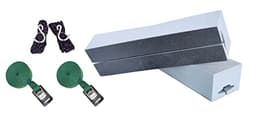
55 lb, straps included, works on a bare roof. The no-rack answer.
Published specs
| Capacity | 55 lb |
|---|---|
| Block size | 14" long × 4.75" wide × 3.75" high |
| Kit weight | 3.3 lb |
| Material | EVA closed-cell foam |
| Included | Two 15' load straps plus safety tie-downs |
| Bar profile | Universal cut-out fits round, square and oval bars |
Our score, broken out
- Capacity6.0
- Fit range9.5
- Ease of loading7.5
- Value9.5
What it gets right
- Works on a completely bare roof, which is the actual situation most people asking about crossbars are in.
- The straps are in the box. Foam blocks sold without straps are not a solution, they are half of one.
- Packs into a boot. Nothing stays on the car.
What it gets wrong
- 55 lb capacity is the lowest here — fine for a recreational kayak, not for a loaded fishing boat.
- Straps pass through the cabin on a bare roof, so the doors have to open before you can unload.
Who should skip it
Skip it for highway distance every weekend. Foam and straps are genuinely safe when rigged properly with bow and stern lines, but they need re-checking at every stop, and after a season of that most people buy bars.
#2 · Rack or no rack
Rightline Gear Foam Block Kayak Carrier
One kit that works with bars or without. Car clips included.
Published specs
| Capacity | 1 kayak |
|---|---|
| Block size | 14.75" × 4.0" × 3.75" |
| Included | 2 foam blocks, 2 dual-lock straps, 4 car clips, 2 kayak end straps, mesh carry bag, setup guide |
| Fits | Vehicles with or without a roof rack |
| Weight limit | Manufacturer does not publish this |
Our score, broken out
- Capacity5.5
- Fit range9.5
- Ease of loading7.5
- Value9.0
What it gets right
- The four car clips give the straps something to hook to inside the door frame, which is the part people improvise badly.
- Bow and stern end straps are included rather than sold separately.
What it gets wrong
- No published load rating, so you cannot check a heavy boat against a number.
- Single boat only.
Who should skip it
Skip it if you want a published weight limit before you put a boat on your roof. The Malone kit publishes 55 lb; this one does not publish anything.
#3 · The strap you buy once
NRS 1" HD Tie-Down Straps
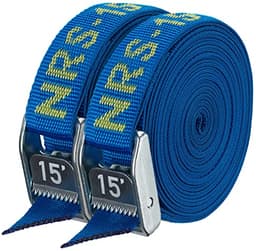
1,500 lb breaking strength, 500 lb working load, published.
Published specs
| Minimum breaking strength | 1,500 lb |
|---|---|
| Working load limit | 500 lb |
| Width | 1" |
| Length | Sold in fixed lengths including 9 ft |
| Buckle | Cam |
Our score, broken out
- Strength9.5
- Hardware9.0
- Length options7.5
- Value7.0
What it gets right
- NRS publishes both MBS and WLL. Most straps sold for kayaks publish neither, and the ones that do usually quote only the number that flatters them.
- Cam buckle, not ratchet — you physically cannot over-tension a plastic hull with a cam.
What it gets wrong
- Costs several times what a supermarket strap costs.
- 9 ft is short for a tall vehicle plus a wide boat; measure before you order a length.
Who should skip it
Skip these if you were about to buy ratchet straps for the same job — but skip the ratchets, not these. A ratchet gives you enough mechanical advantage to dent a polyethylene hull, and people do.
FAQ
Questions people actually ask
Can you transport a kayak without a roof rack?
Yes. Foam blocks between the hull and the roof, straps over the boat and through the cabin, and bow and stern lines to the tow points is the standard method. Malone publishes a 55 lb load rating for its standard kit, which covers a typical recreational hull.
The boat goes upside down, hull up. Re-check the tension after ten minutes of driving and at every stop.
Can I carry a kayak on my roof without a rack on the highway?
Yes, provided it is rigged properly — and at highway speed the bow and stern lines stop being optional. The two hull straps resist lifting; the end lines are what stop the boat rotating under a crosswind or the pressure wave from an overtaking truck.
Run those lines to a metal tow eye or recovery point, never to a plastic bumper.
Should the kayak go upside down on the roof?
Yes, on foam blocks. Hull up and deck down: polyethylene is strongest in that orientation, and the flatter deck sits more stably on the foam.
On saddles designed to cradle the hull, follow the carrier's instructions instead — those are shaped to support the boat the right way up.
Why do my kayak straps make a loud humming noise?
A flat strap in a fast airstream vibrates like a reed. It is harmless but genuinely unpleasant over a long drive.
Put one half-twist in each span of strap. That breaks up the vortex shedding and stops most of the noise. It is a real fix rather than folklore.
We have not paddled with any of this gear. Everything above comes from published specifications, cited manuals and live retailer prices. Here is exactly how we pick.
Sources
Read next
Related on Drift & Dime
Racks & Transport
A kayak roof rack without crossbarsWhat carries a boat on a bare roof — and why side rails are not crossbars.
Racks & Transport
The best budget kayak roof racksRacks ranked on published load capacity and whether you can load solo.
Racks & Transport
The best kayak tie-down strapsCam straps compared on published MBS and working load — and why not to use ratchets.
Racks & Transport
How to transport a kayak on a sedanShort roofs, long overhangs, and the loading method for a small car.