Paddles
What size kayak paddle do I need?
Two measurements decide it: how tall you are and how wide your boat is. Boat width matters more than most people expect. Here is the table.
Disclosure: we earn a commission if you buy through the links on this page, at no extra cost to you. It does not change which products we pick or how we rank them. How this site is funded.
The short answer
Quick picks
Ranked for the person outfitting a used boat: what it costs, what it does, and who should skip it. 3 picks.
| # | Product | Best for | Our score | Price |
|---|---|---|---|---|
| 1 |  Bending Branches Whisper37 oz, 89 sq in blade, 0 or 60° feather. The honest entry paddle. Bending Branches Whisper37 oz, 89 sq in blade, 0 or 60° feather. The honest entry paddle. | First real paddle | 7.6 | $79.95View on Amazon |
| 2 |  Bending Branches Angler ClassicFiberglass shaft, 102.5 sq in blade, and a hook retrieval notch. Bending Branches Angler ClassicFiberglass shaft, 102.5 sq in blade, and a hook retrieval notch. | Fishing | 7.7 | $174.95View on Amazon |
| 3 |  Aqua-Bound Sting Ray Hybrid30 oz on a carbon shaft. Seven ounces lighter than the entry paddles. Aqua-Bound Sting Ray Hybrid30 oz on a carbon shaft. Seven ounces lighter than the entry paddles. | The weight upgrade | 8.0 | $184.95View on Amazon |
Kayak paddle length is set by your height and your boat’s width. Most recreational paddlers on boats under 30 inches wide land between 220 and 230 cm. Wide fishing kayaks commonly need 240 to 260 cm. Measure the beam of your boat before you buy anything.
The sizing table
Height down the side, boat width across the top. Widths are the beam — the widest point of the hull, which is printed in almost every manufacturer’s specification and is easy to measure with a tape.
| Your height | Under 23" beam | 23–28" beam | 28–32" beam | Over 32" beam |
|---|---|---|---|---|
| Under 5'0" | 200 cm | 210 cm | 220 cm | 230 cm |
| 5'0"–5'6" | 210 cm | 220 cm | 230 cm | 240 cm |
| 5'7"–6'0" | 215 cm | 220 cm | 230 cm | 250 cm |
| Over 6'0" | 220 cm | 230 cm | 240 cm | 260 cm |
Why boat width matters more than your height
Look along a row of that table rather than down a column. For a given paddler, going from a narrow touring hull to a wide fishing boat changes the recommendation by 30 to 40 cm. Going from the shortest paddler to the tallest, on a fixed hull width, changes it by 20 or 30.
The reason is geometry. The blade has to reach past the widest point of the boat and enter the water cleanly beside the hull, not out at an angle. A wider boat pushes the entry point further from your body, and the paddle has to be long enough to get there without you leaning.
This is why the manufacturers size their lines the way they do: Bending Branches sells the recreational Whisper in 210 to 240 cm, and the Angler Classic — sold for wide fishing hulls — in 220 to 260 cm.
Two things that shift the answer
Seat height. A raised fishing seat puts you several inches higher, which has the same effect as a wider boat. If your sit-on-top has an elevated frame seat, go up one increment from the table. Which paddles are even published long enough to land there is on the fishing paddle roundup.
Stroke style. A high-angle stroke — the paddle held steeply, blade entering close to the hull, used for speed and acceleration — wants a shorter paddle. A low-angle stroke — shaft nearly horizontal, relaxed, used for long distances — wants a longer one. Most recreational paddlers use low angle without ever thinking about it, which the table assumes.
How to check a paddle you already own
If your used boat came with a paddle, this tells you whether to keep it.
On land: stand the paddle upright beside you. You should be able to hook your fingers over the top blade with your arm extended overhead. Fingers curling over the whole blade means it is short; not reaching the blade at all means it is long. This is rough, but it catches badly wrong.
On the water, which is the real test:
- Knuckles hitting the gunwale on the recovery, or the blade barely clearing the hull: too short.
- Reaching out to plant the blade, and the boat yawing side to side each stroke: too long. Every stroke has become a sweep, which turns the boat.
- The whole blade goes under with no shaft submerged, and the boat tracks straight: correct.
When you fall between two sizes
Paddles come in 10 cm steps, so this happens often. Three tie-breakers, in order:
- Go longer if the boat is wide or has a raised seat. Being short on a wide boat is the more painful error — you cannot fix it by technique.
- Go shorter if you are buying a heavy paddle. A long lever with mass at the ends is more tiring, and on a 37 oz paddle that compounds.
- Go shorter if your shoulders are the limiting factor. A shorter paddle is a lower-effort stroke at a higher cadence.
Once you have a length, choose the paddle itself on the best budget kayak paddles. Length is a requirement; weight and material are refinements.
In full
Every pick, in detail
Specs below are the manufacturer's published figures, cited per product. Where a maker does not publish a number, the row says so rather than guessing at it.
#1 · First real paddle
Bending Branches Whisper
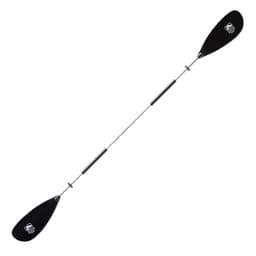
37 oz, 89 sq in blade, 0 or 60° feather. The honest entry paddle.
Published specs
| Weight | 37 oz |
|---|---|
| Blade | 6.75" × 18" (17 × 46 cm), 89 sq in surface area |
| Blade material | Polypropylene |
| Shaft | Aluminum |
| Lengths | 210, 220, 230, 240 cm |
| Ferrule | Two-piece, 0° or 60° feather |
| Blade shape | Asymmetrical with dihedral |
Our score, broken out
- Weight5.5
- Blade8.0
- Adjustability7.0
- Value9.5
What it gets right
- A genuine asymmetrical dihedral blade at the bottom of the market — that shape is what stops the paddle fluttering through the stroke.
- Four published lengths, so you can actually size it rather than buying one-size-fits-nobody.
- 89 sq in is a modest blade, which is the right call for a beginner's shoulders.
What it gets wrong
- 37 oz is heavy. Over a three-hour paddle you lift that difference thousands of times.
- An aluminum shaft is cold in spring and hot in August.
Who should skip it
Skip it if you already know you paddle more than a few times a month. The weight is the one thing you cannot fix later, and the Sting Ray Hybrid is 7 oz lighter for real money but not silly money.
#2 · Fishing
Bending Branches Angler Classic
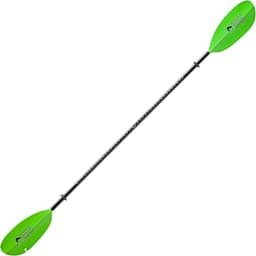
Fiberglass shaft, 102.5 sq in blade, and a hook retrieval notch.
Published specs
| Weight | 35.5 oz (snap-button); 37 oz (Versa-Lok) |
|---|---|
| Blade | 7.5" × 18", 102.5 sq in |
| Blade material | Fiberglass-reinforced nylon |
| Shaft | Fiberglass |
| Lengths | 220–260 cm in 10 cm increments (snap-button) |
| Feature | Grooved blade for retrieving a snagged lure |
Our score, broken out
- Weight6.0
- Blade8.5
- Adjustability8.0
- Value8.0
What it gets right
- Fiberglass shaft rather than aluminum: warmer in the hand, and it does not conduct the cold out of your fingers in April.
- Lengths up to 260 cm, which is what a wide fishing sit-on-top actually needs and what most budget paddles do not offer.
- The lure groove sounds like marketing until the first time it saves a crankbait.
What it gets wrong
- 102.5 sq in is a big blade — more bite, more shoulder load.
- Only 1.5 oz lighter than the Whisper in the snap-button version, despite costing considerably more.
Who should skip it
Skip it if you do not fish and your boat is under 30 inches wide. You are buying blade area and length you will not use, and paying for a groove that retrieves lures you are not casting.
#3 · The weight upgrade
Aqua-Bound Sting Ray Hybrid
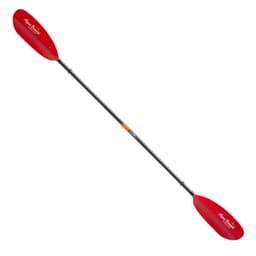
30 oz on a carbon shaft. Seven ounces lighter than the entry paddles.
Published specs
| Weight | 30 oz (850 g) |
|---|---|
| Shaft | Carbon |
| Blade material | Fiberglass-reinforced nylon |
| Ferrule | Posi-Lok, 2-piece or 4-piece |
Our score, broken out
- Weight9.0
- Blade8.0
- Adjustability8.5
- Value6.5
What it gets right
- 30 oz is the number that changes a paddling day. Seven ounces off a 37 oz paddle is a fifth of the weight, lifted every stroke.
- The 4-piece Posi-Lok version breaks down small enough to travel, which no aluminum entry paddle does.
What it gets wrong
- Costs several times the Whisper.
- A carbon shaft is stiff and unforgiving of being levered against a rock.
Who should skip it
Skip it if the boat cost less than the paddle would. Spending more on the paddle than the kayak is a defensible choice — but make it deliberately, in year two, not on day one.
FAQ
Questions people actually ask
What size paddle for a kayak?
Cross your height with your boat's beam — its widest point. Most recreational paddlers on hulls under 30 inches wide land between 220 and 230 cm, and wide fishing kayaks commonly need 240 to 260 cm.
Boat width matters more than height. For a given paddler, moving from a narrow touring hull to a wide fishing boat changes the recommendation by 30 to 40 cm.
How long should a paddle be for a kayak?
Between 200 and 260 cm for almost everyone, set by your height and your boat's beam. A 5'7" to 6'0" paddler on a 23 to 28 inch hull wants about 220 cm; the same paddler on a boat over 32 inches wide wants about 250 cm.
A raised fishing seat has the same effect as a wider boat — go up one 10 cm increment if you have one.
How do I know if my kayak paddle is too short?
On the water, the signs are your knuckles hitting the gunwale on the recovery, or the blade only just clearing the hull as it comes across.
Too long shows differently: you reach out to plant the blade and the boat yaws side to side, because every stroke has become a sweep. Correct length puts the whole blade under with no shaft submerged and the boat tracking straight.
Does kayak paddle length depend on the boat or the paddler?
Both, and the boat matters more. Across a fixed hull width, the difference between the shortest and tallest paddler is roughly 20 to 30 cm. Across hull widths for a fixed paddler it is 30 to 40 cm.
That is why manufacturers size their lines by intended boat: Bending Branches sells the recreational Whisper at 210 to 240 cm and the fishing Angler Classic at 220 to 260 cm.
We have not paddled with any of this gear. Everything above comes from published specifications, cited manuals and live retailer prices. Here is exactly how we pick.
Sources
Read next
Related on Drift & Dime
Paddles
The best budget kayak paddlesPaddles ranked on published weight and blade area — a 10 oz spread.
Paddles
Fiberglass versus carbon kayak paddlesSeven ounces, several times the price — when the carbon upgrade pays off.
Paddles
Do kayaks come with paddles?What package paddles are worth, and using a missing one to negotiate.