Paddles
Do kayaks come with paddles?
New package deals often include one, and it is usually the cheapest the maker could put in the box. Used boats frequently include nothing — which is a negotiating point.
Disclosure: we earn a commission if you buy through the links on this page, at no extra cost to you. It does not change which products we pick or how we rank them. How this site is funded.
The short answer
Quick picks
Ranked for the person outfitting a used boat: what it costs, what it does, and who should skip it. 3 picks.
| # | Product | Best for | Our score | Price |
|---|---|---|---|---|
| 1 |  Bending Branches Whisper37 oz, 89 sq in blade, 0 or 60° feather. The honest entry paddle. Bending Branches Whisper37 oz, 89 sq in blade, 0 or 60° feather. The honest entry paddle. | First real paddle | 7.6 | $79.95View on Amazon |
| 2 | Carlisle Magic PlusFiberglass shaft at an entry price. Heavy, and nearly unbreakable. | Rental-tough | 6.8 | Check price on Amazon |
| 3 |  Aqua-Bound Sting Ray Hybrid30 oz on a carbon shaft. Seven ounces lighter than the entry paddles. Aqua-Bound Sting Ray Hybrid30 oz on a carbon shaft. Seven ounces lighter than the entry paddles. | The weight upgrade | 8.0 | $184.95View on Amazon |
Sometimes. New kayaks sold as a package usually include a paddle; new kayaks sold on their own usually do not. Used kayaks frequently come with nothing, because a paddle is the easiest thing for the seller to keep or to have already lost.
What a package paddle actually is
When a retailer sells a kayak with a paddle and a PFD as a bundle, the bundled items are almost always the cheapest the manufacturer could include while still being usable. That is not a scandal — it is how a package price is achieved — but it is worth knowing what you have.
A typical package paddle is an aluminum shaft with symmetrical polypropylene blades, in one fixed length, with no feather adjustment. Compare that with an entry paddle bought separately: Bending Branches’ Whisper publishes an asymmetrical dihedral blade, four length options from 210 to 240 cm, and 0 or 60 degree feathering. Those are real differences, and the asymmetrical blade in particular is the one that stops the paddle fluttering in your hands.
Keep the package paddle. It is your spare, and every boat should carry one.
Used boats: assume no paddle, and price accordingly
A paddle is the single most common thing missing from a second-hand kayak. Sellers keep them, lend them, or lost them years ago.
Two practical consequences.
Budget for it before you agree a price. A properly sized entry paddle is a meaningful fraction of what a cheap used boat costs. It is not an afterthought purchase.
Use it in the negotiation, specifically. “It doesn’t come with a paddle” is a vague complaint. “There’s no paddle and no PFD, so that’s two things I have to buy before I can use it” is a concrete one, and it is true. The same applies to a missing seat and perished deck rigging — the full list is on what a used kayak is worth.
If the used boat does come with a paddle
Three checks, in about a minute, before you count it as included:
- Is it the right length for you and this boat? A paddle sized for the previous owner on a different hull is not a free paddle. Check it against the table on what size kayak paddle you need.
- Does the ferrule still lock? The joint in the middle is the part that fails. Assemble it, twist it hard, and see whether it holds. A worn ferrule that rotates under load makes a paddle genuinely unpleasant, and it is not economically repairable on a cheap paddle.
- Are the blades intact at the tips? Chips are cosmetic. Cracks that run back into the blade are not, and they propagate.
A paddle that fails the length test is still worth having as a spare. One that fails the ferrule test is scrap.
What to buy if there is no paddle
Get the length right first — that is a requirement, not a preference — then pick on weight and shaft material.
For most people outfitting a used recreational boat, an entry paddle with an asymmetrical blade in the correct length is the right purchase. Bending Branches publishes 37 ounces and 89 square inches of blade for the Whisper, in four lengths. It is not light, and the money you do not spend here buys a cart, which will improve your paddling days more than seven ounces would.
If you already know you paddle for hours at a time, skip that step and buy the 30-ounce Sting Ray Hybrid. The full comparison is on the best budget kayak paddles.
For a first paddle specifically — what to check on the box and what to ignore — see the best kayak paddle for beginners.
Always carry a spare on a long trip
A broken or lost paddle a long way from the car is a serious problem rather than an inconvenience. A four-piece paddle stows under deck bungees and takes up almost nothing; so does the old package paddle you were about to throw out.
And for the more common failure — a paddle that simply gets away from you in wind — a leash costs very little on open flat water. Take it off in surf and current, where tethering yourself to a floating object is an entanglement risk.
In full
Every pick, in detail
Specs below are the manufacturer's published figures, cited per product. Where a maker does not publish a number, the row says so rather than guessing at it.
#1 · First real paddle
Bending Branches Whisper
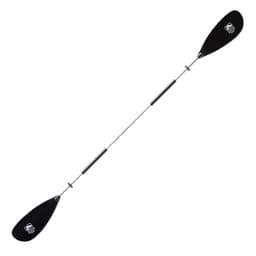
37 oz, 89 sq in blade, 0 or 60° feather. The honest entry paddle.
Published specs
| Weight | 37 oz |
|---|---|
| Blade | 6.75" × 18" (17 × 46 cm), 89 sq in surface area |
| Blade material | Polypropylene |
| Shaft | Aluminum |
| Lengths | 210, 220, 230, 240 cm |
| Ferrule | Two-piece, 0° or 60° feather |
| Blade shape | Asymmetrical with dihedral |
Our score, broken out
- Weight5.5
- Blade8.0
- Adjustability7.0
- Value9.5
What it gets right
- A genuine asymmetrical dihedral blade at the bottom of the market — that shape is what stops the paddle fluttering through the stroke.
- Four published lengths, so you can actually size it rather than buying one-size-fits-nobody.
- 89 sq in is a modest blade, which is the right call for a beginner's shoulders.
What it gets wrong
- 37 oz is heavy. Over a three-hour paddle you lift that difference thousands of times.
- An aluminum shaft is cold in spring and hot in August.
Who should skip it
Skip it if you already know you paddle more than a few times a month. The weight is the one thing you cannot fix later, and the Sting Ray Hybrid is 7 oz lighter for real money but not silly money.
#2 · Rental-tough
Carlisle Magic Plus
Fiberglass shaft at an entry price. Heavy, and nearly unbreakable.
Published specs
| Weight | 2 lb 7.8 oz (about 39.8 oz) |
|---|---|
| Shaft | Wrapped fiberglass |
| Blade material | Fiberglass-reinforced polypropylene |
Our score, broken out
- Weight4.5
- Blade7.0
- Adjustability6.5
- Value8.5
What it gets right
- A fiberglass shaft at close to aluminum-paddle money — warmer to hold and it does not dent.
- The paddle liveries and rental fleets buy, which tells you what it survives.
What it gets wrong
- The heaviest paddle here at roughly 39.8 oz.
- Polypropylene blades flex more than the nylon blades on the Angler Classic.
Who should skip it
Skip it if weight is your complaint. It is heavier than the Whisper, so it solves the shaft-material problem and makes the weight problem slightly worse.
#3 · The weight upgrade
Aqua-Bound Sting Ray Hybrid
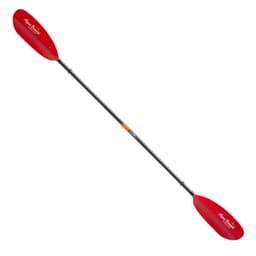
30 oz on a carbon shaft. Seven ounces lighter than the entry paddles.
Published specs
| Weight | 30 oz (850 g) |
|---|---|
| Shaft | Carbon |
| Blade material | Fiberglass-reinforced nylon |
| Ferrule | Posi-Lok, 2-piece or 4-piece |
Our score, broken out
- Weight9.0
- Blade8.0
- Adjustability8.5
- Value6.5
What it gets right
- 30 oz is the number that changes a paddling day. Seven ounces off a 37 oz paddle is a fifth of the weight, lifted every stroke.
- The 4-piece Posi-Lok version breaks down small enough to travel, which no aluminum entry paddle does.
What it gets wrong
- Costs several times the Whisper.
- A carbon shaft is stiff and unforgiving of being levered against a rock.
Who should skip it
Skip it if the boat cost less than the paddle would. Spending more on the paddle than the kayak is a defensible choice — but make it deliberately, in year two, not on day one.
FAQ
Questions people actually ask
Do kayaks come with paddles?
New kayaks sold as a package usually include one; new kayaks sold on their own usually do not. Used kayaks frequently include nothing, because a paddle is the easiest thing for a seller to keep or to have already lost.
Assume a used boat has no paddle unless the listing shows one, and budget for it before agreeing a price.
Are the paddles that come with a kayak package any good?
They are usable and they are the cheapest item the manufacturer could include. Typically an aluminum shaft with symmetrical polypropylene blades in one fixed length, with no feather adjustment.
An entry paddle bought separately gives you an asymmetrical dihedral blade, several length options and feather settings. Keep the package paddle regardless — it is your spare, and every boat should carry one.
How do I check a used kayak paddle before buying?
Three checks. Is it the right length for you and for this boat's beam — a paddle sized for the previous owner is not a free paddle. Does the ferrule still lock when you assemble it and twist hard. Are the blade tips chipped rather than cracked.
A wrong-length paddle is still a useful spare. A worn ferrule that rotates under load makes a cheap paddle scrap.
We have not paddled with any of this gear. Everything above comes from published specifications, cited manuals and live retailer prices. Here is exactly how we pick.
Sources
Read next
Related on Drift & Dime
Paddles
The best budget kayak paddlesPaddles ranked on published weight and blade area — a 10 oz spread.
Paddles
What size kayak paddle do I need?Height crossed with boat width — the sizing table, in inches and centimeters.
Kits
What a used kayak is worthValuing a second-hand hull, and using what is missing to negotiate.
Kits
The used kayak rescue kitFor a neglected hull: what perished, what is missing, what to check first.