Paddles
The kayak paddle leash guide
Cheap insurance on open water, and a genuine hazard in moving water. The one accessory on this site whose right answer depends entirely on where you paddle.
Disclosure: we earn a commission if you buy through the links on this page, at no extra cost to you. It does not change which products we pick or how we rank them. How this site is funded.
The short answer
Quick picks
Ranked for the person outfitting a used boat: what it costs, what it does, and who should skip it. 2 picks.
| # | Product | Best for | Our score | Price |
|---|---|---|---|---|
| 1 |  YakGear Paddle LeashThe cheapest insurance on the boat, and the most often skipped. YakGear Paddle LeashThe cheapest insurance on the boat, and the most often skipped. | Not losing the paddle | 8.0 | $14.39View on Amazon |
| 2 |  Bending Branches Whisper37 oz, 89 sq in blade, 0 or 60° feather. The honest entry paddle. Bending Branches Whisper37 oz, 89 sq in blade, 0 or 60° feather. The honest entry paddle. | First real paddle | 7.6 | $79.95View on Amazon |
The problem a leash solves
Losing a paddle on open water is worse than it sounds, and it is specifically bad because of the feedback loop: you have no paddle, so you cannot chase the paddle. On any breeze at all, a light paddle blows downwind faster than you can hand-paddle after it.
It happens when you put the paddle down to fish, take a photograph, adjust a strap, or drink something. A leash costs very little and removes the whole category of problem.
When you should absolutely take it off
Surf, whitewater, and any moving water with obstructions.
This is not a hedge. A leash attaches you, or your boat, to a three-meter-long floating object by a line. In current, that line can wrap a rock, a branch or a strainer, and it can wrap you. Entanglement in moving water is one of the genuinely serious hazards in paddling, and it is far worse than losing a paddle.
The rule most river paddlers use, and the right one: no loose lines in moving water. That covers leashes, anchor lines and tow lines. If you paddle both flat and moving water, clip the leash on for one and leave it in the car for the other.
If you carry any line at all, carry a knife you can reach one-handed, clipped to your PFD. That is on the safety kit checklist for exactly this reason.
Coiled or flat, and where to attach it
Coiled leashes retract like an old telephone cord and keep the slack off the deck, which is what you want — loose line lying across a deck is what snags. Most kayak-specific leashes are coiled.
Flat webbing leashes are cheaper and lie in a heap. Fine on a big open sit-on-top, worse in a cockpit.
Attach to the boat, not to yourself. A leash from the paddle to a deck fitting means a capsize separates you from a tethered boat-and-paddle unit, which you then swim to. A leash from the paddle to your body means you are the anchor, and that is the arrangement that causes problems.
Clip it to a deck line, a padeye or a gear track — something structural. Not to a bungee, which stretches, and not to a seat strap, which is not made for it.
What fails on cheap leashes
The line itself almost never fails. Two other things do:
The clips. Cheap plated carabiners and snap hooks corrode, particularly in salt water, and a corroded gate either seizes shut or fails to close. Rinse them, and replace them when the gate stops snapping crisply. This is a consumable.
The shaft attachment. Velcro cuffs stretch and let go; plastic clips crack in UV. A leash that stays on the deck while the paddle floats away has failed at exactly one job.
The alternatives worth knowing
A paddle clip or paddle park. A molded plastic clip on the side of the boat that the shaft snaps into. Common on fishing kayaks and better than a leash for the specific case of stowing the paddle while you cast, because there is no line at all. It will not hold in rough water. Which clips and track holders are worth buying, and what each needs from your deck, is on the kayak paddle holder roundup.
A grip, if the problem is your hands rather than the boat. A leash keeps a dropped paddle attached; a padded wrap makes you less likely to drop it on a cold day, and the drip rings most used paddles are missing keep the water off your hands in the first place — both are on kayak drip rings and paddle grips.
Deck bungees. Free, already on most boats, and adequate for a moment’s stowage on flat water. Sliding the blade under the front bungee is what most people do and it is fine for what it is.
A spare paddle. Not a substitute for a leash, but it is the answer to the underlying fear. A four-piece paddle under the deck bungees weighs little and means a lost paddle is annoying rather than serious. On a long trip, carry one regardless of whether you use a leash.
The short version
- Open lake or slow river, and you fish or take photos: use a coiled leash, attached to the boat.
- Surf, whitewater, anything with current and obstructions: no leash, and carry a knife.
- Long trip anywhere: carry a spare paddle, leash or not.
In full
Every pick, in detail
Specs below are the manufacturer's published figures, cited per product. Where a maker does not publish a number, the row says so rather than guessing at it.
#1 · Not losing the paddle
YakGear Paddle Leash
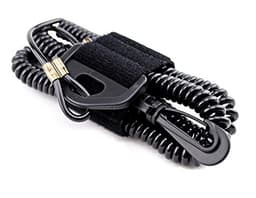
The cheapest insurance on the boat, and the most often skipped.
Published specs
| Type | Coiled leash with clips at both ends |
|---|---|
| Attachment | Carabiner to deck rigging, velcro or clip to shaft |
| Length | Manufacturer does not publish a consistent figure across variants |
Our score, broken out
- Security8.0
- Hardware6.5
- Stowage8.5
- Value9.0
What it gets right
- A drifting paddle is a genuinely bad afternoon, and this costs less than a tank of fuel.
- Coiled construction keeps the slack off the deck where it would otherwise snag.
What it gets wrong
- A leash is one more line in the cockpit, which is a real consideration in moving water.
- Cheap clips corrode. Rinse them or replace them.
Who should skip it
Skip a paddle leash entirely on whitewater or in surf. A line attached to you and to a floating object is an entanglement risk, and that risk outweighs losing a paddle.
#2 · First real paddle
Bending Branches Whisper
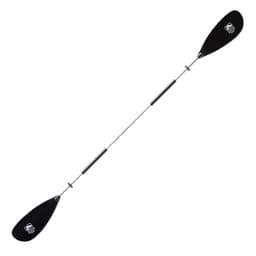
37 oz, 89 sq in blade, 0 or 60° feather. The honest entry paddle.
Published specs
| Weight | 37 oz |
|---|---|
| Blade | 6.75" × 18" (17 × 46 cm), 89 sq in surface area |
| Blade material | Polypropylene |
| Shaft | Aluminum |
| Lengths | 210, 220, 230, 240 cm |
| Ferrule | Two-piece, 0° or 60° feather |
| Blade shape | Asymmetrical with dihedral |
Our score, broken out
- Weight5.5
- Blade8.0
- Adjustability7.0
- Value9.5
What it gets right
- A genuine asymmetrical dihedral blade at the bottom of the market — that shape is what stops the paddle fluttering through the stroke.
- Four published lengths, so you can actually size it rather than buying one-size-fits-nobody.
- 89 sq in is a modest blade, which is the right call for a beginner's shoulders.
What it gets wrong
- 37 oz is heavy. Over a three-hour paddle you lift that difference thousands of times.
- An aluminum shaft is cold in spring and hot in August.
Who should skip it
Skip it if you already know you paddle more than a few times a month. The weight is the one thing you cannot fix later, and the Sting Ray Hybrid is 7 oz lighter for real money but not silly money.
FAQ
Questions people actually ask
Should you use a kayak paddle leash?
On open flat water, yes. A paddle that blows away downwind cannot be chased, because you have no paddle to chase it with, and a leash costs very little.
In surf or moving water, no. A line attaching you or your boat to a long floating object can wrap a rock or a branch, and entanglement in current is far more dangerous than losing a paddle.
Should a paddle leash attach to the kayak or to me?
To the kayak, on a structural fitting — a deck line, padeye or gear track. Not to a bungee, which stretches.
A leash from the paddle to the boat means a capsize leaves you swimming to a tethered boat-and-paddle unit. A leash from the paddle to your body makes you the anchor, which is the arrangement that causes problems.
What is better than a paddle leash for kayak fishing?
A paddle clip or paddle park — a molded clip on the side of the boat that the shaft snaps into. For stowing the paddle while you cast it is better than a leash, because there is no line at all to snag.
It will not hold in rough water, so it is a flat-water solution. Deck bungees do the same job for free and slightly less securely.
We have not paddled with any of this gear. Everything above comes from published specifications, cited manuals and live retailer prices. Here is exactly how we pick.
Sources
Read next
Related on Drift & Dime
Paddles
The best budget kayak paddlesPaddles ranked on published weight and blade area — a 10 oz spread.
PFDs & Safety
The kayak safety kit checklistThe required items, the genuinely useful ones, and the padding to skip.
Fishing Rigging
The kayak crate setupBuilding a crate: rod tubes, tackle, strapping — and no holes in the hull.