Paddles
The best kayak paddle holders
A paddle holder answers one question: where does the paddle go when both hands are busy? The answer is decided by what your deck already has, not by the clip.
Disclosure: we earn a commission if you buy through the links on this page, at no extra cost to you. It does not change which products we pick or how we rank them. How this site is funded.
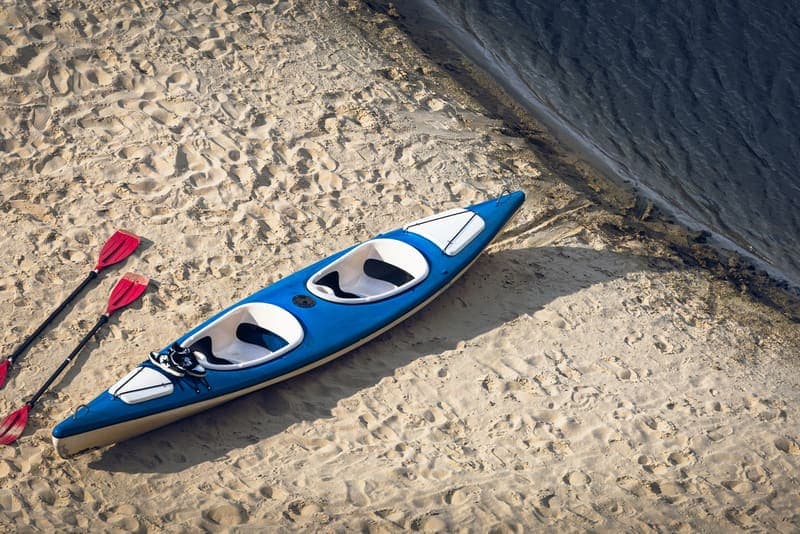
The short answer
Quick picks
Ranked for the person outfitting a used boat: what it costs, what it does, and who should skip it. 4 picks.
| # | Product | Best for | Our score | Price |
|---|---|---|---|---|
| 1 |  YakAttack RotoGrip Paddle HolderSoft rollers that take the shaft one-handed, 2.25 inches tall, on any common track. The tidiest answer if the boat already has a rail. YakAttack RotoGrip Paddle HolderSoft rollers that take the shaft one-handed, 2.25 inches tall, on any common track. The tidiest answer if the boat already has a rail. | A boat with a track | 8.1 | $20.14View on Amazon |
| 2 |  RAILBLAZA QuickGripThe only holder here that prints a shaft diameter range: 1-1/8 to 1-3/8 inches. It takes a pole or a landing net as well. RAILBLAZA QuickGripThe only holder here that prints a shaft diameter range: 1-1/8 to 1-3/8 inches. It takes a pole or a landing net as well. | The one that publishes a fit range | 7.9 | $19.99View on Amazon |
| 3 |  YakAttack PadLoc Paddle HolderTwo screws, no track, rubber bumpers and a dual-contact grip. The one to buy if your boat has a bare deck and you accept two small holes. YakAttack PadLoc Paddle HolderTwo screws, no track, rubber bumpers and a dual-contact grip. The one to buy if your boat has a bare deck and you accept two small holes. | A deck with no track | 7.9 | $13.95View on Amazon |
| 4 |  Scotty 0136 Paddle ClipA low-profile clip that snaps a shaft down and also takes a landing net. The starting point, and it fits the Scotty mounts half the used boats already have. Scotty 0136 Paddle ClipA low-profile clip that snaps a shaft down and also takes a landing net. The starting point, and it fits the Scotty mounts half the used boats already have. | The cheapest holder that is not bungee | 7.9 | $12.99View on Amazon |
A holder and a leash solve different problems
These two products get shopped for together and they are not alternatives.
A leash is retention. It keeps the paddle attached to the boat if you drop it, which matters because a kayak blows downwind faster than you can swim after a floating paddle. It does nothing about where the paddle sits while you are not using it, and in some conditions a line in the water is itself a hazard — which is the argument on the kayak paddle leash guide.
A holder is stowage. It gives the shaft a defined place to live when your hands are on a rod, a camera or a sandwich. There is no line, nothing to tangle, and nothing trailing in current. It also does nothing if the paddle goes over the side while you are not looking.
On a fishing boat most people end up with both, and if you are buying one first, buy the holder: the paddle spends far more time parked than it does being dropped.
How we ranked these
Four criteria, weighted equally and published on how we pick:
- Grip. How positively it holds a shaft, and whether you can get the paddle in and out with one hand.
- Mounting. What the holder needs from your deck. On a second-hand hull, holes are the real cost, not the part.
- Reach. Whether it can be placed where your hand actually falls, rather than where the deck happens to be flat.
- Value. Against deck bungees, which are free and already on your boat.
Start with what your deck already has
This category is unusual: the right product is decided almost entirely by your boat, not by the holder. Look at the deck beside the seat before you shop.
A factory accessory track. The best case. A track-mounted holder slides on with no holes, and it moves later when you discover your reach is different from where you first put it. YakAttack's RotoGrip and RAILBLAZA's QuickGrip both mount this way.
Scotty mounts already fitted. Very common on used fishing kayaks, because a previous owner put a rod holder on. Scotty's own paddle clip drops into that existing mount and costs nothing in new holes.
A bare deck. Then it is two screws, a glue-on mount, or bungee. YakAttack's PadLoc is the two-screw answer and ships with the screws.
Nothing you want to drill. Then bungee, honestly. More on that below.
If you are weighing adding a track so that this and the rest of your rigging gets easier, the standards and what each one accepts are on the gear track and accessory rail roundup.
The number almost nobody publishes
A paddle holder has exactly one fit spec that matters: the shaft diameter it accepts. Shafts vary, small-diameter shafts exist for smaller hands, and a clip sized for a fat aluminum shaft will not hold a slim carbon one.
RAILBLAZA publishes 1-1/8 to 1-3/8 inches for the QuickGrip. That is the only published range in this roundup, and it is the reason that holder is here despite thinner stock than the YakAttack products.
YakAttack names compatible paddle brands for the PadLoc — Werner, Bending Branches and other common shafts — which is useful but is not a measurement. Scotty publishes neither. So if your paddle is unusual in either direction, the QuickGrip is the one you can check before buying rather than after.
Clips, rollers and what each does to a shaft
Three mechanisms, and they feel different on the water.
Snap-in clips capture the shaft between two sprung jaws. Positive, cheap, and they need a deliberate push in and a deliberate pull out. Scotty's clip is this kind, and the trade is that a two-handed shove is exactly what you do not want when a fish is on.
Rollers hold by tension against soft wheels. The shaft rolls in and rolls out, which is genuinely one-handed. YakAttack publishes soft rollers tensioned to hold the shaft on the RotoGrip. The trade is that tension is not capture: it stows a paddle, it does not restrain one.
Open cradles with a strap or a bungee are the free version, and the least secure of the three.
One detail worth paying for on a fishing boat: rubber. YakAttack publishes integrated rubber bumpers on the PadLoc to prevent noise and protect the shaft. A carbon shaft dropped into a bare plastic clip in shallow water is a sound the fish hear before you do.
Where to mount it, and how to find out
The mistake is mounting the holder where the deck is flat and convenient rather than where your hand naturally goes.
Do this before you drill anything. Sit in the boat on dry land with the paddle across your lap. Let go of it the way you would when a rod goes off. Notice where the shaft ends up and where your hand reaches without leaning. That spot — usually just behind the seat on the side you do not cast from — is where the holder belongs.
Two more constraints. It must not foul the paddle stroke, so keep it behind the seat rather than in front of it. And it must not interfere with re-entry if you capsize, because the rear deck is where you climb back on — the sequence that depends on a clear rear deck is on the paddle float roundup.
One holder or two?
One holder parks a paddle at an angle across the boat. Two holders, fitted in line on the same side, hold the shaft parallel to the hull and out of the way.
For casual use one is enough. For fishing, two is the arrangement that actually keeps the deck clear, and it is worth knowing before you price this up: YakAttack sells the RotoGrip singly at this listing and also in a two-pack, and the honest cost of a tidy setup is two units plus, possibly, a track.
On a boat where the paddle is parked for hours at a time — a pedal kayak, or an anchored fishing session — two is not a luxury. On a recreational boat where the paddle is in your hands ninety percent of the time, one is fine.
The free version, honestly
Your boat already has deck bungees, and tucking a paddle blade under them works. It is what most paddlers do, it costs nothing, and for flat-water paddling with occasional stops it is genuinely sufficient.
What bungee does badly is repetition. It is two-handed, it is slow, the cord slips off a wet shaft, and on a used boat the cord is usually perished anyway — elastic dies in UV, and ten-year-old bungee has no stretch left. Replacing it is the cheapest fix on the whole boat and it is covered on the deck rigging guide.
So the honest test is frequency. If you park the paddle twice a trip, fix your bungees and save your money. If you park it every few minutes because you are fishing, a holder pays for itself in irritation avoided within one outing.
The same fitting probably holds your drink
Worth knowing while you are choosing a mounting system: the same track, StarPort or Scotty post that takes a paddle holder also takes a drink holder, a rod holder and a light.
That is an argument for picking one system and staying in it rather than buying whatever holder comes up first for each item. The drink-holder version of this decision is on the kayak cup holder roundup.
Sit-in and sit-on-top are different decks
The advice above is written for a sit-on-top, because that is where most paddle holders end up. A sit-in changes two things.
There is less flat deck, and what there is may be over a sealed compartment. Drilling into a bulkheaded bow or stern compartment turns a dry hatch into a wet one unless every fastener is sealed properly. If you are not confident reaching inside, a glue-on mount or a track avoids the problem.
The paddle is your brace. On a sit-in, especially in any kind of chop, the paddle stays in your hands far more of the time. A holder there is for lunch stops and photographs rather than for the constant parking a fishing angler does, which is worth factoring into whether you need one at all.
On both hull types, keep the holder clear of the cockpit rim or seat back. A fitting where your hand lands during a re-entry is a fitting you will eventually catch a knuckle on.
What fails, and what that costs
These are cheap plastic parts in a harsh environment. Three failure modes are worth knowing.
UV. A holder that lives on a deck in the sun goes brittle, and the first sign is usually a cracked jaw rather than a broken base. This is the same aging that kills handles and bungee on a used boat.
The fastener, not the part. On a screw-mounted holder in soft polyethylene, the screw pulls before the plastic breaks. Use the supplied screws with large backing washers or well nuts, and bed them in sealant — every fastener through a hull is a hole.
Loss overboard. A holder is not a restraint, and a paddle parked in one can still come out in a capsize or a big wake. If you are somewhere losing the paddle would be serious, use a leash as well. That is the division of labor these two products exist for.
What else these hold
Worth knowing before you buy, because a second job changes the value.
Scotty states its clip holds an aluminum landing net as well as a paddle. RAILBLAZA publishes that the QuickGrip takes a paddle, a pole or a landing net. On a fishing deck where every fitting competes for space, a holder that also parks a net or a stakeout pole is doing two jobs from one footprint — and if the pole in question is a stakeout pole, the poles themselves are on the stakeout pole roundup.
The corollary: if you already run a crate, some of this is solved already. A milk crate with rod tubes will take a paddle blade in a pinch, which is one of the reasons the crate is the first fishing purchase on the kayak crate setup.
What we would buy
If the boat has a track, the RotoGrip. Rollers make it one-handed, a published 2.25-inch height keeps it out of your stroke, and it slides to the spot your hand actually reaches. Budget for two.
If your paddle shaft is unusually thick or thin, the QuickGrip — the only holder here that publishes the range it accepts, and it takes a pole or a net as well.
If the deck is bare and you will accept two screws, the PadLoc. Screws in the box, rubber bumpers, and no track required.
If the boat already has Scotty mounts, the Scotty clip. It is the cheapest branded option here and it uses fittings the previous owner already paid for.
And if you park the paddle twice a trip, replace your perished deck bungee and buy nothing. That is the honest answer for a lot of recreational paddlers.
In full
Every pick, in detail
Specs below are the manufacturer's published figures, cited per product. Where a maker does not publish a number, the row says so rather than guessing at it.
#1 · A boat with a track
YakAttack RotoGrip Paddle Holder
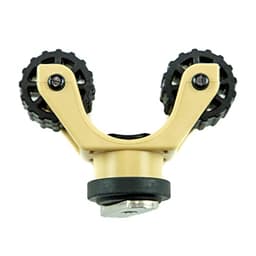
Soft rollers that take the shaft one-handed, 2.25 inches tall, on any common track. The tidiest answer if the boat already has a rail.
Published specs
| Mounting | GearTrac, MightyMount and most other kayak track systems |
|---|---|
| Height | 2.25" |
| Grip | Soft rollers tensioned to hold the shaft |
| Sold as | Single unit (a 2-pack is also sold) |
| Origin | Made in the USA |
Our score, broken out
- Grip8.5
- Mounting8.0
- Reach9.0
- Value7.0
What it gets right
- Rollers rather than a snap fit, so the paddle goes in and comes out one-handed — which is the whole point when the other hand is holding a rod.
- Track mounted, so on a boat with a factory rail it costs no holes and it slides to wherever your reach actually is.
- A published 2.25-inch height keeps it below the line where a holder starts catching your stroke.
What it gets wrong
- Sold individually at this listing. A paddle really wants two holders, which doubles the cost.
- No track, no deal: on a bare deck you are adding a track, its holes and its cost first.
- Rollers hold by tension rather than by capture. It is a stowage device, not a tie-down for rough water.
Who should skip it
Skip it if your boat has no accessory track and you do not want to add one. The two-screw holder does the same job for less.
#2 · The one that publishes a fit range
RAILBLAZA QuickGrip
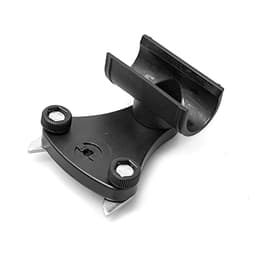
The only holder here that prints a shaft diameter range: 1-1/8 to 1-3/8 inches. It takes a pole or a landing net as well.
Published specs
| Fits shafts | 1-1/8" to 1-3/8" |
|---|---|
| Width | 2-3/4" wide |
| Screw spacing | 2-3/8" between screw holes |
| Mounting | Track mount ready out of the package; track nuts included; can also mount directly to the kayak |
| Also holds | A pole or a landing net |
Our score, broken out
- Grip8.0
- Mounting8.5
- Reach7.5
- Value7.5
What it gets right
- It publishes the number that decides fit. Nobody else in this category prints a shaft diameter range, and a holder that does not fit your shaft is a wasted purchase.
- Track nuts in the box and the option to screw it straight to the deck, so it suits either kind of boat.
- Holds a stakeout pole or a landing net, which on a fishing deck means one fitting doing several jobs.
What it gets wrong
- Stock is thinner than the YakAttack holders, and RAILBLAZA's US product page for it was not reachable when we checked — the published figures here come from its own retail listing.
- 2-3/4 inches wide is a bigger footprint than the low-profile clips, on a deck where space is the constraint.
- Like everything here, it is a stowage clip rather than a restraint. It does not replace a leash offshore.
Who should skip it
Skip it if your shaft falls outside 1-1/8 to 1-3/8 inches — the published range is the reason to buy this one, so respect it.
#3 · A deck with no track
YakAttack PadLoc Paddle Holder
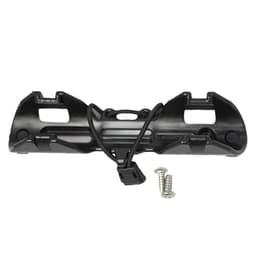
Two screws, no track, rubber bumpers and a dual-contact grip. The one to buy if your boat has a bare deck and you accept two small holes.
Published specs
| Mounting | Two included screws; no track required |
|---|---|
| Grip | Dual-contact design |
| Noise | Integrated rubber bumpers to prevent noise and protect the shaft |
| Shafts | Stated to work with common kayak paddle shafts including Werner and Bending Branches |
| Shaft diameter range | Manufacturer does not publish a figure |
Our score, broken out
- Grip8.0
- Mounting7.0
- Reach7.5
- Value9.0
What it gets right
- No track needed. Two screws into a flat patch of deck is the lowest-commitment permanent mount on this page.
- The rubber bumpers are the detail that matters on a fishing boat — a shaft dropped into bare plastic is the noise that empties a shallow flat.
- YakAttack names specific paddle brands it fits rather than claiming to fit everything.
What it gets wrong
- Two holes in a hull, which on a second-hand boat is a decision rather than a detail. Back and seal them properly.
- No published shaft diameter range, so a very thin or very thick shaft is a gamble.
- Fixed position. Unlike a track mount, moving it later means two more holes.
Who should skip it
Skip it if the boat has a factory track. Sliding a holder along a track beats drilling a fixed position.
#4 · The cheapest holder that is not bungee
Scotty 0136 Paddle Clip
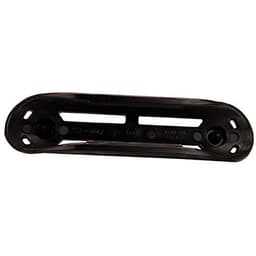
A low-profile clip that snaps a shaft down and also takes a landing net. The starting point, and it fits the Scotty mounts half the used boats already have.
Published specs
| Type | Snap-in clip |
|---|---|
| Mounts to | A kayak deck, or any Scotty mount |
| Also holds | An aluminum landing net |
| Profile | Low-profile design |
| Shaft diameter range | Manufacturer does not publish this |
Our score, broken out
- Grip6.5
- Mounting8.5
- Reach7.0
- Value9.5
What it gets right
- It fits the Scotty mounting system, which is the most common fitting already bolted to second-hand fishing kayaks — so on a lot of boats it costs no new holes at all.
- It takes a landing net as well as a paddle, which on a small deck is two jobs from one fitting.
- Cheapest branded holder here by a clear margin, and a clip has nothing to wear out but the plastic.
What it gets wrong
- Scotty publishes no shaft diameter range, so on an unusually fat or thin shaft you are guessing.
- A snap-in clip holds by spring tension. It is secure on flat water and it is not what you want in surf.
- Scotty's own store listed this clip as out of stock when we checked, even though it is available at the retailer we link.
Who should skip it
Skip it if your boat has an accessory track rather than Scotty mounts. A track-native holder is tidier there.
FAQ
Questions people actually ask
What is a kayak paddle holder for?
Giving the paddle a defined place to sit when your hands are busy — fishing, taking photographs, or eating. The shaft clips or rolls into the holder instead of sliding around the deck or across your lap.
It is not the same as a leash. A leash keeps the paddle attached if you drop it; a holder stows it while you are not using it. On a fishing boat most people end up with both.
Do I need a paddle holder or a paddle leash?
Depends on the problem. If the paddle keeps sliding around the deck while you fish, you want a holder. If the worry is losing it overboard, you want a leash — a kayak blows downwind faster than you can swim after a floating paddle.
A holder is not a restraint: a parked paddle can still come out in a capsize or a big wake. Where losing the paddle would be serious, use both.
Will a paddle holder fit my paddle?
Check the shaft diameter, which is the one spec that decides it. RAILBLAZA publishes 1-1/8 to 1-3/8 inches for the QuickGrip — the only published range among the holders we rank.
YakAttack names compatible paddle brands for the PadLoc rather than a measurement, and Scotty publishes neither. If your shaft is unusually thin or thick, buy the one that prints a number.
Where should a paddle holder be mounted on a kayak?
Behind the seat, on the side you do not cast from, at the spot your hand reaches without leaning. Sit in the boat on dry land with the paddle across your lap and let go of it — where the shaft lands is where the holder belongs.
Keep it behind the seat so it cannot foul your stroke, and keep the rear deck clear enough to climb back onto after a capsize.
Can I just use the deck bungees to hold my paddle?
Yes, and for flat-water paddling with occasional stops that is genuinely enough. It costs nothing and every boat already has it.
What bungee does badly is repetition: it is two-handed, slow, and the cord slips off a wet shaft. On a used boat the cord is usually perished anyway — elastic dies in UV. If you park the paddle every few minutes because you are fishing, a holder pays for itself quickly.
We have not paddled with any of this gear. Everything above comes from published specifications, cited manuals and live retailer prices. Here is exactly how we pick.
Sources
- YakAttack — RotoGrip paddle holder published height, track compatibility and origin
- RAILBLAZA — QuickGrip published shaft diameter range, width and screw spacing (via its retail listing; the US product page was unreachable)
- YakAttack — PadLoc published mounting, grip design and paddle compatibility
- Scotty — 0136 Paddle Clip published mounting, profile and landing-net use
Read next
Related on Drift & Dime
Paddles
The kayak paddle leash guideCheap insurance on flat water, a hazard in current — when to use one.
Outfitting
The best kayak gear tracks and accessory railsTracks and rails compared on the hardware standard they accept, not the marketing.
Fishing Rigging
The kayak crate setupBuilding a crate: rod tubes, tackle, strapping — and no holes in the hull.
Paddles
Kayak drip rings and paddle gripsDrip rings and grips for a used paddle: what fits and what to check first.