Outfitting
The best kayak gear tracks and accessory rails
One slot bolted to the deck, and every accessory after it goes on without a drill. The spec that matters is not the track — it is the hardware the slot accepts.
Disclosure: we earn a commission if you buy through the links on this page, at no extra cost to you. It does not change which products we pick or how we rank them. How this site is funded.
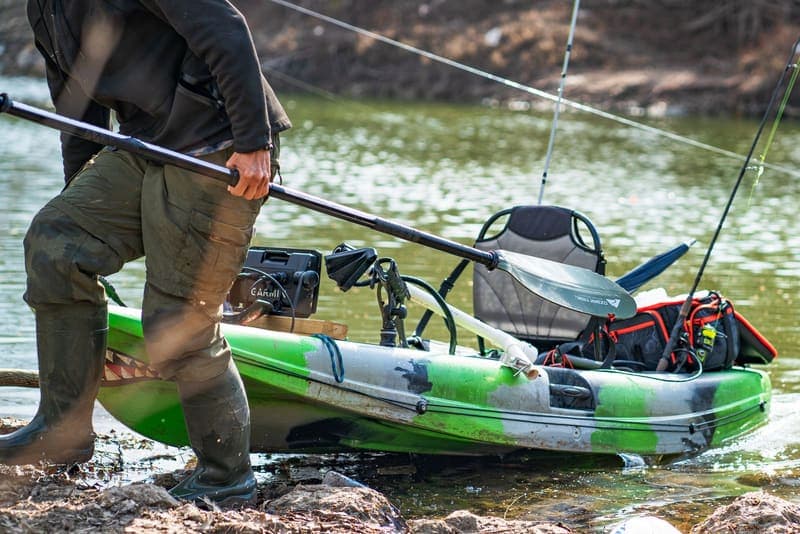
The short answer
Quick picks
Ranked for the person outfitting a used boat: what it costs, what it does, and who should skip it. 4 picks.
| # | Product | Best for | Our score | Price |
|---|---|---|---|---|
| 1 |  YakAttack GTSL90 GearTracTakes standard 1/2" track hardware, and arrives drilled with fasteners. YakAttack GTSL90 GearTracTakes standard 1/2" track hardware, and arrives drilled with fasteners. | Most used boats | 8.5 | $25.95View on Amazon |
| 2 |  Scotty 438 Gear-Head Track AdapterThe part that makes a track you already own accept post-mount Scotty gear. Scotty 438 Gear-Head Track AdapterThe part that makes a track you already own accept post-mount Scotty gear. | Scotty gear on any track | 8.5 | $20.99View on Amazon |
| 3 |  RAILBLAZA StarPort HDA locking socket on the industry four-bolt pattern. No track needed. RAILBLAZA StarPort HDA locking socket on the industry four-bolt pattern. No track needed. | Reusing old holes | 8.5 | $20.00View on Amazon |
| 4 |  Scotty 440 Low Profile Track3/8" tall. The lowest way to put a mounting point on a deck you walk on. Scotty 440 Low Profile Track3/8" tall. The lowest way to put a mounting point on a deck you walk on. | The flattest deck | 8.3 | $12.55View on Amazon |
Gear track, accessory rail, mounting track: one part, three names
A gear track is a short slotted strip that bolts to a kayak deck once and afterwards accepts and releases accessory mounts without tools. Retailers call the same part an accessory rail, a gear rail, a mounting track or simply a track. If a listing uses one of those words and shows a length of slotted plastic or aluminum with screw holes down the middle, it is this.
Why it belongs on a second-hand boat in particular comes down to arithmetic about holes. Bolting a rod holder straight to the deck costs two to four permanent holes. Bolting a fish finder costs two to four more, plus a transducer. Change your mind about either position and the old holes stay. A track costs one set of holes and then never costs another, however many times you rearrange what is on it.
The second reason is resale. A used hull with a track and nothing on it looks rigged and ready. A used hull with eleven filled holes in three abandoned patterns looks like somebody’s abandoned project, and it sells like one.
Before you buy: check what the boat already has
Most fishing kayaks built in the last decade left the factory with at least one length of track already molded or bolted in, and a surprising number of recreational sit-on-tops have one too. People buy a second track because they never found the first.
Four places to look, in order:
- Either side of the seat well. The most common factory position, usually a short run on the flat between the seat and the gunwale.
- The recess in front of the cockpit. Where a fish finder or a phone mount is expected to live, often on a raised flat pad.
- The gunwale line behind the seat. Frequently longer than the forward tracks, and frequently hidden under a crate.
- The holes left by the previous owner. Not a track, but the same opportunity. If somebody removed a rod holder before selling, you have a bolt pattern and a sealed deck already, and a base that matches it costs less than a new track and adds no holes at all.
Measure any holes you find before you order anything. Scotty publishes the bolt pattern for its 230 mount as 1 5/16" by 3 3/16", and a rectangular four-point base such as the RAILBLAZA StarPort HD is designed around the same North American convention, so the odds of landing on existing holes are better than they look.
What people actually mount on them
The accessories that end up on a track are mostly small: a rod holder, a fish finder arm, a camera mount, a light, a drink holder, and — the one people forget until the paddle is sliding around the deck — a paddle holder.
That last one is the cheapest reason to fit a track on a boat that has none, because a track-mounted paddle holder slides to wherever your hand actually reaches instead of committing you to two screw holes. The holders are compared on the kayak paddle holder roundup.
The only spec that decides anything: what the slot accepts
Every track looks like every other track in a photograph. What separates them is invisible in the listing image: the width of the slot, and therefore the hardware that fits it.
The half-inch family. Most kayak accessory mounts are built around half-inch track hardware — a T-shaped bolt head that drops into the slot, turns ninety degrees and clamps. YakAttack publishes the GTSL90 as 0.90" wide with 1-3/4" hole spacing and explicitly “compatible with 1/2" wide track hardware.” That published sentence is the reason this is the default recommendation: buy into the half-inch standard and almost anything you want later will fit.
The Scotty family. Scotty’s 440 Low Profile Track is a top-load design, and Scotty’s own route onto it is the 438 Gear-Head Track Adapter, which it publishes as fitting “all kayak track systems.” That asymmetry is worth reading twice. The adapter is the universal part; the track is the specific one. If you already own Scotty post-mount gear, the 438 goes onto whatever track you buy, including a half-inch one.
The socket, which is not a track at all. A four-point base such as the StarPort HD gives you one locking mounting point rather than a slot. RAILBLAZA publishes it as a rectangular four-point installation base consistent with the North American industry standard, lining up with many Scotty, RAM and Cannon patterns. You lose fore-and-aft adjustment and you gain the ability to land on holes that already exist.
One published exception is worth knowing before you drill: YakAttack states the GTSL90 is not intended for use with the RAM Mounts Quick Release Track Base. Manufacturers rarely publish incompatibility at all, and this is exactly the kind of detail people discover after the holes are in.
How we ranked these
Four criteria, weighted equally and published on how we pick: fit standard (what hardware the part accepts, and how much of the market that opens), mounting (how many new holes it costs and how reversible it is), build (published material and duty rating), and value.
Fit standard does most of the work here, and that is deliberate. A track is not a thing you enjoy; it is a decision about what you will be allowed to buy for the next five years. A slightly better-made track that locks you into one brand’s catalog is the worse purchase.
How long a track do you actually need
YakAttack publishes the GTSL90 in 4", 8", 12" and 16". Longer is not better; longer is more holes and more deck.
| Length | What it holds | Buy it when |
|---|---|---|
| 4" | One mount, effectively fixed | A fish finder or a phone mount in a known spot |
| 8" | One mount with real adjustment | A rod holder you want to slide clear when you land a fish |
| 12" to 16" | Two mounts with separation | Rod plus electronics on the same side |
Measure the overall part, not the usable slot. Scotty publishes the 440-8 as 1 3/4" wide by 3/8" tall by 10 3/4" long for 8" of usable track — nearly three inches of it is end material that still has to sit on a flat run of deck.
That 3/8" height is the other number worth noticing. On a sit-on-top you stand in, drag a crate across, or strap down over a roof bar, a low track is the difference between a mounting point and a shin barker. If you are strapping the boat with the track in the path of a cam buckle, look at how the straps actually run before you choose where it goes.
Mounting it: the part people get wrong
A track fails in one of two ways, and both are decided before you pick up a drill.
It leaks. A track needs a genuinely flat run. Bolted across a curve, the ends lift, the sealant bridges a gap it was never meant to bridge, and water finds the screw threads by the second season. Lay the track on the deck and look along it at eye level before you mark anything.
It pulls out. Polyethylene is soft. A machine screw through bare hull with a washer will hold a phone and will not hold a loaded rod holder for long. YakAttack publishes an optional FullBack backing plate for exactly this reason. Where you can reach behind the deck, a backing plate or a large fender washer and locknut is the fix. Where you cannot — and on a sealed sit-on-top hull you usually cannot — well nuts spread the load and seal the hole in one part, which is why they are the standard answer for kayak deck hardware.
RAILBLAZA publishes three install routes for the StarPort HD — rivets, screws with locknuts, or self-tapping screws — and lists the base on its own in the parts list, with fixing hardware as separate options. Check what your retailer is actually shipping rather than assuming screws are in the bag. The YakAttack track, by contrast, is published as arriving drilled and with hardware.
Seal every fastener, including ones going into existing holes. If any of those holes are ragged, oversized or in soft plastic, fix them first — that is a repair, not a mounting job, and it is covered in what to fix on a used kayak.
What goes on a track, and what should not
The honest list of what a track earns its holes for is shorter than the accessory catalogs suggest.
- Rod holders. The clearest case, because you want them in different places for trolling and for casting. The mounts and the trade-offs are in the budget rod holder roundup.
- Electronics. A fish finder head, a phone or a camera. All three are things you want to remove when you leave the boat, which is precisely what a track lock does.
- A light. A visibility light on a track is legal gear you can take off in daylight rather than a permanent mast.
- A leash anchor — with care. A track is a structural fitting and a legitimate leash point, unlike a bungee. The full argument about what to tie to what is in the paddle leash guide.
What does not belong on a track is anything that pulls sideways and hard for hours. An anchor trolley loads a fitting in a direction a surface-mounted track was never specified for, and a seat frame loads it with your body weight. Both want dedicated padeyes through the hull with proper backing.
When not to buy one at all
A page about tracks should be able to say when a track is the wrong purchase, and there are two clear cases.
You are going to move the boat on within a season. If this hull is a way to find out whether you actually like paddling, drilling it is a decision made on behalf of a version of you who may not exist. Rig it with things that clamp, sit or strap instead, use it for a summer, and put the holes in the boat you keep.
A crate does the same job for less. A milk crate in the tankwell with rod tubes attached to the crate rather than the hull gives you most of a rigged fishing boat, costs a fraction of a track plus mounts, lifts out in one piece, and touches the deck nowhere. The crate setup is the honest first move on a boat you might resell, and it is the reason this roundup does not open with “every kayak needs a track.”
Where a track genuinely wins over a crate is anything that has to sit forward of you and stay put: a fish finder head you need to read, a camera, a phone. Those cannot live behind the seat, and holding them on with a strap is how they end up in the water.
What we would buy, in what order
If the boat already has a track, buy nothing but the mount. If your gear is Scotty post-mount, that means the 438 adapter and nothing else — it is the cheapest useful thing on this page and it needs no holes.
If the boat has no track and you want options, the GTSL90 in 8". The published half-inch hardware compatibility is the whole argument, and it ships drilled with fasteners.
If the previous owner left a bolt pattern, the StarPort HD before anything else. Reusing four sealed holes beats drilling four new ones, and the four-point pattern exists precisely because those holes are so common.
If the deck is one you walk on, the Scotty 440 and the 438 together. Nothing else here is 3/8" tall, and on a stand-and-fish deck that number outranks the fit standard.
None of these is a large purchase, and that is worth stating plainly: a track is one of the few kayak upgrades that costs less than the accessory it holds. If you are working out the order to spend in across a whole boat, the sequencing is in the first season kit.
In full
Every pick, in detail
Specs below are the manufacturer's published figures, cited per product. Where a maker does not publish a number, the row says so rather than guessing at it.
#1 · Most used boats
YakAttack GTSL90 GearTrac
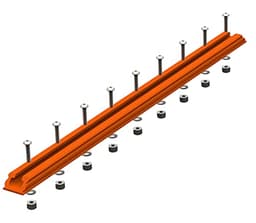
Takes standard 1/2" track hardware, and arrives drilled with fasteners.
Published specs
| Track width | 0.90" |
|---|---|
| Hole spacing | 1-3/4" |
| Lengths | 4", 8", 12" or 16" |
| Hardware fit | Compatible with 1/2" wide track hardware |
| Material | Polymer, specified for harsh marine environments |
| Duty | Light to medium duty applications |
| Included | Track, drilled, with hardware |
| Known exception | Not intended for the RAM Mounts Quick Release Track Base |
Our score, broken out
- Fit standard9.5
- Mounting8.0
- Build8.0
- Value8.5
What it gets right
- The 1/2" track-hardware standard is what most kayak accessory mounts are built around, so this is the track that leaves your options open rather than tying you to one brand.
- It ships drilled and with the fasteners in the box, which on a used boat means you are not standing in a hardware aisle guessing at machine screw lengths.
- Four published lengths, so a single fish-finder mount gets the 4" and a fore-and-aft slider gets the 16" — you are not paying for track you will never use.
What it gets wrong
- YakAttack rates it for light to medium duty and describes it as similar in size and shape to its aluminum GT90, so the heaviest loads are a different product.
- YakAttack publishes one explicit exception — it is not intended for the RAM Mounts Quick Release Track Base — which is exactly the sort of thing you find out after drilling.
- The FullBack backing plate that makes installation easier is published as an optional extra, not part of the kit.
Who should skip it
Skip it if the boat already has a factory track, or if the only thing you will ever hang on it is one Scotty rod holder. In that second case the low-profile Scotty track plus its adapter is the cheaper pair of parts, and it sits closer to the deck.
#2 · Scotty gear on any track
Scotty 438 Gear-Head Track Adapter
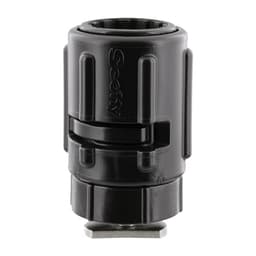
The part that makes a track you already own accept post-mount Scotty gear.
Published specs
| Function | Slides into a track and locks post-mounted Scotty rod holders and accessories |
|---|---|
| Track fit | Designed to fit all kayak track systems |
| Adjustment | Twist to unlock and reposition |
| Drilling | None — no permanent mounting holes |
| Material | Manufacturer does not publish this |
| Dimensions | Manufacturer does not publish this |
Our score, broken out
- Fit standard9.0
- Mounting9.5
- Build8.0
- Value7.5
What it gets right
- It is the single part that connects a track to the Scotty post fitting, which is what the 230 Powerlock and the rest of Scotty's range mount on.
- The twist-to-reposition action means you move a rod holder mid-session without a tool, which is the whole reason to have a track rather than a bolted mount.
- Nothing gets drilled. On a second-hand hull that is the difference between a reversible decision and a permanent one.
What it gets wrong
- It is a third purchase on top of the track and the holder, and the headline price of any one of the three understates what the setup costs.
- Scotty publishes no material and no dimensions for it, so you cannot check clearance against a crate or a seat back before you buy.
Who should skip it
Skip it if you do not own Scotty post-mount gear. It is an adapter, not a mount — on its own it holds nothing.
#3 · Reusing old holes
RAILBLAZA StarPort HD
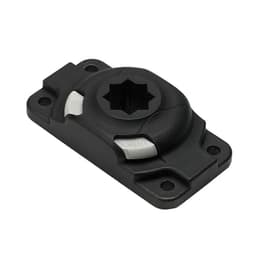
A locking socket on the industry four-bolt pattern. No track needed.
Published specs
| Type | Four-point socket base, not a track |
|---|---|
| Base | Rectangular four-point installation base consistent with the North American industry standard |
| Cross-brand fit | Lines up with many Scotty, RAM and Cannon mount patterns |
| Material | UV-stabilized fiberglass-reinforced plastic |
| Weight | 0.18 lb |
| Locking | Push-and-twist locking system |
| Install options | Rivets, screws with locknuts, or self-tapping screws |
| Parts list | 1 × StarPort HD; fixing hardware listed separately |
Our score, broken out
- Fit standard8.5
- Mounting9.0
- Build8.5
- Value8.0
What it gets right
- The rectangular four-point pattern is the reason it belongs on a used boat — it can often land on holes the previous owner already made instead of new ones.
- RAILBLAZA publishes UV-stabilized fiberglass-reinforced plastic at 0.18 lb, which is a real material spec in a category where most listings say nothing at all.
- The push-and-twist lock takes the accessory off in a second, so nothing valuable rides on the roof or sits on the deck in a parking lot.
What it gets wrong
- It is one fixed position, not a track. Fore-and-aft adjustment is the thing you are giving up.
- RAILBLAZA's parts list is the base alone and shows fixing hardware as options, so confirm what your retailer actually ships before you order screws separately.
Who should skip it
Skip it if you want to slide a fish finder or a rod between positions during a session. That is a track's job, and a socket will not do it.
#4 · The flattest deck
Scotty 440 Low Profile Track
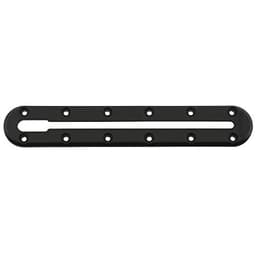
3/8" tall. The lowest way to put a mounting point on a deck you walk on.
Published specs
| Dimensions (8") | 1 3/4" wide × 3/8" tall × 10 3/4" long (8" usable track) |
|---|---|
| Dimensions (1") | 1 3/4" wide × 3/8" tall (1" usable track) |
| Material | Corrosion-proof high-strength composite |
| Design | Top-load |
| Included | 438 Gear-Head Adapter, rod holders and accessories not included |
| Mounting hardware | Manufacturer does not publish this |
Our score, broken out
- Fit standard7.0
- Mounting9.0
- Build8.5
- Value8.5
What it gets right
- At 3/8" tall it is genuinely low, which matters on a sit-on-top deck you stand on, drag a crate across, or strap a boat down over.
- Composite rather than metal, so there is nothing to corrode where a stainless screw meets the track in salt water.
- Sold in a 1" piece as well as an 8", so you can put a single mounting point exactly where you want it without committing a whole length of deck.
What it gets wrong
- Scotty publishes it as a top-load design used through the 438 Gear-Head adapter, so budget for two parts rather than one.
- The 8" version is 10 3/4" long overall for 8" of usable track — measure the space you have, not the usable figure.
- Scotty does not publish hole spacing or what mounting hardware is in the box, so you cannot check either before it arrives.
Who should skip it
Skip it if you want one track that accepts anybody’s hardware. That is the 1/2" standard, and this is not it.
FAQ
Questions people actually ask
What is a kayak gear track?
A gear track is a short slotted strip bolted to a kayak deck that accepts and releases accessory mounts without tools. It is also sold as an accessory rail, a gear rail or a mounting track — the same part under different names.
It costs one set of holes and then no more, however often you change what is mounted on it, which is why it is the standard way to rig a used boat you do not want to fill with holes.
Are kayak gear tracks universal?
No, and this is the spec to check before buying. Most kayak accessory mounts are built around 1/2-inch track hardware — YakAttack publishes the GTSL90 as compatible with it, at 0.90 inches wide with 1-3/4 inch hole spacing.
Scotty's 440 Low Profile Track is a top-load design used through the separate 438 Gear-Head adapter, which Scotty publishes as fitting all kayak track systems. YakAttack also publishes one explicit exception: the GTSL90 is not intended for the RAM Mounts Quick Release Track Base.
Can you add a gear track to a kayak that does not have one?
Yes. A surface-mount track bolts to any flat run of deck, and the YakAttack GTSL90 is published as arriving drilled and with hardware in 4, 8, 12 and 16 inch lengths.
The two things that decide whether you regret it are flatness and backing. A track bolted across a curve will lift at the ends and leak, and polyethylene is soft enough that a screw with only a washer behind it will eventually pull under load. Use a backing plate where you can reach behind the deck and well nuts where you cannot.
Do you have to drill holes to mount kayak accessories?
Not always. If the boat has a factory track, track mounts slide on with no holes at all. If a previous owner removed hardware, a rectangular four-point base such as the RAILBLAZA StarPort HD is designed around the common North American pattern and may land on the holes already there.
A milk crate behind the seat with rod tubes attached is the third no-drill route and touches the hull not at all.
We have not paddled with any of this gear. Everything above comes from published specifications, cited manuals and live retailer prices. Here is exactly how we pick.
Sources
Read next
Related on Drift & Dime
Fishing Rigging
The best budget kayak rod holdersHolders compared on locking ring, published bolt pattern and mounting.
Outfitting
What to fix on a used kayakWhat matters on a second-hand hull, what is cosmetic, and what to walk away from.
Fishing Rigging
Rigging a used fishing kayakSealing inherited holes, reusing bolt patterns, and no-drill rigging.
Paddles
The kayak paddle leash guideCheap insurance on flat water, a hazard in current — when to use one.