Outfitting
What to fix on a used kayak
Most of the damage on a second-hand hull is cosmetic and can be ignored. Four things are not, and one of them is a reason to walk away.
Disclosure: we earn a commission if you buy through the links on this page, at no extra cost to you. It does not change which products we pick or how we rank them. How this site is funded.
The short answer
Quick picks
Ranked for the person outfitting a used boat: what it costs, what it does, and who should skip it. 3 picks.
| # | Product | Best for | Our score | Price |
|---|---|---|---|---|
| 1 | Harmony Scupper StoppersTapered rubber, 0.875" to 1.5", with tether holes in the tabs. | Wilderness Systems hulls | 8.1 | Check price on Amazon |
| 2 |  Attwood Hand Bilge PumpUp to 8 gpm, floating grip. The one that empties a swamped boat. Attwood Hand Bilge PumpUp to 8 gpm, floating grip. The one that empties a swamped boat. | Getting water out | 8.2 | $39.99View on Amazon |
| 3 | Skwoosh Paddling Cushion13 oz, 1" of gel, non-skid base. Fixes the actual complaint. | A numb backside | 8.0 | Check price on Amazon |
What you can safely ignore
A used polyethylene kayak looks worse than it is. Almost all the damage you can see is irrelevant to whether it floats and paddles. What is usually genuinely missing is smaller and cheaper: handles, a drain plug, a hatch cover — the shopping list, with the measurements to take first, is on kayak replacement parts.
- Surface scratches. Years of being dragged up ramps. They have no effect on strength and essentially none on speed at recreational pace. Ignore them — unless the keel line itself is going flat and thin, which is the one case for a keel guard.
- Deep gouges that have not gone through. Run a fingernail across; if it catches but you cannot see light through it, the hull is fine. A hot air gun can smooth a raised burr if it bothers you, but it is cosmetic.
- Sun fade. A boat that was red and is now pink has faded pigment. That alone is cosmetic — but see the brittleness note below, because heavy fade is a signal about something else.
- Scuffed hatch covers and worn stickers. Cosmetic.
The four things that actually matter
1. Cracks that go all the way through. Hold the boat up and look for light. Check especially at the bow and stern, at the scupper tubes, and around any hardware. A through-crack in polyethylene is repairable by plastic welding, and that is a specialist job that costs real money on a cheap boat.
2. Deformation. Set the boat down on a flat surface and look along it from the bow. A hull that was stored badly — on its side against a wall, or strapped down hard on a hot roof — can hold a permanent flat spot or a twist. A flat spot makes the boat track badly and it is very hard to reverse. Mild dents will often relax if you leave the boat in the sun the right way up; a twist will not.
3. Water inside the hull. Lift the bow. If you hear sloshing, water is inside a cavity that should be sealed. On a sit-on-top the usual cause is a cracked scupper tube; on a sit-in it is a failed bulkhead or a hole under a fitting. This is the fault most worth finding, because it gets worse and because the boat gets heavier all season.
4. Brittleness from UV. Heavy fade plus a chalky surface that leaves powder on your finger means years outdoors, and UV does eventually make polyethylene brittle rather than just faded. Press firmly on a large flat panel: it should flex and spring back. If it feels stiff and makes a crackling sound, walk away. That is the one on this list that is not economic to fix. Once the boat is yours, a cover rigged off the hull is the only thing that stops the same process starting again — see the kayak cover roundup.
Both this fault and the flat spot below it are storage damage rather than paddling damage, which is worth remembering once the boat is yours — how to keep the next owner from finding the same things is on the kayak storage rack roundup.
The cheap fixes worth doing straight away
Deck rigging and bungees. Elastic perishes in UV and a ten-year-old bungee has no elasticity left. Replacing all of it with fresh cord costs very little and takes an evening, and it restores the places you actually stow things. What diameter to buy, and how to fasten a pad eye to a hull you cannot reach inside, is on the deck rigging guide.
Seat straps and buckles. On used boats the strap webbing is usually fine and the plastic buckles have gone brittle. Replacement buckles cost almost nothing. Check this before concluding you need a whole new seat — details on seat upgrades.
Scupper plugs. Rubber perishes. If the previous owner left plugs in for five years they are probably hard and cracked. Cheap to replace, and worth understanding before you refit them.
Hatch seals. A perished foam or rubber seal lets water into the hull every trip. Replacement seal kits exist for most brands, and in the meantime a dry bag inside the hatch does the real work.
Old holes from removed hardware
Very common on a used fishing kayak, where the previous owner took the rod holders and fish finder with them.
Every abandoned hole is a leak. The fix is straightforward: a stainless bolt with a rubber well nut, or a plastic hole plug, bedded in marine sealant. Do this before the first trip rather than after, because a slow leak into the hull is exactly the fault described above and it is annoying to trace later.
If the holes happen to match the bolt pattern of the hardware you were going to fit anyway, reuse them. Scotty publishes the bolt pattern for its mounts specifically so you can check — details on rigging a used fishing kayak.
What to carry once it is fixed
A boat that has had water in it once will have it again, so a hand bilge pump belongs on the deck rather than in the garage. Attwood publishes up to 8 gallons a minute for its hand pump, which is an order of magnitude above the small kayak-specific pumps.
The full list of what a neglected boat needs, priced, is the used kayak rescue kit.
In full
Every pick, in detail
Specs below are the manufacturer's published figures, cited per product. Where a maker does not publish a number, the row says so rather than guessing at it.
#1 · Wilderness Systems hulls
Harmony Scupper Stoppers
Tapered rubber, 0.875" to 1.5", with tether holes in the tabs.
Published specs
| Fits | Sit-on-top kayaks with 1"–1 3/8" scupper holes |
|---|---|
| Plug taper | 0.875" at the tip rising to 1.5" at the top |
| Material | Pliable rubber |
| Tabs | Finger tabs, pre-drilled for tethering |
| Compatibility | Wilderness Systems sit-on-tops incl. Tarpon and Ride, 2007 onward |
| Pack | 4 |
Our score, broken out
- Fit8.0
- Material7.5
- Retention8.5
- Value8.5
What it gets right
- The taper is the reason these work across a range of hole sizes instead of fitting exactly one hull.
- Pre-drilled tabs mean you can tether them. Untethered scupper plugs are consumables.
What it gets wrong
- Only rated for 1"–1 3/8" holes — measure yours before ordering.
- Rubber perishes in UV. These are a repeat purchase, not a lifetime part.
Who should skip it
Skip them entirely if you paddle in surf or moving water. Scuppers exist to drain the boat; plugging them keeps you drier in flat water and keeps the water IN when a wave puts it there.
#2 · Getting water out
Attwood Hand Bilge Pump
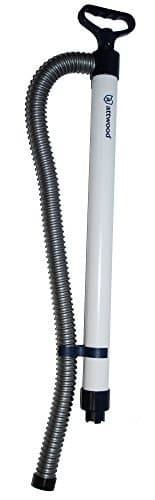
Up to 8 gpm, floating grip. The one that empties a swamped boat.
Published specs
| Flow | Up to 8 gallons per minute |
|---|---|
| Grip | Floating |
| Body | Plastic |
| Hose | Removable 32" discharge hose |
Our score, broken out
- Flow9.5
- Ergonomics8.0
- Stowage6.5
- Value8.5
What it gets right
- 8 gpm is an order of magnitude above the small kayak hand pumps, and volume is the entire point of a bilge pump.
- A floating grip means dropping it in the water is an inconvenience rather than a loss.
What it gets wrong
- The pump body plus a 32" hose is a lot of length for a small cockpit — check it stows where you can reach it while seated.
- Plastic construction; the shaft is the failure point if you lean on it.
Who should skip it
Skip it if it will live in a hatch. A bilge pump you cannot reach while sitting in a swamped boat is decoration. Deck-bungee it or do not buy it.
#3 · A numb backside
Skwoosh Paddling Cushion
13 oz, 1" of gel, non-skid base. Fixes the actual complaint.
Published specs
| Weight | 13 oz |
|---|---|
| Dimensions | 13" × 16" × 1" |
| Cover | 70-denier waterproof nylon |
| Base | Integrated polyurethane non-skid |
| Fill | Gel |
Our score, broken out
- Support6.0
- Attachment8.5
- Durability8.0
- Value9.5
What it gets right
- Most seat complaints are pressure, not posture. A gel pad addresses pressure directly and costs a fraction of a seat system.
- The non-skid base is the reason it stays put — cheap cushions slide out from under you on the first wake.
- 13 oz and it works with the seat you already have.
What it gets wrong
- It adds 1" of height, which raises your center of gravity slightly in a tippy boat.
- It does nothing whatsoever for back support.
Who should skip it
Skip it if your lower back is what hurts. Gel under you will not hold your spine up — that is what the GTS Elite is for, and no cushion substitutes.
FAQ
Questions people actually ask
Are scratches on a used kayak a problem?
Almost never. Surface scratches from years of being dragged up ramps have no effect on strength and essentially none on speed at recreational pace.
What matters is whether a gouge has gone all the way through. Hold the boat up and look for light, especially at the bow, stern, scupper tubes and around any hardware.
What is a spray deck for kayaking?
A spray deck, or spray skirt, is a fabric or neoprene cover that seals the cockpit of a sit-in kayak around your waist, keeping waves and rain out of the boat.
It is standard for sea kayaking and whitewater. It is unnecessary for flat-water recreational paddling, and a sit-on-top cannot use one at all — its equivalent is the scupper drainage.
How do I know if a used kayak has water inside the hull?
Lift the bow and listen for sloshing. Water inside a cavity that should be sealed is the fault most worth finding, because it gets worse and the boat gets heavier all season.
On a sit-on-top the usual cause is a cracked scupper tube. On a sit-in it is a failed bulkhead or a hole under a fitting where hardware was removed.
How do I fill old holes in a kayak deck?
A stainless bolt with a rubber well nut, or a plastic hole plug, bedded in marine sealant. Do it before the first trip rather than after — a slow leak into the hull is hard to trace later.
If the old holes match the bolt pattern of hardware you were going to fit anyway, reuse them. Scotty publishes its mount bolt patterns so you can check before drilling anything new.
We have not paddled with any of this gear. Everything above comes from published specifications, cited manuals and live retailer prices. Here is exactly how we pick.
Sources
Read next
Related on Drift & Dime
Kits
The used kayak rescue kitFor a neglected hull: what perished, what is missing, what to check first.
Kits
What a used kayak is worthValuing a second-hand hull, and using what is missing to negotiate.
Outfitting
Kayak scupper plugs, and when not to use themSizing, fitting, and the conditions where plugs become a hazard.
Outfitting
The best kayak seat upgradesSeats and cushions matched to the actual complaint — pressure or support.