Outfitting
The kayak bilge pump guide
Volume is the only spec that matters, and the spread is enormous — from about a gallon a minute to eight. Then it has to be somewhere you can reach while seated.
Disclosure: we earn a commission if you buy through the links on this page, at no extra cost to you. It does not change which products we pick or how we rank them. How this site is funded.
The short answer
Quick picks
Ranked for the person outfitting a used boat: what it costs, what it does, and who should skip it. 2 picks.
| # | Product | Best for | Our score | Price |
|---|---|---|---|---|
| 1 |  Attwood Hand Bilge PumpUp to 8 gpm, floating grip. The one that empties a swamped boat. Attwood Hand Bilge PumpUp to 8 gpm, floating grip. The one that empties a swamped boat. | Getting water out | 8.2 | $39.99View on Amazon |
| 2 | SealLine Baja Dry Bag19 oz vinyl sides, 30 oz bottom. Built to be dragged. | Abuse | 8.1 | Check price on Amazon |
Who needs one, and who does not
If you paddle a sit-in kayak, yes. A cockpit has no drainage. Water that gets in — from a wave, from rain, from drips off the paddle over a long day — stays in until you remove it. A swamped sit-in is heavy, unstable and very hard to recover without a way to empty it.
If you paddle a sit-on-top, probably not on flat water. The scuppers drain the deck continuously, which is what they are for. The exception is a boat that has water inside the hull cavity through a cracked scupper tube or an old bolt hole — and that is a fault to fix rather than to pump. See what to fix on a used kayak.
Flow rate is the whole specification
Everything else about a hand pump is packaging. The number to compare is gallons per minute, and the spread across products marketed for the same job is remarkable.
Attwood publishes up to 8 gallons per minute for its hand-operated bilge pump. A small kayak-specific hand pump published elsewhere in the same market moves roughly 1 gallon per minute.
That is not a marginal difference. Emptying a swamped cockpit is a task measured in tens of gallons, and doing it at one gallon a minute while holding a boat upright in wind is not a realistic plan. Buy on volume.
Length, and the trade against volume
Attwood publishes its hand pumps in several body lengths, commonly 18 inches and up.
A longer body means a longer stroke, which means more water per stroke. It also means a longer object to stow in a small cockpit and to operate while sitting down with a spray deck on.
For most recreational sit-in kayaks, something in the 18-inch range is the sensible compromise. Beyond about 24 inches you are into motorboat-sized pumps that are awkward to work in a kayak seat.
Where you keep it decides whether it is any use
This is the part people get wrong, and it makes the pump worthless.
A bilge pump in a hatch is decoration. The moment you need it, you are sitting in a boat full of water, possibly in wind, probably with a spray deck fastened. Opening a hatch at that point means letting more water in.
Correct stowage is under the deck bungees, forward of the cockpit, within arm’s reach while seated. Some paddlers keep it beside the seat inside the cockpit, which is fine on a boat with room.
Which assumes the bungees still have tension in them. On a used boat they usually do not, and a pump under slack gray cord is a pump that leaves on the first wave — replacing it is on the deck rigging guide. If you are also shopping for the spray deck referred to above, sizing one for a boat with no model badge is on the spray skirt guide.
A floating grip is not a gimmick. Attwood publishes a floating grip on its hand pump, and it means dropping the pump in the water is an inconvenience rather than a loss. You will be doing this with cold wet hands, in the exact situation where you cannot afford to lose it.
Technique, briefly
Put the intake end at the lowest point of the water, brace the pump against the boat or your thigh rather than holding it in mid-air, and use long full strokes. Short fast strokes move much less water than they feel like they do, because you never get the full displacement.
Aim the outlet over the side, downwind. It sounds obvious and people reliably pump water into their own laps.
What a pump does not replace
- A sponge. A pump cannot get the last inch. A cheap sponge finishes the job and is genuinely worth having.
- Float bags or bulkheads. On a sit-in kayak with no bulkheads, float bags in the bow and stern — compared on the float bag roundup — are what stop the boat filling completely in the first place. A pump empties a boat; float bags stop it needing emptying.
- A PFD. Worth saying plainly. Pumping out a swamped boat is something you do while floating, and the vest is what makes that possible.
Where it sits in a budget
A pump is cheap and it is not the first thing to buy. The order that makes sense on a used boat: the PFD you will actually wear, a whistle attached to it, a light, then the pump. That sequence is priced out on the first season kit, and the legally required subset is on the safety kit checklist.
In full
Every pick, in detail
Specs below are the manufacturer's published figures, cited per product. Where a maker does not publish a number, the row says so rather than guessing at it.
#1 · Getting water out
Attwood Hand Bilge Pump
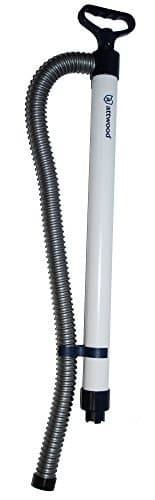
Up to 8 gpm, floating grip. The one that empties a swamped boat.
Published specs
| Flow | Up to 8 gallons per minute |
|---|---|
| Grip | Floating |
| Body | Plastic |
| Hose | Removable 32" discharge hose |
Our score, broken out
- Flow9.5
- Ergonomics8.0
- Stowage6.5
- Value8.5
What it gets right
- 8 gpm is an order of magnitude above the small kayak hand pumps, and volume is the entire point of a bilge pump.
- A floating grip means dropping it in the water is an inconvenience rather than a loss.
What it gets wrong
- The pump body plus a 32" hose is a lot of length for a small cockpit — check it stows where you can reach it while seated.
- Plastic construction; the shaft is the failure point if you lean on it.
Who should skip it
Skip it if it will live in a hatch. A bilge pump you cannot reach while sitting in a swamped boat is decoration. Deck-bungee it or do not buy it.
#2 · Abuse
SealLine Baja Dry Bag
19 oz vinyl sides, 30 oz bottom. Built to be dragged.
Published specs
| Sizes | 5 L to 55 L |
|---|---|
| Body | 19 oz vinyl sides |
| Base | Heavy-duty 30 oz bottom |
| Closure | Dry Seal roll-top |
| Attachment | D-ring |
| IP rating | Manufacturer does not publish this |
Our score, broken out
- Waterproofing8.5
- Durability9.5
- Carry7.0
- Value7.0
What it gets right
- The heavier base is where dry bags fail first — they get dragged across a concrete ramp, not submerged.
- A published size ladder from 5 L to 55 L means you can buy the size you need rather than the size sold.
What it gets wrong
- Vinyl is stiff in cold weather and does not pack down small when empty.
- No published IP rating to compare against bags that quote one.
Who should skip it
Skip it if you want a bag that stuffs into a hatch when empty. Vinyl holds its shape, which is exactly what makes it tough and exactly what makes it bulky.
FAQ
Questions people actually ask
Do I need a bilge pump for a kayak?
For a sit-in kayak, yes. A cockpit has no drainage, so water from waves, rain or paddle drips stays in until you remove it, and a swamped sit-in is heavy, unstable and hard to recover.
For a sit-on-top on flat water, usually not — the scuppers drain the deck continuously. The exception is a hull that has taken on water internally, which is a fault to fix rather than to pump.
How many gallons per minute should a kayak bilge pump move?
As many as you can reasonably operate, because emptying a swamped cockpit is measured in tens of gallons. Attwood publishes up to 8 gallons per minute for its hand-operated pump.
Some small kayak-specific hand pumps move roughly 1 gallon per minute, which is not a realistic rate for the job while holding a boat upright in wind.
Where should you store a bilge pump on a kayak?
Under the deck bungees forward of the cockpit, within arm's reach while you are seated. A pump in a hatch is decoration — the moment you need it you are sitting in a boat full of water, and opening a hatch then lets more in.
Look for a floating grip, which Attwood publishes on its hand pump. You will be handling it with cold wet hands.
We have not paddled with any of this gear. Everything above comes from published specifications, cited manuals and live retailer prices. Here is exactly how we pick.
Sources
Read next
Related on Drift & Dime
PFDs & Safety
The kayak safety kit checklistThe required items, the genuinely useful ones, and the padding to skip.
Outfitting
What to fix on a used kayakWhat matters on a second-hand hull, what is cosmetic, and what to walk away from.
Outfitting
Kayak scupper plugs, and when not to use themSizing, fitting, and the conditions where plugs become a hazard.
Kits
The used kayak rescue kitFor a neglected hull: what perished, what is missing, what to check first.