PFDs & Safety
The best kayak float bags
A recreational sit-in with no bulkheads fills to the brim when it goes over, and a full kayak is almost impossible to empty alone. Float bags are the cheap fix.
Disclosure: we earn a commission if you buy through the links on this page, at no extra cost to you. It does not change which products we pick or how we rank them. How this site is funded.

The short answer
Quick picks
Ranked for the person outfitting a used boat: what it costs, what it does, and who should skip it. 4 picks.
| # | Product | Best for | Our score | Price |
|---|---|---|---|---|
| 1 |  NRS Split Kayak FlotationA pair of tapered urethane bags in two sizes, made to fit around a center wall, with a lifetime warranty behind them. NRS Split Kayak FlotationA pair of tapered urethane bags in two sizes, made to fit around a center wall, with a lifetime warranty behind them. | A stern with a pillar down the middle | 8.3 | $109.95View on Amazon |
| 2 |  NRS Split Kayak Flotation, Bow SingleThe one bag in this category that publishes its inflated size: 23 inches long, 10 inches wide at the top, tapering to 3 at the bottom. NRS Split Kayak Flotation, Bow SingleThe one bag in this category that publishes its inflated size: 23 inches long, 10 inches wide at the top, tapering to 3 at the bottom. | Filling the bow only | 8.0 | $47.95View on Amazon |
| 3 |  Harmony Gear Micro Flotation SetFour bags — two bow, two stern — sized by Harmony for 8 to 10 foot kayaks, with RF-welded seams and a shaped end. Harmony Gear Micro Flotation SetFour bags — two bow, two stern — sized by Harmony for 8 to 10 foot kayaks, with RF-welded seams and a shaped end. | Doing the whole boat at once | 7.4 | $203.63View on Amazon |
| 4 | 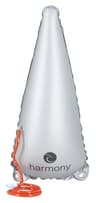 Harmony Vinyl Mini Float Bag, BowA single bow bag with isolated tie-ins and a proper dump valve, at the price the rest of this category should be. Harmony Vinyl Mini Float Bag, BowA single bow bag with isolated tie-ins and a proper dump valve, at the price the rest of this category should be. | The cheapest honest way in | 7.3 | $49.91View on Amazon |
What a swamped kayak actually does
Turn a sealed sit-on-top over and it floats, because the hull is one closed volume with nothing inside it. Turn a recreational sit-in over and water fills the cockpit, then keeps going into the bow and the stern if nothing is stopping it.
A kayak full of water weighs several hundred pounds. It floats level with the surface, it cannot be emptied by a person in the water, and it cannot be climbed back into. The boat has not sunk — polyethylene floats — but it has become unusable, which in cold water and any distance from shore is the same problem.
Float bags fill the empty ends so the water has nowhere to go. A swamped boat with bags in it sits high, can be emptied, and can be re-entered. That is the entire product, and for a certain kind of used kayak it is the most important thing you can buy after a life jacket.
First: does your boat need them at all?
Before you spend anything, look inside the boat. There are four situations and only two of them need bags.
- A sit-on-top. No bags needed. The hull is sealed and it is its own flotation, which is why these boats are the default recommendation for beginners on this site.
- A sea kayak with bulkheads fore and aft. No bags needed in the sealed compartments — those are the flotation. A day hatch and two sealed ends is exactly the design this problem was solved with.
- A sit-in with a rear bulkhead and an open bow. Very common on recreational boats. You need a bow bag, or a pair if the bow has a center pillar.
- A sit-in with no bulkheads at all. The cheap recreational hull, and the reason this page exists. It needs flotation at both ends.
Check by knocking on the deck fore and aft and by opening any hatches. A hatch that opens into the whole hull is not a sealed compartment; a hatch that opens into a boxed-off space with a solid wall behind it is.
How we ranked these
Four criteria, weighted equally and published on how we pick:
- Coverage. How much of the boat the purchase actually fills — which for most of these means whether you get one bag or a pair.
- Fit. Shape, taper and whether it works around a center pillar, plus what the maker publishes about size.
- Build. Material, seams, valves and warranty.
- Value. Against the boat, and against the cheaper improvisations further down this page.
The mistake: buying one bag
This is the thing to get right, and it is why one product on this page scores well despite being the cheapest.
Most float bags are sold singly. Harmony states it outright on its own listing: only one bag is included, and two bags are needed to achieve proper flotation. A single bag in one end of a two-ended boat leaves the other end free to fill, and a boat that is heavy at one end is arguably worse to rescue than one that is evenly swamped.
So read the quantity before the price. The NRS Split set is two bags. Harmony’s Micro set is four — two bow, two stern — because many hulls have a center wall and each end needs a bag either side of it. Everything else here is one bag, and the real cost is double what the listing says.
Sizing, and the chart that does not exist
Nobody publishes a proper sizing chart for this category, which is frustrating because fit is most of the performance.
What is published:
- NRS publishes inflated dimensions for its bow single — 23 inches long, 10 inches wide at the top, tapering to 3 inches at the bottom. That is the only measurement in this roundup and it is the reason that bag is here.
- Harmony publishes a boat-length range for its Micro set — a stated universal fit for 8 to 10 foot kayaks.
- Harmony’s single bags are sold in named sizes — Micro, Mini, Rodeo, Rec — with no boat-length guidance attached, and the listings note that stated dimensions are for the bag inflated.
So measure your own boat. Run a tape from the front of the cockpit to the inside of the bow, and do the same at the stern. That length, and the width where the bag will sit, is what you are matching. A bag that is slightly too big can be under-inflated; a bag that is too small leaves a void that fills with water.
Material: vinyl or urethane
Two materials dominate, and the difference shows up over years rather than trips.
Vinyl is the cheaper option and what Harmony’s single bags use. It works, it is repairable, and it eventually goes stiff and cracks at the folds after enough UV and enough seasons.
Urethane is what NRS uses, published as 10-gauge and stated not to leak or delaminate, and it carries a lifetime warranty. It costs roughly double, and on gear whose entire job is to be intact on the one day it matters, that is a defensible premium.
Two construction details worth knowing. Harmony publishes that its tie-in points are isolated from the air-holding cell, so a lacing point that rips out does not vent the bag — that is a genuinely good design. And its Micro set is RF welded for a continuous seam, which is the join most likely to fail on an inflatable.
Fitting them so they stay put
A float bag that floats out of the boat during a capsize has done nothing at all. Fitting is half the product.
- Lace the ends first. Most sit-ins have deck lines or lacing inside the hull. If yours does not, running a criss-cross of cord between pad eyes is the job, and how to fit a pad eye you cannot reach behind is on the deck rigging guide.
- Put the bag in deflated, pushed right up into the end, with the inflation hose led back to where you can reach it from the cockpit.
- Clip the tie-ins to the lacing — NRS publishes three D-ring attachment points on its split bags for this.
- Inflate until firm, not drum tight. A little give is what stops a bag bursting when the air inside it warms up.
- Check before every trip that matters. Bags leak slowly, and a soft bag is only partly doing its job.
Heat is the failure mode nobody warns about
Air expands when it gets hot. A bag inflated hard on a cool morning and then left in a boat on a hot roof rack, or on a beach at midday, can burst its seam.
Harmony addresses this directly: its Micro set uses what it calls a temperature-regulating colored material, stated to make the bag less likely to burst on hot, sunny days. That is an unusual thing for a maker to publish, and it tells you the failure is real.
The free version of that protection is simply to let some air out when the boat is going to sit in the sun, and top it back up at the launch. A high-capacity dump valve — which Harmony publishes on its bags — is what makes that a five-second job rather than a chore.
If the boat came with bags already
Bags sometimes come with a used kayak, and they are worth ten minutes before you trust them.
Inflate each one fully at home and leave it overnight. A bag that is soft in the morning has a leak, and a slow leak is the version you will not notice on the water. Check the seams and the folds, which is where old vinyl cracks, and check that the tie-in points are intact rather than torn.
Old bags are also often the wrong ones — fitted by a previous owner to a different boat, or a single bag where the hull needs two. The same inspection logic applies to everything that arrives with a second-hand hull, and the full list is on what to fix on a used kayak.
The cheap alternatives, honestly
Three substitutes people use, with what each actually gives you.
Dry bags stuffed into the ends. The common improvisation, and it does displace water. What it lacks is shape and attachment: a round dry bag leaves voids around it, and unless it is tied in it will float out through the cockpit when the boat is upside down. As a half-measure it is far better than nothing.
Pool noodles or foam blocks. Closed-cell foam cannot deflate, which is a real advantage, and it is cheap. It also cannot be removed for drying, it holds water against the hull, and it displaces far less volume than a shaped bag that fills the whole end.
A sea sock. A fabric bag you sit inside, sealed around the cockpit rim, so the hull cannot fill at all. Genuinely effective and genuinely rare, and it changes how the boat feels to sit in. Worth knowing about; hard to buy.
What none of these do is make the rescue itself easy. That is a separate purchase and a separate skill — the float and the pump you need after a capsize are on the paddle float roundup and the bilge pump guide.
Where this sits in the safety order
Money first, in the order that actually reduces risk.
A life jacket you will wear comes before everything, and the ones worth buying are on the budget life jacket roundup. After that, on an open-ended sit-in, float bags are the next purchase, because they change a capsize from an emergency into an inconvenience. Then a pump, then a float, then practice.
Practice is the part with no product attached and the biggest effect. A boat with bags in it can be emptied and re-entered by one person — but only if that person has done it before, in shallow water, on a warm day, rather than for the first time in October.
The full list of what belongs in the boat, priced, is on the used kayak rescue kit.
What we would buy
If your stern has a center pillar, the NRS Split pair. It is a pair rather than a single, the split shape is designed for exactly that wall, and the urethane and lifetime warranty are the durable end of this market.
If your boat has a sealed stern and an open bow, the NRS bow single. It is the only bag here that publishes its inflated size, so you can check it against a tape measure before ordering.
If the boat is 8 to 10 feet and open at both ends, the Harmony Micro set. Four bags, both ends, both sides of a center wall, and the only published boat-length guidance in the category.
If money is the binding constraint, two Harmony vinyl singles. Buy two, not one — Harmony says so itself — and accept that vinyl is the shorter-lived material.
And if you paddle a sit-on-top, buy none of it. Your hull is already the flotation, and the money belongs somewhere else.
In full
Every pick, in detail
Specs below are the manufacturer's published figures, cited per product. Where a maker does not publish a number, the row says so rather than guessing at it.
#1 · A stern with a pillar down the middle
NRS Split Kayak Flotation
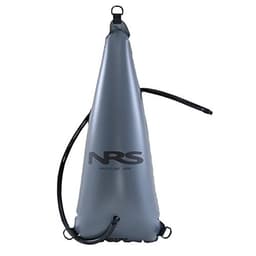
A pair of tapered urethane bags in two sizes, made to fit around a center wall, with a lifetime warranty behind them.
Published specs
| Sold as | 2 bags, a pair, in two different sizes |
|---|---|
| Material | 10-gauge urethane fabric |
| Shape | Tapered profile, stated to fit most kayak stern compartments |
| Attachment | 3 D-ring attachment points |
| Warranty | Lifetime |
| Inflated dimensions | Manufacturer does not publish these for the pair |
Our score, broken out
- Coverage9.0
- Fit8.5
- Build9.5
- Value6.0
What it gets right
- It is a pair. Flotation only works in pairs, and buying a set removes the most common mistake in this category — fitting one bag and thinking the job is done.
- The split shape is built for the pillar or center wall that runs down the stern of many recreational kayaks, where a single fat bag simply will not go.
- 10-gauge urethane with a lifetime warranty is the serious end of this market, and urethane does not delaminate the way cheap vinyl eventually does.
What it gets wrong
- It is the expensive way to do this, and on a boat worth a few hundred dollars that ratio feels wrong until the day it matters.
- NRS publishes inflated dimensions for its single bow bag but not for this pair, so you are trusting 'fits most stern compartments' rather than a measurement.
- Stock on the NRS flotation line is thin and moves between sizes; what is available today may not be next week.
Who should skip it
Skip it if your stern has no center pillar. A plain pair of bags costs less and fills the space just as well.
#2 · Filling the bow only
NRS Split Kayak Flotation, Bow Single
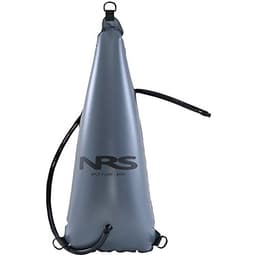
The one bag in this category that publishes its inflated size: 23 inches long, 10 inches wide at the top, tapering to 3 at the bottom.
Published specs
| Sold as | One float bag |
|---|---|
| Inflated dimensions | 23" L × 10" W at top, 3" W at bottom |
| Material | 10-gauge urethane (Infinity series), stated not to leak or delaminate |
| Warranty | Lifetime |
Our score, broken out
- Coverage6.5
- Fit9.0
- Build9.5
- Value7.0
What it gets right
- Published inflated dimensions, which is the only way to know whether a bag will actually fill your bow before you buy it. Nobody else here prints them.
- The taper matches the shape of a bow, so it displaces water right up into the point rather than stopping short of it.
- Sold singly, which is exactly right for a boat that already has a sealed stern bulkhead and an open bow.
What it gets wrong
- One bag. If your boat is open at both ends, this is half the purchase and the page says so.
- At this price per bag, doing a whole boat costs more than a pair from the cheaper vinyl lines.
- Stock is intermittent, and the bow and stern versions are separate listings rather than one product.
Who should skip it
Skip it if your kayak is open at both ends and your budget is tight. Two cheaper bags beat one good one when the alternative is a bare stern.
#3 · Doing the whole boat at once
Harmony Gear Micro Flotation Set
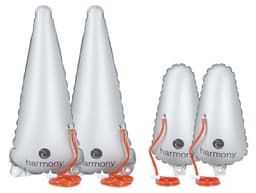
Four bags — two bow, two stern — sized by Harmony for 8 to 10 foot kayaks, with RF-welded seams and a shaped end.
Published specs
| Sold as | Four bags: two stern and two bow, to accommodate center walls |
|---|---|
| Fit | Stated universal fit for 8–10 foot kayaks |
| Seams | RF welded for a continuous leak-free seam |
| Shape | 3D vertical end seam that conforms to the curvature of the hull |
| Valves | Easy twist valve with high-capacity dump |
| Material | Temperature-regulating colored material, stated to be less likely to burst on hot days |
Our score, broken out
- Coverage9.5
- Fit6.5
- Build8.0
- Value5.5
What it gets right
- It is the whole job in one box: both ends, both sides of a center wall, no working out which single bags pair together.
- A published boat-length range — 8 to 10 feet — is the closest thing to sizing guidance anyone in this category offers.
- The heat note is not marketing fluff. Air expands in a bag left inflated in the sun, and bursting is a real failure mode for cheap flotation.
What it gets wrong
- It is by far the most expensive option here, and on a cheap used kayak the set can cost a meaningful fraction of the boat.
- Sized for 8 to 10 foot boats. On a 12 or 14 foot recreational kayak the bags will not fill the ends.
- Four bags is four things to inflate, lace and check before every trip you actually care about.
Who should skip it
Skip it if your kayak is longer than 10 feet — the published fit range is the reason to buy this set, so respect it.
#4 · The cheapest honest way in
Harmony Vinyl Mini Float Bag, Bow
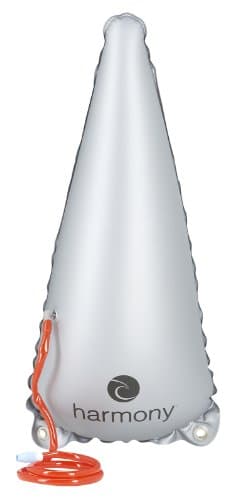
A single bow bag with isolated tie-ins and a proper dump valve, at the price the rest of this category should be.
Published specs
| Sold as | One bag; Harmony states two bags are needed for proper flotation |
|---|---|
| Tie-ins | Isolated from the air-holding cell, so a tear-out is limited to the anchor |
| Inflation | Twist valve on the inflation hose for a positive seal |
| Deflation | High-capacity dump valve |
| Dimensions | Listed dimensions are for the bag inflated |
Our score, broken out
- Coverage6.0
- Fit7.0
- Build7.0
- Value9.0
What it gets right
- Harmony states plainly on the listing that one bag is not enough and two are needed — which is the single most important fact in this category and the one most sellers leave out.
- The tie-in points are isolated from the air cell, so a lacing point that rips out does not vent the bag. That is a real design decision, not a marketing line.
- A high-capacity dump valve matters more than it sounds: a bag you cannot deflate quickly is a bag you will not take out to dry.
What it gets wrong
- Vinyl rather than urethane. Cheaper, and less durable over years of UV and folding than the 10-gauge urethane bags.
- You need two, so the real price is double the sticker — and Harmony's own set of four costs several times this.
- Harmony sells Micro, Mini, Rodeo and Rec sizes without publishing a boat-length chart, so choosing between them is guesswork unless you measure.
Who should skip it
Skip it if your bow has a sealed bulkhead and a dry hatch. That compartment is already your flotation.
FAQ
Questions people actually ask
Do I need float bags in my kayak?
It depends on the boat. A sit-on-top does not need them — the sealed hull is its own flotation. A sea kayak with bulkheads fore and aft does not need them in those sealed compartments.
A recreational sit-in with no bulkheads, or with a sealed stern and an open bow, does. Without flotation those hulls fill completely in a capsize, and a kayak full of water weighs several hundred pounds, cannot be emptied from the water, and cannot be climbed back into.
How many float bags does a kayak need?
Two at minimum, and four if both ends have a center pillar. Harmony states plainly on its own listing that only one bag is included and two are needed for proper flotation.
Most float bags are sold singly, so read the quantity before the price. NRS sells its Split flotation as a pair; Harmony's Micro set is four bags — two bow and two stern — to accommodate center walls.
What size float bag do I need?
Measure the boat, because a proper sizing chart does not exist in this category. Run a tape from the front of the cockpit to the inside of the bow, and the same at the stern.
What makers publish is limited: NRS gives inflated dimensions for its bow single (23 inches long, 10 inches wide at the top, tapering to 3 at the bottom), and Harmony states an 8 to 10 foot boat range for its Micro set. A slightly oversized bag can be under-inflated; an undersized one leaves a void that fills with water.
Can I use dry bags instead of float bags?
As a half-measure, yes, and it is far better than nothing. Stuffed dry bags displace water in the ends of the hull.
What they lack is shape and attachment: a round bag leaves voids around it, and unless it is tied in it will float out through the cockpit when the boat is upside down. Purpose-made bags are shaped to fill the end and have tie-in points — Harmony isolates those tie-ins from the air cell so a tear-out does not deflate the bag.
Can float bags burst in the heat?
Yes, and it is a real failure mode rather than a theoretical one. Air expands when it warms, so a bag inflated hard on a cool morning and then left on a hot roof rack or a midday beach can split a seam.
Harmony publishes a temperature-regulating colored material on its Micro set for exactly this reason. The free protection is to inflate firm rather than drum tight, and to dump a little air when the boat will sit in the sun.
We have not paddled with any of this gear. Everything above comes from published specifications, cited manuals and live retailer prices. Here is exactly how we pick.
Sources
- NRS — Split Kayak Flotation published material, shape, attachment points and warranty
- NRS — Split Kayak Flotation bow single published inflated dimensions and material
- Harmony Gear — Micro Flotation Set published contents, 8–10 ft fit range, RF-welded seams and material note
- Harmony Gear — vinyl float bag published valves, isolated tie-ins and 'two bags needed' statement
Read next
Related on Drift & Dime
PFDs & Safety
The best kayak paddle floatsFoam against inflatable on published specs, and the practice that makes either work.
Kits
The used kayak rescue kitFor a neglected hull: what perished, what is missing, what to check first.
Outfitting
The kayak bilge pump guideFlow rates compared, and why stowage decides whether a pump is any use.
PFDs & Safety
The kayak safety kit checklistThe required items, the genuinely useful ones, and the padding to skip.