PFDs & Safety
The kayak safety kit checklist
What the law requires, what actually helps, and what the safety-kit lists sell you that you do not need. Nine items, in the order they matter.
Disclosure: we earn a commission if you buy through the links on this page, at no extra cost to you. It does not change which products we pick or how we rank them. How this site is funded.
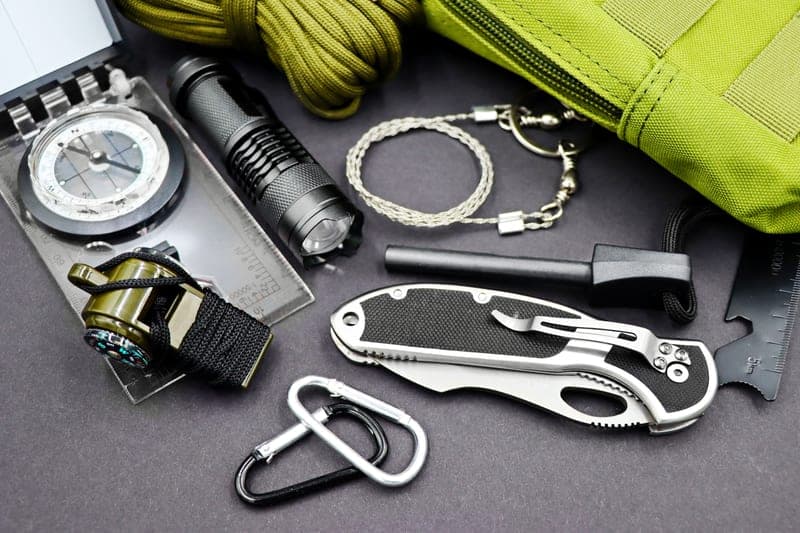
The short answer
Quick picks
Ranked for the person outfitting a used boat: what it costs, what it does, and who should skip it. 3 picks.
| # | Product | Best for | Our score | Price |
|---|---|---|---|---|
| 1 | 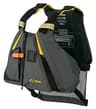 Onyx MoveVent DynamicMesh back panel clears a kayak seat, which is the whole job. Onyx MoveVent DynamicMesh back panel clears a kayak seat, which is the whole job. | Most used boats | 8.4 | $66.32View on Amazon |
| 2 | 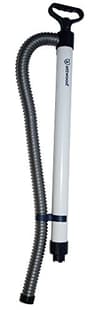 Attwood Hand Bilge PumpUp to 8 gpm, floating grip. The one that empties a swamped boat. Attwood Hand Bilge PumpUp to 8 gpm, floating grip. The one that empties a swamped boat. | Getting water out | 8.2 | $39.99View on Amazon |
| 3 |  YakGear Paddle LeashThe cheapest insurance on the boat, and the most often skipped. YakGear Paddle LeashThe cheapest insurance on the boat, and the most often skipped. | Not losing the paddle | 8.0 | $14.39View on Amazon |
Required, useful, and sold to you anyway
Search “kayak safety kit” and you will be sold a bag of twenty items, most of which will never come out of it. This list is sorted into three honest groups instead: what the law wants, what genuinely changes an outcome, and what is padding.
Group one: legally required
1. A wearable approved PFD per person. Correct size, serviceable condition, readily accessible. This is 33 CFR 175.15 and it is the whole legal foundation. Detail on whether life jackets are required.
2. A sound-producing device. A whistle satisfies this on most waters. Several paddle vests include one — Onyx ships a marine whistle with the MoveVent Dynamic. Attach it to the jacket, not to the boat: a whistle in a hatch during a capsize is not a signaling device.
3. A white light, if you might be out after sunset. Between sunset and sunrise a paddle craft needs, at minimum, a white light available to show in time to prevent a collision. A headlamp does this. It also means you can see, which is the other half of the problem. If evening paddles become a habit, a raised all-round light is the upgrade that gets you seen first — compared on the best kayak lights.
That is the legal list. It is genuinely short, and it surprises people who expected flares and a first aid kit to be mandatory. The priced version is the legal minimum kit.
Group two: not required, actually matters
4. A way to get water out of the boat. If your kayak has a cockpit rather than scuppers, there is no automatic drainage, and bailing with a cut bottle is slow enough to matter in a wind. A hand pump moves real volume — Attwood publishes up to 8 gallons a minute for its hand pump, against roughly one gallon a minute for the small kayak-specific pumps. Keep it under a deck bungee. A pump in a hatch is decoration.
5. A paddle leash, in the right conditions. Losing a paddle on open water in wind is a genuinely serious situation, because you have nothing to chase it with. A leash costs very little. Take it off in surf and moving water — a line attaching you to a floating object is an entanglement risk, and there that risk is larger than the one it solves. The same reasoning is why a dog is never tied into a boat, whatever the conditions — see kayak accessories for dogs.
6. A phone, waterproofed, on your body. Not in the hatch. Not in the crate. Modern phones plus a cheap waterproof pouch are the most effective rescue device most paddlers will ever carry, and they are useless in a bag that floated away with the boat.
7. A knife you can reach one-handed. Cheap, small, clipped to the PFD. If you carry an anchor line, a paddle leash or a tow line, you have something that can trap you, and the knife is the answer to all of them.
8. A dry layer in a dry bag. Cold is the actual risk on most inland water, more than drowning. Getting wet in April and having nothing dry to change into is how a nuisance becomes hypothermia.
9. Somebody knowing where you are. Free. A text before you launch with where you put in and when you expect to be back is more useful than most of the equipment above.
Group three: what the kits pad with
Not useless, just usually not the right first purchase on a budget:
- Flares. Not required for a paddle craft on inland water, and awkward to store safely in a kayak.
- A full trauma first aid kit. A small waterproof kit with plasters, tape and painkillers covers what actually happens in a kayak. A trauma kit is for a different activity.
- A paddle float and stirrup are excellent kit for deep-water self-rescue in a sea kayak, and mostly irrelevant if you paddle a sit-on-top within swimming distance of shore. If you do paddle deep water alone, the floats worth owning are on the paddle float roundup.
- A throw bag is river rescue equipment. If you are paddling moving water it belongs in group two. If you are on a lake, it belongs here.
The rule that actually keeps you safe
Every item above is worth less than the one decision it cannot make for you: whether to go out at all. Cold water, an offshore wind, and paddling alone are the three factors present in the large majority of incidents, and none of them is fixed by a whistle.
If you buy in order: the PFD you will actually wear, then a whistle attached to it, then a light, then the pump. That sequence is the one on the first season kit, priced line by line.
In full
Every pick, in detail
Specs below are the manufacturer's published figures, cited per product. Where a maker does not publish a number, the row says so rather than guessing at it.
#1 · Most used boats
Onyx MoveVent Dynamic
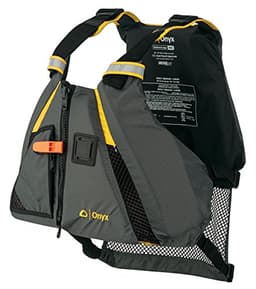
Mesh back panel clears a kayak seat, which is the whole job.
Published specs
| Approval | USCG approved; Transport Canada approved |
|---|---|
| Chest range | 28–56" across three sizes |
| Shell | Nylon ripstop outer shell |
| Back panel | Mesh, to sit above a kayak seat back |
| Expandable zippered pocket with mesh drainage | |
| Reflective | SOLAS grade |
| Buoyancy | Manufacturer does not publish this |
Our score, broken out
- Fit range7.5
- Mobility9.0
- Ventilation8.5
- Value8.5
What it gets right
- The lower-back mesh is the feature that matters on a sit-in kayak — solid foam there fights the seat back and pushes you forward all day.
- Shoulder and side adjustment plus neoprene shoulder pads, which is more adjustment than the cheapest approved vests offer.
- A whistle is included, and a sound-producing device is separately required by the USCG on most waters.
What it gets wrong
- Onyx does not publish a buoyancy figure, so you cannot compare it numerically against vests that do.
- Three broad sizes rather than fine-grained sizing — the fit is good, not tailored.
Who should skip it
Skip it if your chest is at the very top of a size band. The three-size split means you land between sizes more often than with a vest sold in five, and a loose PFD rides up over your ears in the water.
#2 · Getting water out
Attwood Hand Bilge Pump
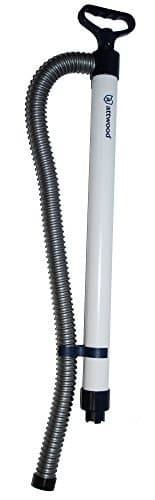
Up to 8 gpm, floating grip. The one that empties a swamped boat.
Published specs
| Flow | Up to 8 gallons per minute |
|---|---|
| Grip | Floating |
| Body | Plastic |
| Hose | Removable 32" discharge hose |
Our score, broken out
- Flow9.5
- Ergonomics8.0
- Stowage6.5
- Value8.5
What it gets right
- 8 gpm is an order of magnitude above the small kayak hand pumps, and volume is the entire point of a bilge pump.
- A floating grip means dropping it in the water is an inconvenience rather than a loss.
What it gets wrong
- The pump body plus a 32" hose is a lot of length for a small cockpit — check it stows where you can reach it while seated.
- Plastic construction; the shaft is the failure point if you lean on it.
Who should skip it
Skip it if it will live in a hatch. A bilge pump you cannot reach while sitting in a swamped boat is decoration. Deck-bungee it or do not buy it.
#3 · Not losing the paddle
YakGear Paddle Leash
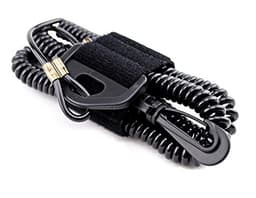
The cheapest insurance on the boat, and the most often skipped.
Published specs
| Type | Coiled leash with clips at both ends |
|---|---|
| Attachment | Carabiner to deck rigging, velcro or clip to shaft |
| Length | Manufacturer does not publish a consistent figure across variants |
Our score, broken out
- Security8.0
- Hardware6.5
- Stowage8.5
- Value9.0
What it gets right
- A drifting paddle is a genuinely bad afternoon, and this costs less than a tank of fuel.
- Coiled construction keeps the slack off the deck where it would otherwise snag.
What it gets wrong
- A leash is one more line in the cockpit, which is a real consideration in moving water.
- Cheap clips corrode. Rinse them or replace them.
Who should skip it
Skip a paddle leash entirely on whitewater or in surf. A line attached to you and to a floating object is an entanglement risk, and that risk outweighs losing a paddle.
FAQ
Questions people actually ask
Do you need a safety kit in a kayak?
You need three things legally: a wearable Coast Guard-approved PFD per person, a sound-producing device such as a whistle, and — if you may be out between sunset and sunrise — a white light available to show to prevent a collision.
Everything else is optional. The most useful additions are a bilge pump you can reach while seated, a waterproofed phone carried on your body, and a small knife clipped to the PFD.
Do I need flares in a kayak?
Not on inland water for a paddle craft, and they are awkward to store safely in a kayak. Visual distress signal requirements apply to coastal waters and the Great Lakes, and they are not typically imposed on manually propelled vessels on inland lakes and rivers.
A whistle, a light and a waterproofed phone will do more for you in the situations a kayaker actually gets into.
Should I use a paddle leash?
On open flat water, yes. A paddle that gets away from you in wind is genuinely hard to recover, because you have nothing to chase it with.
In surf or moving water, no. A line attaching you to a floating object is an entanglement risk, and there that risk outweighs losing the paddle. Carry a knife you can reach one-handed if you carry any line at all.
We have not paddled with any of this gear. Everything above comes from published specifications, cited manuals and live retailer prices. Here is exactly how we pick.
Sources
Read next
Related on Drift & Dime
PFDs & Safety
Are life jackets required on kayaks?The federal rule, what 'readily accessible' means on a kayak, and where wear is mandatory.
Kits
The legal minimum kayak kitThe three items federal rules require, priced — and nothing else.
Outfitting
The kayak bilge pump guideFlow rates compared, and why stowage decides whether a pump is any use.
PFDs & Safety
The best budget kayak life jacketsSix approved vests ranked on fit, mesh back panels and published buoyancy figures.