PFDs & Safety
Kayak accessories for dogs
Three things matter and one of them is a rule rather than a purchase. Buy the flotation aid, fix the deck, and never clip the dog to the boat.
Disclosure: we earn a commission if you buy through the links on this page, at no extra cost to you. It does not change which products we pick or how we rank them. How this site is funded.
The short answer
Quick picks
Ranked for the person outfitting a used boat: what it costs, what it does, and who should skip it. 3 picks.
| # | Product | Best for | Our score | Price |
|---|---|---|---|---|
| 1 | Outward Hound Granby RipstopFront float, grab handles, neoprene belly band. Stocked everywhere. | Most dogs, most weekends | 7.9 | Check price on Amazon |
| 2 | Ruffwear Float CoatSix girth sizes, published materials, and a handle built to lift. | Getting the dog back aboard | 8.3 | Check price on Amazon |
| 3 | Hydro-Turf Traction Sheet5–6 mm closed-cell EVA you cut to fit. The fix for a sliding dog. | Stopping the skid | 7.4 | Check price on Amazon |
The short version
A dog in a kayak needs three things, and only two of them are products.
- A flotation aid that fits by girth, with a handle you can lift the dog by.
- Something on the deck that is not slippery, because a dog skidding on wet plastic is the thing that actually tips boats.
- No tether. This is the rule, and it is free. NRS puts it plainly in its own boating safety guidance for dogs: “Never tie your dog onto the boat, at least in any condition that could lead to a boat upset.”
Everything else sold under “kayak accessories for dogs” — branded bowls, deck bags with paw prints, doggy sunglasses — is optional at best. This page covers the three that are not.
A dog PFD is not a PFD, legally
Worth being precise about this, because the language in the category is loose and it matters.
33 CFR 175.15 requires one wearable Coast Guard–approved PFD, correctly sized, for each person on board a recreational vessel. A dog is not a person. There is no federal requirement to carry flotation for an animal, and nothing you buy for the dog changes what you are required to carry for yourself.
Nor are these devices approved. NRS states it directly about its own canine product: “NRS CFDs are not a Coast Guard approved life jacket but a flotation aid.” That is true of every dog jacket sold in the United States. There is no USCG approval category for animals, so a listing that implies one is either sloppy or lying.
None of which is an argument against buying one. It is an argument for judging them on published construction rather than on a certification that does not exist — and for remembering that your own vest is the one with a legal requirement attached, which is on whether life jackets are required on kayaks.
How we picked these
Four criteria, weighted equally and published on how we pick: fit range (how many dog shapes the published sizing actually covers), retention (handles, belly band, whether it stays on a swimming dog), published data (whether the maker prints materials and figures at all), and value.
Published data carries real weight here and it is a harsh criterion in this category, deliberately. The pet aisle publishes less hard information than any other corner of this site. A brand that tells you the denier of the shell and the type of the foam is doing something genuinely unusual, and it is reasonable to reward it.
The deck traction sheet is scored on its own terms — grip, durability, reversibility and value — because it is not a garment and scoring it on fit range would be meaningless.
Girth, not weight. Dogs are not proportional.
Human PFDs are sized by chest measurement and children’s by body weight. Dog jackets are sized by girth — the circumference of the rib cage at its widest point — and that is the only measurement that matters.
The reason is breed variation. A 50-pound greyhound and a 50-pound bulldog are the same weight and nowhere near the same shape. Weight tells you how much flotation the dog needs; girth tells you whether the jacket will actually stay on.
| Size | Outward Hound Granby (girth) | Ruffwear Float Coat (girth) |
|---|---|---|
| XXS | — | 13–17" |
| XS | 11–15" | 17–22" |
| S | 16–20" | 22–27" |
| M | 21–27" | 27–32" |
| L | 28–32" | 32–36" |
| XL | 33–44" | 36–42" |
Note that the two brands’ letters do not line up. An Outward Hound Small and a Ruffwear Small cover completely different dogs. Measure the girth with a soft tape, write the number down, and buy to the number rather than to the letter.
The neck is the second measurement worth taking. Ruffwear publishes an adjustable telescoping neck closure precisely because a deep-chested dog with a narrow neck — every sighthound — is the fit case a fixed collar cannot handle.
Buoyancy: the number this category will not print
Neither jacket on this page publishes a flotation figure. Neither does almost anything else in the pet aisle.
It can be done. NRS publishes a per-size flotation figure for its canine device — 2.7 lb at XS, rising through 3.4, 4.9 and 6.4 to 7.9 lb at XL — alongside a 420-denier ripstop nylon shell and a seven-panel construction. That is the level of disclosure this category is capable of and almost never delivers.
We are not recommending it here, and the reason is availability rather than quality: at the time of writing it is on backorder at NRS and sold out at every retailer we checked. If it comes back into stock and you want a number to compare against, it is the one that publishes one.
In the meantime, the honest position is that a correctly sized foam jacket from either brand will float a healthy dog. What the published specs actually let you judge is durability and fit, not flotation, and it is better to say that than to pretend a scoring column is doing more work than it is.
The handle is the product
If you take one thing from the product side of this page: you are buying the handle.
A dog that goes over the side of a sit-on-top cannot get back on alone. Not a small one, not a strong swimmer, not a retriever. There is nothing to climb and nothing to grip, and a wet dog is a heavy, panicking, unhelpfully shaped object to lift from a seated position in an unstable boat.
NRS puts it as plainly as anyone: “A grab handle is essential for lifting your dog into the boat and holding on to them at times.” Ruffwear publishes a handle positioned for water rescue; Outward Hound publishes two handles on medium and up, and one on the two smallest sizes.
Two handles beat one on a heavy dog, because you can lift level rather than hoisting from a single point at the shoulders. Practice it once, in shallow water, before you need it — the same principle as every other rescue skill on the safety kit checklist.
Never tether the dog
This is the part of the page that is not a purchase, and it is the part that matters most.
The instinct is reasonable: the dog might jump out, so clip the leash to something. The consequence is not. A tethered dog in a capsize is trapped under an upturned hull by a line you cannot reach and cannot see, in the same moment you are dealing with your own exit.
NRS’s guidance is unambiguous: “Never tie your dog onto the boat, at least in any condition that could lead to a boat upset.”
What to do instead. Let the dog swim — a dog in a flotation aid on flat water is in far less trouble than you are, and it will head for shore or for the boat on its own. Keep a leash aboard, coiled and stowed, for the launch and the take-out where you actually need control. And use the jacket’s D-ring on land, which is what Ruffwear and the others intend it for, rather than as an anchor point afloat.
The same logic governs paddle leashes and anchor lines: anything that ties a person or an animal to a boat is a hazard in a capsize, which is why the paddle leash guide says leash the paddle to the boat and never to yourself.
The deck is the other half of the job
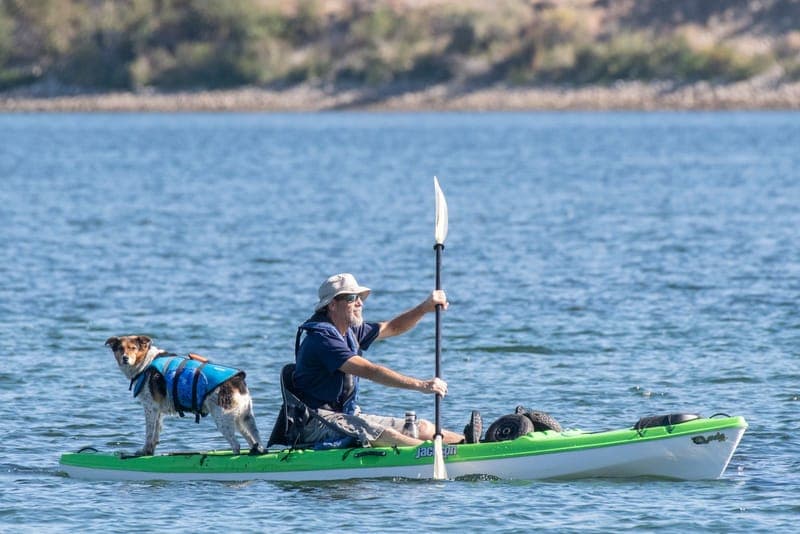
A dog on wet polyethylene has no grip at all. It braces, slides, over-corrects and shifts its weight in exactly the way a narrow boat least appreciates, and it does it every time a wake goes past.
This is the most under-sold problem in taking a dog paddling. People buy the jacket, get in the boat, and discover the real issue is traction rather than flotation.
Three fixes, in increasing order of commitment:
- A rubber-backed bath mat, cut to the footwell. Costs almost nothing, lifts straight out, and does most of the job. Start here.
- A closed-cell foam camping pad offcut. Warmer under paws than a mat and slightly grippier than bare plastic, though it slides itself unless you weigh it down.
- Adhesive EVA traction sheet, cut to a template. Hydro-Turf publishes 5–6 mm closed-cell EVA at roughly 50 Shore C, in a 37 by 58 inch PWC sheet that is more material than any kayak footwell needs. It is permanent and it is the right answer if the dog is a regular.
The insulation point is worth its own sentence. A dark polyethylene deck in July is genuinely too hot for paws, and foam is the only one of these three that solves heat as well as grip.
The boat matters more than any of this
An honest page has to say that most of the outcome is decided before you buy anything.
A sit-on-top is the boat for this. Open deck, room for a dog to stand or lie forward of you, self-draining when the dog shakes, and easy for both of you to get back onto. A sit-in cockpit gives a dog nowhere to be except your lap.
Width is stability, and stability is what a moving passenger demands. A wide fishing-style hull tolerates a dog shifting around; a narrow touring boat does not. That is the same beam trade-off that decides paddle length, covered on what size kayak paddle you need.
Capacity is not just the dog. A 70-pound dog plus you plus gear can put a used recreational hull close to its rated load, and a boat near capacity sits low, handles badly and takes water over the gunwale.
If your seat is a bare molded pan, the dog will end up on it. A cushion or a proper seat gives you a defined space and the dog a different one — the options are on the seat upgrade roundup.
Getting the dog used to it
None of the gear works on a dog that does not want to be there, and the first trip decides a lot.
NRS’s guidance is the sensible sequence: “Put their life jacket on them at home and let them get used to wearing it. First, take them out in your boat for short jaunts. Don’t make their first outing a multiday trip.”
Add to that: put the boat on the lawn and let the dog get in and out of it while it is not moving. Feed them in it. The goal is that the hull is furniture rather than an event before it ever touches water.
Two practical points NRS also raises that are easy to forget. Short- haired, light-skinned dogs can sunburn, and exposed areas want a sunscreen of SPF 15 or higher. And rough rock, sharp sand and gravel at launches can injure paws — worth a look at where you are putting in, not just where you are paddling.
Water and shade come aboard too. A dog cannot tell you it is overheating until it is well past the point where you should have noticed.
What we would buy
For most dogs and most weekends, the Outward Hound Granby Ripstop. The front float holds the chin up, the larger sizes have two handles, and it is stocked in enough places that you can size it on the actual dog rather than guessing from a chart.
If the dog is out most weeks, or the water is cold, the Ruffwear Float Coat. You are paying for the 800D shell, the six girth sizes and a handle built for lifting, not for more flotation. On a dog that swims regularly, that is a fair trade.
For the deck, start with a bath mat. Buy the Hydro-Turf sheet when the dog has proven to be a fixture and you have accepted that the boat now has foam glued to it for good.
And buy nothing at all until you have measured the girth, checked the boat’s capacity against dog plus you plus gear, and decided that the leash stays coiled in a dry bag. The last one is free and it is the one that matters.
In full
Every pick, in detail
Specs below are the manufacturer's published figures, cited per product. Where a maker does not publish a number, the row says so rather than guessing at it.
#1 · Most dogs, most weekends
Outward Hound Granby Ripstop
Front float, grab handles, neoprene belly band. Stocked everywhere.
Published specs
| Sizes (girth) | XS 11–15"; S 16–20"; M 21–27"; L 28–32"; XL 33–44" |
|---|---|
| Shell | Ripstop |
| Flotation | Front float support under the chest and chin |
| Handles | One on XS and S; two on larger sizes |
| Belly band | Neoprene |
| Closures | Adjustable side-release buckles |
| Visibility | Bright colors with reflective accents |
| Buoyancy | Manufacturer does not publish this |
| Approval | Not a USCG-approved life jacket — no canine device is |
Our score, broken out
- Fit range8.5
- Retention8.0
- Published data5.5
- Value9.5
What it gets right
- The front float is the feature that matters when a dog panics. It holds the chin clear instead of letting the head drop, which is the failure mode that drowns dogs who can otherwise swim fine.
- Two grab handles on medium and up, so a heavy dog comes out of the water level rather than being hoisted by one point at the shoulders.
- Stocked in pet shops nationwide, which means you can put it on the actual dog before paying for it. On a product sized by girth rather than weight, trying it on is worth more than any spec sheet.
What it gets wrong
- No published buoyancy figure, and nothing published about the foam or the shell beyond the word ripstop, so there is nothing here to compare on paper.
- The XS carries one handle rather than two. Fine on a small dog, and worth knowing if you were expecting the pair the larger sizes get.
Who should skip it
Skip it if you paddle cold or moving water regularly. This is a good flat-water vest, and the heavier-built alternative earns its price when a swim is a rescue rather than a game.
#2 · Getting the dog back aboard
Ruffwear Float Coat
Six girth sizes, published materials, and a handle built to lift.
Published specs
| Sizes (girth) | XXS 13–17"; XS 17–22"; S 22–27"; M 27–32"; L 32–36"; XL 36–42" |
|---|---|
| Shell | 800D ballistic polyester with DWR and PU coating |
| Lining | 210D nylon with nonfluorinated DWR and PU coating |
| Foam | Layered EVA and PE, PVC-free |
| Buckles | ITW Nexus Airloc side-release |
| Neck | Adjustable telescoping closure |
| Handle | Strong handle, positioned for water rescue |
| Visibility | Tonal reflective accents; light loop |
| Buoyancy | Manufacturer does not publish this |
| Approval | Not a USCG-approved life jacket — no canine device is |
Our score, broken out
- Fit range9.5
- Retention9.0
- Published data8.0
- Value6.5
What it gets right
- Ruffwear names the shell, the lining and the foam by denier and type. Almost nothing else in this category publishes anything beyond a color, so this is the only vest here you can assess on paper.
- Six published girth sizes, the widest range on this page. That matters more for dogs than for people, because a deep-chested dog and a barrel-chested one of identical weight need different jackets.
- The handle is placed and built for hauling a soaked dog vertically out of the water, which is the single moment the entire product exists for.
What it gets wrong
- No published buoyancy figure. NRS publishes a per-size flotation number for its canine device, so it can be done — and not having one means you cannot compare this jacket numerically against anything.
- It is by some distance the most expensive item on this page, and for a dog that comes along three times a summer that is genuinely hard to justify.
Who should skip it
Skip it if the dog only comes out on flat water a handful of times a year. The Outward Hound floats a dog perfectly well for a fraction of the money — what you are paying for here is the shell, the size range and the handle, not the flotation.
#3 · Stopping the skid
Hydro-Turf Traction Sheet
5–6 mm closed-cell EVA you cut to fit. The fix for a sliding dog.
Published specs
| Sheet sizes | PWC 37" × 58"; Boating 43" × 83"; Pro 40" × 80" |
|---|---|
| Material | Closed-cell EVA foam |
| Thickness | 5–6 mm |
| Hardness | Approximately 50 Shore C |
| Adhesive | PSA backing included on boating sheets; optional on PWC sheets |
| Patterns | Cut groove, cut diamond, molded diamond, cut waffle, wide groove, flat |
| Colors | Over 40 |
| Made in | Clearwater, Florida |
Our score, broken out
- Grip9.5
- Durability9.0
- Reversibility4.0
- Value7.0
What it gets right
- The PWC sheet at 37 by 58 inches is more material than any kayak footwell needs and it is the cheapest way into the range — buy that one rather than the much larger boating sheet.
- Five to six millimeters of closed-cell foam is grip and insulation at once. Hot polyethylene in July is a real problem for paws, and this is the only fix on this page that addresses it.
- Hydro-Turf publishes a thickness and a hardness figure, which is more than the unbranded EVA sheets sold for the same job tell you.
What it gets wrong
- It is permanent. Adhesive-backed foam on polyethylene does not come off cleanly, so this is a poor choice on a second-hand boat you might move on.
- The PWC sheet lists the adhesive as an option rather than including it, so check the configuration before ordering or you will receive a sheet and no glue.
- It is a template-and-knife job, not a peel-and-stick accessory, and a bad template is visible forever.
Who should skip it
Skip it if the dog is an occasional passenger. A rubber-backed bath mat cut to the footwell does most of the same job for almost nothing, and it lifts straight out when you want the deck back.
FAQ
Questions people actually ask
Do dogs need a life jacket in a kayak?
There is no legal requirement. 33 CFR 175.15 requires an approved PFD for each person aboard, and a dog is not a person, so nothing you buy for the dog changes what you must carry for yourself.
Practically, yes for most dogs — not because they cannot swim but because a dog that goes over the side of a kayak cannot get back on alone. The handle on the jacket is what you actually lift them by, and that is the feature worth paying for.
Are dog life jackets Coast Guard approved?
No, and none of them are. There is no USCG approval category for animals, so any listing implying approval is wrong. NRS states it plainly about its own product: its canine devices are 'not a Coast Guard approved life jacket but a flotation aid.'
That means you judge them on published construction and fit rather than on a certification, which is why brands that print their shell denier and foam type are worth more attention than brands that print a color.
What size life jacket does my dog need?
Size by girth — the circumference of the rib cage at its widest point — not by weight. A 50 lb greyhound and a 50 lb bulldog weigh the same and are nowhere near the same shape.
The letters do not transfer between brands either. Outward Hound publishes a Small at 16-20 inches of girth while Ruffwear's Small is 22-27 inches. Measure with a soft tape, write the number down, and buy to the number.
Should you tie your dog to the kayak?
No. A tethered dog in a capsize is trapped under an upturned hull by a line you cannot see or reach, at the same moment you are getting yourself out. NRS's own guidance is 'Never tie your dog onto the boat, at least in any condition that could lead to a boat upset.'
Let the dog swim — in a flotation aid on flat water it is in far less trouble than you are. Keep the leash coiled and stowed for the launch and the take-out, where you actually need it.
How do you stop a dog slipping in a kayak?
Put something grippy on the deck. Wet polyethylene gives a dog no traction at all, and a dog bracing and sliding is what actually destabilizes the boat — more often than the dog's weight does.
A rubber-backed bath mat cut to the footwell costs almost nothing and does most of the job. The permanent answer is an adhesive EVA traction sheet; Hydro-Turf publishes 5-6 mm closed-cell foam at about 50 Shore C, which adds insulation against hot plastic as well as grip.
We have not paddled with any of this gear. Everything above comes from published specifications, cited manuals and live retailer prices. Here is exactly how we pick.
Sources
- Ruffwear — Float Coat published materials and girth sizing
- Outward Hound — Granby Ripstop published girth sizing and construction, via stocking retailers
- Hydro-Turf — EVA traction sheet published sizes, thickness and hardness
- NRS — CFD dog life jacket published per-size flotation, and boating safety guidance for dogs
- 33 CFR 175.15 — Personal flotation devices required (eCFR)
Read next
Related on Drift & Dime
PFDs & Safety
The best budget kayak life jacketsSix approved vests ranked on fit, mesh back panels and published buoyancy figures.
PFDs & Safety
The kayak safety kit checklistThe required items, the genuinely useful ones, and the padding to skip.
Outfitting
The best kayak seat upgradesSeats and cushions matched to the actual complaint — pressure or support.
PFDs & Safety
Are life jackets required on kayaks?The federal rule, what 'readily accessible' means on a kayak, and where wear is mandatory.