Outfitting
The best kayak stabilizers and outriggers
Outriggers buy you stability and charge you speed, deck space and holes. Most people who want them have a trim problem a free afternoon would fix.
Disclosure: we earn a commission if you buy through the links on this page, at no extra cost to you. It does not change which products we pick or how we rank them. How this site is funded.
The short answer
Quick picks
Ranked for the person outfitting a used boat: what it costs, what it does, and who should skip it. 3 picks.
| # | Product | Best for | Our score | Price |
|---|---|---|---|---|
| 1 |  VEVOR Kayak StabilizersInflatable floats on an adjustable rod. Deflates into a hatch. VEVOR Kayak StabilizersInflatable floats on an adjustable rod. Deflates into a hatch. | Finding out if you want them | 8.0 | $61.89View on Amazon |
| 2 |  Scotty 302 Kayak Stabilizer SystemOver 30 lb of published buoyancy, and rod holders in the same box. Scotty 302 Kayak Stabilizer SystemOver 30 lb of published buoyancy, and rod holders in the same box. | The only published buoyancy figure | 7.1 | $327.09View on Amazon |
| 3 |  YakGear Standncast Outriggers (Gen II)30-inch arms on a StarPort HD base, and the arms lift out of the way. YakGear Standncast Outriggers (Gen II)30-inch arms on a StarPort HD base, and the arms lift out of the way. | A boat you already track-mounted | 7.1 | $212.62View on Amazon |
Read this before you buy any of them
Stabilizers are the most-searched accessory on this site that most buyers should not buy, and a page that opened with a ranking would be doing you a disservice.
“My kayak feels tippy” has four common causes. Only one of them is fixed by outriggers, and the other three are free.
- Your weight is too high. An aftermarket seat that raised you two inches, or a cushion on top of a seat pan, moves your center of gravity up and makes a stable hull feel nervous. Sit on the bare pan for one trip and see. This is the single most common cause on a boat that was fine when you bought it, and it is the reason we put the seat height warning on the seat upgrade roundup.
- Your load is in the wrong place. A full crate and a cooler behind the seat lift the bow and make the boat skittish. Move weight low and toward the middle before you move money.
- You are fighting primary stability. Most recreational hulls feel twitchy for the first few hours and then stop, because you have learned to let your hips move independently of your shoulders. That is not a boat problem and no hardware fixes it.
- The boat is genuinely too narrow for what you are asking of it. Standing to cast on a 28-inch hull, fishing with a dog aboard, a nervous passenger, a recovering injury, photography with both hands off the paddle. This is what stabilizers are for.
If you are in the fourth group, the rest of this page is for you. If you are in the first three, you will spend real money to make your boat slower and wider and still have the original problem.
How we ranked these
Four criteria, weighted equally and published on how we pick: flotation (what the maker actually publishes, not what the photo suggests), mounting (what the installation costs a hull you may want to resell), stowage (whether it packs down or lives in the garage forever), and value.
Flotation is the criterion this category fails hardest, and it is worth being blunt about why. Of the three systems here, exactly one publishes a buoyancy figure. The other two publish float dimensions or nothing at all, which means you cannot compare what any of them will actually hold up. We have scored that honestly rather than pretending a bigger photograph means more flotation.
The one published number in the whole category
Scotty publishes over 30 pounds of extra buoyancy for the 302 system. That is the only flotation figure any manufacturer on this page prints.
VEVOR publishes float dimensions — 35.4 by 14.2 inches each — and no buoyancy. YakGear publishes a weight guidance figure (best under 350 pounds total) and no float dimensions at all. Neither is a flotation number, and neither can be converted into one without knowing the float’s volume and how deep it is designed to sit.
What 30 pounds means in practice is worth understanding, because it is less than people assume. Thirty pounds of buoyancy per side is not enough to let you stand on the float, and it is not a substitute for a life jacket. It is enough to resist the last few degrees of a lean — to make a tippy boat stop feeling like it is about to go, and to hold a boat upright while you land a fish one-handed. That is the whole promise, and it is a real one.
What outriggers cost you
Everything on this page is a trade. Stated plainly so you can decide whether you want it:
| What you gain | What you pay |
|---|---|
| Secondary stability at the edge of a lean | Noticeably more drag, so lower cruising speed |
| A platform you can stand or turn around on | Roughly four feet of extra beam — docks, weed and overhanging banks all become obstacles |
| Confidence for a passenger, a dog or a camera | Bolted deck fittings on a hull you may resell |
| A boat that will not roll while you fight a fish | Something else to strap down, carry and store all winter |
The width point is the one people underestimate, and it is the one figure in this table you can check against a published spec: YakGear states a float base sitting roughly 22 inches out from each side, which is where the four-foot number comes from. A kayak that wide will not fit between the pilings you used to slip through, and on a narrow creek you will be lifting an arm every few minutes — which is exactly why the ability to raise one arm independently is a feature worth paying for rather than a gimmick.
Inflatable or rigid
This is the decision that actually separates the products, and it is mostly about where the thing lives when it is not on the boat.
Inflatable floats — the VEVOR and the Scotty pontoons — deflate and roll into a hatch. On a boat that already has a crate, a cooler and a paddle competing for deck space, that is a genuine advantage, and it is the reason the cheap inflatable set is the honest way to find out whether you want stabilizers at all. The cost is punctures: on a rocky launch or an oyster bar, an inflatable is a failure mode a solid float does not have.
Rigid floats — the YakGear — are ready the moment you clip them on and cannot go flat. They also do not pack down. Rigid arms and floats take up the same garage space whether you used them that weekend or not, which on a used boat that is already competing for space with a rack and a cart is a real consideration.
One thing neither type fixes: an inflatable float still needs a pump. VEVOR does not include one, and the listing does not flag it. If you buy inflatables, budget a pump on the same order or your first trip is a lung exercise.
The mounting is the part that lasts
The floats come off. The fittings do not, and on a second-hand hull that is the decision you are really making.
Clamped across the hull. VEVOR’s connecting rod spans the boat, adjustable from 81.5 to 94 inches, with screws and expansion pipes supplied. The advantage is that a clamped rod is the least permanent arrangement here. The disadvantage is that a rod crossing your deck is a rod crossing your deck — it sits where your legs, your rod tips and your paddle want to be.
On a track or socket fitting. YakGear mounts on a RAILBLAZA StarPort HD, which is included. If your boat already carries StarPort sockets from a rod holder, the outriggers drop onto fittings you already own and cost you nothing new. If it does not, the base still has to be bolted down, and the honest way to think about that is on the gear track and accessory rail roundup — the same logic applies, because the fitting outlives the accessory.
Four bolted deck mounts. Scotty’s kit includes four 241L locking side deck mounts. That is the most permanent installation on this page. It is also the most reusable: a 241L later takes a rod holder, a light or a camera arm from the same range, so the holes keep earning after the outriggers come off.
Whatever you fit, seal every fastener and back it properly. Polyethylene is soft and an outrigger loads a fitting sideways, hard, which is exactly the direction that pulls hardware out — the method is on the deck rigging guide.
Where they go on the boat
Position changes how they behave more than brand does.
Behind the seat is the standard position and the right one for most people. It keeps the arms out of your paddle stroke and puts the flotation where the boat actually rolls.
Forward of the seat gives a standing angler something to brace against and puts the arms straight through the paddle stroke. Workable if you are fishing rather than travelling; irritating if you are covering distance.
Height above the water is the setting people get wrong. Floats set so they touch the water at rest are permanently dragging and permanently slowing you down. Set them a couple of inches clear so the boat sits on its own hull and the floats only engage when you lean. A stabilizer that is always in the water is a stabilizer that has turned your kayak into a slow trimaran.
What stabilizers are not
Three things worth stating because the listings imply otherwise.
They are not a flotation device. Thirty pounds a side is not a life jacket and is not intended to be. The legally required gear does not change because you bolted floats on — that list is on whether life jackets are required on kayaks.
They are not for moving water. YakGear states plainly that its outriggers are not intended for use in surf. In current, an outrigger catches, and a caught outrigger is a lever applying a capsizing force rather than resisting one. The same reasoning that says never anchor a kayak from the side applies here, and it is on the anchor trolley guide.
They do not make a kayak a standing platform on their own. Standing is a function of hull width and deck traction as much as flotation. If the plan is to stand and cast, deck grip is the cheaper half of that purchase.
What this costs against the boat
Worth saying out loud on a site about second-hand kayaks: the spread in this category is wider than in any other accessory we cover. The cheapest inflatable set here is in the same bracket as a low-end paddle. The Scotty kit is a meaningful fraction of what a lot of people paid for the whole boat.
That is not an argument against the expensive one. You are buying two rod holders, four reusable deck mounts and the only published buoyancy figure in the category, and each of those is a real thing you can point at. It is an argument about the order you buy in. On a boat that still needs a paddle worth using, a life jacket that actually fits and a way of getting to the water, outriggers are not the next purchase — they are the purchase you make once the boat is doing its job and one specific limitation is still in the way. The arithmetic for the rest of it is on what kayak accessories you actually need.
The homemade option, honestly
PVC pipe and two pool noodles is a real thing people build, it costs almost nothing, and on flat water it floats. We are not going to pretend otherwise in order to sell you hardware.
What it does not solve is the half that matters. The float is the easy part of an outrigger. The hard part is a mount that takes a sideways load, repeatedly, without working loose or tearing out of soft polyethylene — and a homemade arm bolted through a deck with no backing fails the same way every time, at the moment you are leaning on it. If you build your own, spend what you saved on stainless hardware, large backing washers and sealant. The commercial kits here are mostly selling you the mounting, and that is the correct thing for them to be selling.
What we would buy
If you are not sure you want stabilizers at all, the VEVOR set. It is the cheapest way to answer the question, it deflates when the answer turns out to be no, and the published 35.4-inch floats are a real amount of displacement. Buy a pump at the same time.
If you fish, and you want the one system that publishes a flotation figure, the Scotty 302 — accepting that you are also buying two rod holders and committing to four bolted mounts per side. Those mounts take the rest of the Scotty range later, which is the part that makes the price defensible.
If your boat already has StarPort fittings, the YakGear. The arms lift independently, which on a real day out is the feature you will use most, and the mounting costs you nothing you have not already paid for.
And if you got here because the boat feels tippy, go back to the top of this page and try the free fixes first. A lowered seat and a redistributed load has solved this for more people than every product on this page combined.
In full
Every pick, in detail
Specs below are the manufacturer's published figures, cited per product. Where a maker does not publish a number, the row says so rather than guessing at it.
#1 · Finding out if you want them
VEVOR Kayak Stabilizers
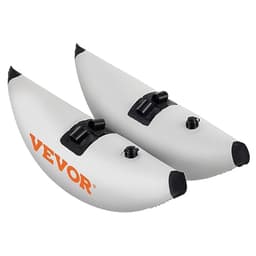
Inflatable floats on an adjustable rod. Deflates into a hatch.
Published specs
| Float size | 35.4" × 14.2" (90 × 36 cm) each |
|---|---|
| Float material | PVC with sealed seams |
| Arms | 2 sidekick arms plus 1 connecting rod, pre-drilled |
| Adjustment | 81.5" to 94" across the connecting rod |
| Package weight | 6.6 lb (3 kg) |
| Included | 2 floats, 2 arms, 1 connecting rod, screws, expansion pipes, bungee straps |
| Not included | A pump — the floats inflate but nothing inflates them |
| Buoyancy | Manufacturer does not publish this |
| Weight capacity | Manufacturer does not publish this |
Our score, broken out
- Flotation7.5
- Mounting6.0
- Stowage9.5
- Value9.0
What it gets right
- It deflates. A rigid outrigger lives in your garage forever; this one rolls into a hatch when you decide you only wanted it for photography days, which makes it the honest way to find out whether you want stabilizers at all.
- 35.4 by 14.2 inches of float is a genuinely large displacement per side, and VEVOR publishes the dimension rather than a marketing adjective.
- It costs a fraction of the rigid systems, which matters on a product a lot of paddlers take off again after one season.
What it gets wrong
- No published buoyancy or weight-capacity figure, so you cannot work out what it will actually hold up before you buy it — the one number that would let you compare stabilizers is the one nobody prints.
- No pump in the box. An inflatable stabilizer with nothing to inflate it is a two-item purchase, and it is not flagged on the listing.
- Inflatable floats puncture. On a rocky launch or an oyster bar that is a real failure mode a rigid float does not have.
Who should skip it
Skip it if you already know you want stabilizers permanently. The mounting hardware here is a rod clamped across the hull rather than a purpose-made deck fitting, and for a permanent install the StarPort-mounted system is the tidier answer.
#2 · The only published buoyancy figure
Scotty 302 Kayak Stabilizer System
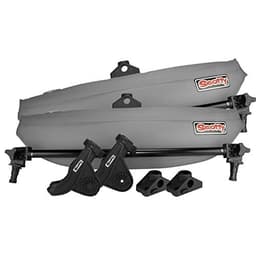
Over 30 lb of published buoyancy, and rod holders in the same box.
Published specs
| Buoyancy | Over 30 lb of extra buoyancy |
|---|---|
| Pontoons | 2 inflatable, rugged PVC with a thick outer shell |
| Arms | 2 anodized aluminum stabilizer arms (28") |
| Rod holders | 2 baitcaster/spinning rod holders (Scotty 279) |
| Mounts | 4 locking side deck mounts (Scotty 241L) |
| SKU | 302 |
| Pontoon dimensions | Manufacturer does not publish this |
Our score, broken out
- Flotation9.0
- Mounting7.0
- Stowage7.0
- Value5.5
What it gets right
- It publishes a buoyancy figure — over 30 lb — and it is the only system on this page that does. In a category where every other listing describes flotation with an adjective, that single number is the reason this is here.
- Anodized aluminum arms rather than plated steel, which is the difference between hardware that survives salt and hardware that stains the deck by August.
- The 241L side deck mounts are standard Scotty fittings, so the same four holes later take a rod holder, a light or a camera arm from the range you may already own.
What it gets wrong
- It is by a wide margin the most expensive thing on this page, and a large fraction of that price is two rod holders you may already have.
- Scotty publishes no pontoon dimensions, so the 30 lb figure cannot be sanity-checked against float volume.
- Four locking deck mounts means four bolted fittings per side. This is the most permanent installation here and the hardest to undo on a boat you might resell.
Who should skip it
Skip it if you do not want the rod holders. You are paying for a fishing package, and a paddler who wants stability for photography or a nervous passenger is buying two accessories they will never clip in.
#3 · A boat you already track-mounted
YakGear Standncast Outriggers (Gen II)
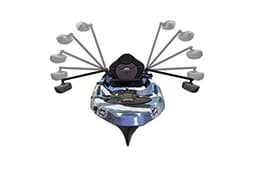
30-inch arms on a StarPort HD base, and the arms lift out of the way.
Published specs
| Arms | 30" adjustable outrigger arms |
|---|---|
| Float stance | Float base roughly 22" from each side of the hull |
| Mounting | RAILBLAZA StarPort HD base included |
| Float thread | Pre-installed 1/4 × 20 brass insert |
| Quantity | 2 outriggers — one port, one starboard |
| Weight guidance | Best for total weights under 350 lb |
| Canoe fitting | Needs a piece of Hardie board, not included |
| Stated limit | Not intended for use in surf conditions |
| Float dimensions | Manufacturer does not publish this |
Our score, broken out
- Flotation7.0
- Mounting9.0
- Stowage5.5
- Value7.0
What it gets right
- The arms raise independently, so you can lift one clear at a dock or in weed without unbolting anything. On a product whose main complaint is that it is always in the way, that is the feature that matters.
- It mounts on a RAILBLAZA StarPort HD, which is included — and if your boat already carries StarPort sockets from a rod holder, the outriggers drop onto fittings you own rather than costing new holes.
- YakGear publishes a weight guidance figure (under 350 lb total) and a stated limitation (not for surf). Almost nothing else in this category publishes either.
What it gets wrong
- No published float dimensions or material, so the flotation comparison against the inflatables is guesswork.
- Canoe owners need a piece of Hardie board that is not in the box, which is an odd thing to discover after ordering.
- It is several times the price of an inflatable set, and it does not pack down — the arms and floats are rigid and live somewhere all year.
Who should skip it
Skip it if you have no StarPort fittings and no intention of drilling for them. The included base still has to be bolted to the deck, and on a hull you are trying not to add holes to that is the whole cost.
FAQ
Questions people actually ask
Do kayak stabilizers actually work?
Yes, for what they actually do: they resist the last few degrees of a lean, which stops a tippy boat feeling like it is about to go and holds it upright while you land a fish one-handed. Scotty publishes over 30 lb of extra buoyancy for its 302 system — the only flotation figure any maker on this page prints.
What they do not do is make a kayak a standing platform on their own, replace a life jacket, or fix a boat that feels tippy because an aftermarket seat raised your center of gravity. That last one is the most common cause and it is free to fix.
Do outriggers slow a kayak down?
Yes, noticeably, and more if you set them wrong. Floats adjusted so they touch the water at rest are dragging on every stroke and have effectively turned the kayak into a slow trimaran.
Set them a couple of inches clear of the surface so the boat sits on its own hull and the floats only engage when you lean. You still lose speed to the extra beam and the arms, but far less than with floats permanently in the water.
Are inflatable or rigid kayak outriggers better?
It mostly comes down to storage. Inflatable floats — VEVOR's and Scotty's pontoons — deflate into a hatch, which matters on a deck already carrying a crate and a cooler, and they make the cheap inflatable set the honest way to test whether you want stabilizers at all. They can also puncture on a rocky launch.
Rigid floats such as YakGear's cannot go flat and are ready the moment you clip them on, but they take up the same garage space all year whether you used them or not. Note that VEVOR does not include a pump.
Can you use kayak stabilizers in a river or surf?
No. YakGear states plainly that its outriggers are not intended for use in surf, and the reasoning extends to current: an outrigger that catches becomes a lever applying a capsizing force rather than resisting one.
It is the same mechanism that makes anchoring a kayak from the side dangerous. Stabilizers are flat-water equipment.
Will kayak stabilizers put holes in my boat?
Usually, and that is the part that lasts after the floats come off. VEVOR's connecting rod clamps across the hull, which is the least permanent option but puts a rod where your legs and rod tips want to be. YakGear mounts on a RAILBLAZA StarPort HD, which is included but still has to be bolted down unless the boat already carries StarPort sockets.
Scotty's kit includes four 241L locking side deck mounts — the most permanent install here, and also the most reusable, since a 241L later takes a rod holder or a camera arm. Whatever you fit, back the fittings properly: an outrigger loads hardware sideways, which is the direction that pulls it out of soft polyethylene.
We have not paddled with any of this gear. Everything above comes from published specifications, cited manuals and live retailer prices. Here is exactly how we pick.
Sources
Read next
Related on Drift & Dime
Outfitting
The best kayak gear tracks and accessory railsTracks and rails compared on the hardware standard they accept, not the marketing.
Outfitting
The best kayak seat upgradesSeats and cushions matched to the actual complaint — pressure or support.
Fishing Rigging
Rigging a used fishing kayakSealing inherited holes, reusing bolt patterns, and no-drill rigging.
Racks & Transport
The best kayak storage racksWall racks and slings compared on published capacity and hull support.