Fishing Rigging
Rigging a used fishing kayak
The previous owner took the rod holders and left the holes. Here is how to seal what they left, reuse what you can, and add the rest without drilling anything new.
Disclosure: we earn a commission if you buy through the links on this page, at no extra cost to you. It does not change which products we pick or how we rank them. How this site is funded.
The short answer
Quick picks
Ranked for the person outfitting a used boat: what it costs, what it does, and who should skip it. 4 picks.
| # | Product | Best for | Our score | Price |
|---|---|---|---|---|
| 1 |  Scotty 230 Powerlock1.95" interior, 360° rotation, locking ring. The default holder. Scotty 230 Powerlock1.95" interior, 360° rotation, locking ring. The default holder. | Most rods | 8.6 | $24.95View on Amazon |
| 2 |  RAILBLAZA Rod Holder II & StarPort HD360° around, 90° vertical, and the base is in the box. RAILBLAZA Rod Holder II & StarPort HD360° around, 90° vertical, and the base is in the box. | Holder and base together | 8.6 | $40.00View on Amazon |
| 3 | Harmony Scupper StoppersTapered rubber, 0.875" to 1.5", with tether holes in the tabs. | Wilderness Systems hulls | 8.1 | Check price on Amazon |
| 4 | 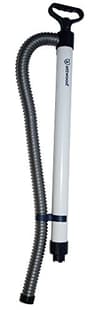 Attwood Hand Bilge PumpUp to 8 gpm, floating grip. The one that empties a swamped boat. Attwood Hand Bilge PumpUp to 8 gpm, floating grip. The one that empties a swamped boat. | Getting water out | 8.2 | $39.99View on Amazon |
Start by finding every hole
A used fishing kayak arrives stripped. The seller took the rod holders, the fish finder, the transducer mount and probably the seat — and left every hole those things were bolted through. Replacing the electronics is the most expensive of those and the least urgent, and the honest cost of a working install — battery, box, transducer arm, mount — is on the budget fish finder roundup.
Before you add anything, go over the deck systematically. Look at the gunwales, behind the seat, in the tankwell, and around the bow hatch. Include holes that still have a bolt in them, because a bolt without sealant is still a leak.
Then check whether water is already inside. Lift the bow and listen for sloshing. Water in the hull cavity means an existing leak, and finding it now is much easier than finding it in August. The full inspection is on what to fix on a used kayak.
Seal what you are not going to use
Every abandoned hole gets closed. Two options:
A plastic hole plug bedded in marine sealant, for holes you will never want back.
A stainless bolt with a rubber well nut, also bedded in sealant, for holes you might use later. A well nut expands as you tighten it, which both seals and grips from one side — useful in places you cannot reach behind.
Do this before the first trip. A slow leak into the hull is exactly the fault that is annoying to trace once the boat is wet all the time anyway.
Measure before you drill: you may not need to
This is the trick worth knowing. Manufacturers publish their bolt patterns.
Scotty publishes 1 5/16 inch by 3 3/16 inch for the 230 Powerlock’s side/deck mount, along with overall mount dimensions of 4 by 2 by 2 inches. Measure the holes the previous owner left. If they match, you fit a new holder into an existing pattern and the boat gains no new holes at all.
This is common in practice, because Scotty mounts are the default in kayak fishing and a lot of used boats were rigged with them.
The no-drill rigging that covers most of it
The gear track, if the boat has one. Most fishing kayaks made in the last decade have at least one length of accessory track. Track-mounted holders, camera arms and fish finder mounts slide on in seconds, move between boats, and need nothing drilled. RAM publishes track-compatible bases for exactly this. A boat without a track can have one added for one set of holes, which is the whole argument in the gear track and accessory rail roundup.
The crate. A milk crate strapped into the tankwell, with rod tubes or a bolted holder attached to the crate rather than to the hull, gives you most of a rigged fishing boat with zero holes. The crate setup covers it in full, and it is the single best move on a boat you might resell.
Existing deck rigging. Bungees and deck lines are attachment points you already own. If they are perished — and on a used boat they usually are — replacing all the cord is cheap and restores the places you stow things.
If you do drill, do it once
- Check you can reach behind before making the hole, not after. Well nuts and rivet nuts exist for blind locations, but that changes your hardware choice.
- Mark, then measure again. Sit in the boat with a rod and check the position is actually reachable and does not foul your paddle stroke. This is the step people skip.
- Stainless hardware, large backing washers or a backing plate. A small washer against soft polyethylene pulls through under load.
- Marine sealant on every bolt, both sides.
- Snug, not tight. Polyethylene creeps under sustained pressure. Re-check after the first trip.
Rig in this order
1. Seal the old holes. Before anything else.
2. Fit a seat, or fix the one that came with it. Comfort determines how long you stay out, and a used boat frequently has a perished strap or a cracked buckle rather than a dead seat.
3. Add the crate. Instant storage, instant rod tubes, no holes.
4. One rod holder in the working position, on the track if there is one, on the crate if there is not.
5. Anchoring, once you know whether you fish shallow or deep.
6. An anchor trolley, eventually. It is genuinely useful and it is a job to do when you know where you want the attachment points — which is after a season on the water, not before.
What is deliberately not on that list is outriggers, which is where a lot of people start. A rigged boat sits differently from an empty one, and a crate and a cooler in the wrong place account for most of the tippiness that sends anglers shopping for stabilizers. Rig the boat, fish it for a season, and then decide — if you still want to stand and cast, that page covers what each mounting system costs a second-hand deck.
Two things specific to used boats
Scupper plugs will be perished. If the previous owner left them in for years, the rubber is hard and cracked. Cheap to replace, and worth understanding before you refit them — see scupper plugs.
Carry a bilge pump. A boat that has had water inside it once will again. Attwood publishes up to 8 gallons per minute for its hand pump, and it belongs under a deck bungee within reach rather than in a hatch.
In full
Every pick, in detail
Specs below are the manufacturer's published figures, cited per product. Where a maker does not publish a number, the row says so rather than guessing at it.
#1 · Most rods
Scotty 230 Powerlock
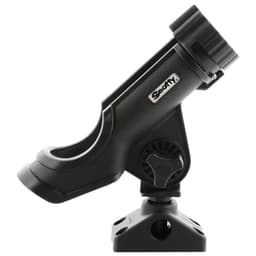
1.95" interior, 360° rotation, locking ring. The default holder.
Published specs
| Interior diameter | 1.95" |
|---|---|
| Mount dimensions | 4" × 2" × 2" |
| Bolt pattern | 1 5/16" × 3 3/16" |
| Rotation | 360° horizontal, adjustable up and down |
| Material | Fiber-reinforced engineering-grade nylon |
| Included | #241 side/deck mount |
Our score, broken out
- Mount8.0
- Adjustability9.5
- Build8.5
- Value8.5
What it gets right
- The front locking ring is the difference between a rod holder and a rod launcher. Open-style holders without one lose rods.
- Publishes its bolt pattern, so you can check it against your existing holes before you drill new ones.
- The mount is in the box. Scotty holders sold without a mount are a common and annoying surprise.
What it gets wrong
- Mounting means drilling the deck, and every hole is a potential leak.
- The open cradle collects grit; it needs rinsing.
Who should skip it
Skip it if your kayak has a factory gear track. A track-mounted holder gives you the same function with zero holes in the hull, and holes in a used boat are the thing you are trying to stop, not start.
#2 · Holder and base together
RAILBLAZA Rod Holder II & StarPort HD
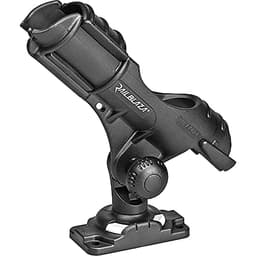
360° around, 90° vertical, and the base is in the box.
Published specs
| Type | Rod holder supplied with its StarPort HD base |
|---|---|
| Adjustment | 360° rotation, 90° vertically |
| Reels | Baitcaster, spinning, offshore and fly |
| Material | UV-stabilized fiberglass-reinforced plastic |
| Weight | 0.86 lb for the kit |
| Parts list | 1 × Rod Holder II; 1 × StarPort HD |
Our score, broken out
- Mount9.0
- Adjustability9.0
- Build8.5
- Value8.0
What it gets right
- The base is in the box, so the price you see is the finished holder rather than one part of a system you keep buying.
- RAILBLAZA publishes the StarPort HD as a rectangular four-point base that lines up with many Scotty, RAM and Cannon patterns, which on a used boat often means mounting to holes somebody already made.
- 360° of rotation and 90° of vertical movement are published figures, so you aim the rod at the cast you are making instead of accepting one fixed angle.
What it gets wrong
- It still needs four fixings. If the previous owner's pattern does not line up, this is a drilled mount like any other.
- Once the base is down it is one fixed position. Sliding a holder fore and aft mid-session is a track's job, not a socket's.
Who should skip it
Skip it if the cheapest holder that does the job is the point. The Scotty holds a rod for less, and its published bolt pattern is the one a used boat is most likely to already carry.
#3 · Wilderness Systems hulls
Harmony Scupper Stoppers
Tapered rubber, 0.875" to 1.5", with tether holes in the tabs.
Published specs
| Fits | Sit-on-top kayaks with 1"–1 3/8" scupper holes |
|---|---|
| Plug taper | 0.875" at the tip rising to 1.5" at the top |
| Material | Pliable rubber |
| Tabs | Finger tabs, pre-drilled for tethering |
| Compatibility | Wilderness Systems sit-on-tops incl. Tarpon and Ride, 2007 onward |
| Pack | 4 |
Our score, broken out
- Fit8.0
- Material7.5
- Retention8.5
- Value8.5
What it gets right
- The taper is the reason these work across a range of hole sizes instead of fitting exactly one hull.
- Pre-drilled tabs mean you can tether them. Untethered scupper plugs are consumables.
What it gets wrong
- Only rated for 1"–1 3/8" holes — measure yours before ordering.
- Rubber perishes in UV. These are a repeat purchase, not a lifetime part.
Who should skip it
Skip them entirely if you paddle in surf or moving water. Scuppers exist to drain the boat; plugging them keeps you drier in flat water and keeps the water IN when a wave puts it there.
#4 · Getting water out
Attwood Hand Bilge Pump
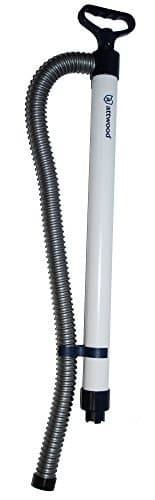
Up to 8 gpm, floating grip. The one that empties a swamped boat.
Published specs
| Flow | Up to 8 gallons per minute |
|---|---|
| Grip | Floating |
| Body | Plastic |
| Hose | Removable 32" discharge hose |
Our score, broken out
- Flow9.5
- Ergonomics8.0
- Stowage6.5
- Value8.5
What it gets right
- 8 gpm is an order of magnitude above the small kayak hand pumps, and volume is the entire point of a bilge pump.
- A floating grip means dropping it in the water is an inconvenience rather than a loss.
What it gets wrong
- The pump body plus a 32" hose is a lot of length for a small cockpit — check it stows where you can reach it while seated.
- Plastic construction; the shaft is the failure point if you lean on it.
Who should skip it
Skip it if it will live in a hatch. A bilge pump you cannot reach while sitting in a swamped boat is decoration. Deck-bungee it or do not buy it.
FAQ
Questions people actually ask
How do I fix the holes left by the previous owner on a kayak?
A plastic hole plug bedded in marine sealant for holes you will never want back, or a stainless bolt with a rubber well nut — also bedded in sealant — for holes you might reuse later.
A well nut expands as you tighten it, which seals and grips from one side, so it works where you cannot reach behind the deck. Do this before the first trip.
Can I reuse the old rod holder holes on a used kayak?
Often, yes. Scotty publishes the bolt pattern for its 230 Powerlock mount as 1 5/16 by 3 3/16 inches, so you can measure the previous owner's holes and see whether a new holder lands on them.
Scotty mounts are the default in kayak fishing, so a lot of used boats were rigged with them and the pattern matches more often than you would expect.
How do I install kayak deck rigging?
On most boats you are replacing cord through fittings that already exist rather than making new ones. Perished bungee is the usual problem on a used hull — elastic dies in UV, and ten-year-old cord has no stretch left.
Run fresh cord through the existing padeyes and finish the ends with a simple knot or a crimp. If a padeye itself has pulled out, refit it with stainless hardware, a large backing washer and marine sealant on both sides.
We have not paddled with any of this gear. Everything above comes from published specifications, cited manuals and live retailer prices. Here is exactly how we pick.
Sources
Read next
Related on Drift & Dime
Outfitting
What to fix on a used kayakWhat matters on a second-hand hull, what is cosmetic, and what to walk away from.
Fishing Rigging
The kayak crate setupBuilding a crate: rod tubes, tackle, strapping — and no holes in the hull.
Fishing Rigging
The best budget kayak rod holdersHolders compared on locking ring, published bolt pattern and mounting.
Kits
The used kayak rescue kitFor a neglected hull: what perished, what is missing, what to check first.