Fishing Rigging
The best budget kayak rod holders
The front locking ring is the difference between a rod holder and a rod launcher. And on a used boat, the best holder is the one that needs no new holes.
Disclosure: we earn a commission if you buy through the links on this page, at no extra cost to you. It does not change which products we pick or how we rank them. How this site is funded.
The short answer
Quick picks
Ranked for the person outfitting a used boat: what it costs, what it does, and who should skip it. 2 picks.
| # | Product | Best for | Our score | Price |
|---|---|---|---|---|
| 1 |  Scotty 230 Powerlock1.95" interior, 360° rotation, locking ring. The default holder. Scotty 230 Powerlock1.95" interior, 360° rotation, locking ring. The default holder. | Most rods | 8.6 | $24.95View on Amazon |
| 2 |  RAILBLAZA Rod Holder II & StarPort HD360° around, 90° vertical, and the base is in the box. RAILBLAZA Rod Holder II & StarPort HD360° around, 90° vertical, and the base is in the box. | Holder and base together | 8.6 | $40.00View on Amazon |
Before you buy: stop drilling
Every hole in a kayak deck is a potential leak and a permanent decision. On a used boat you have probably inherited somebody else’s holes already, and adding more before you know how you fish is how a hull ends up looking like a colander.
Three no-drill options, and one of them is almost certainly available to you:
- A factory gear track. Most fishing kayaks built in the last decade have at least one length of accessory track. Track mounts slide on in seconds, move between boats, and leave no holes. If yours has none, adding one costs a single set of holes — which track to buy, and what hardware it accepts.
- A crate with rod tubes. A milk crate behind the seat with tubes attached to it holds rods and tackle and touches the hull not at all. It is also the cheapest rigging on this site — see the crate setup.
- Existing holes from removed hardware. Scotty publishes the bolt pattern for its 230 mount — 1 5/16" by 3 3/16" — so you can measure the previous owner’s holes and see whether a new holder lands on them.
The locking ring is the product
Open-style rod holders come in two kinds: those with a front locking ring and those that eventually launch a rod into the lake.
The scenario is specific and common. A rod sits in an open cradle. A fish hits, or you hit a wake, and the rod jumps up and out. Without a ring across the front there is nothing holding it in.
Scotty’s 230 publishes a front locking ring and a 1.95-inch interior diameter, which takes essentially any reel you would use from a kayak. That combination — wide enough for a baitcaster, closed enough to retain — is why it is the default holder in kayak fishing.
Fixed mount or ball joint
The two philosophies here suit different kinds of fishing.
A fixed mount that rotates — the Scotty 230 with its published 360-degree horizontal rotation and up-and-down adjustment — is set once and largely left. It is the right choice for holding a rod while you paddle, and for trolling.
A holder that aims — the RAILBLAZA Rod Holder II approach — publishes 360 degrees of rotation and 90 degrees of vertical movement. You aim the rod for the cast you are actually making, and you can drop it out of the way to land a fish. It costs more than the Scotty, but the StarPort HD base is in the box rather than a part you buy afterwards.
If you paddle to a spot and then fish, the aiming is worth paying for. If you troll, or you just want the rod out of your hands while you move, the Scotty does the job for less.
Mount types, and what each costs you
| Mount | Holes needed | Best for |
|---|---|---|
| Track mount | None | Any boat with a factory gear track |
| Side/deck mount (e.g. Scotty #241) | Bolted, published pattern | A permanent, known position |
| Flush mount | One large cut plus bolts | Trolling; the cleanest look |
| Crate-mounted tube | None | Used boats, and anyone who may resell |
The flush mount is the tidiest and the least reversible. It is a good choice on a boat you intend to keep for a decade and a poor one on a second-hand hull you might move on in two years.
Fitting a bolted mount properly
If you do drill, do it once and do it right:
- Reach behind first. Confirm you can get a hand or a tool to the underside. Rivet nuts and well nuts exist for places you cannot reach, but you need to know before you make the hole.
- Use stainless hardware with large backing washers or a backing plate. A small washer against soft polyethylene will pull through under load.
- Bed everything in marine sealant. Every bolt, both sides. A dry bolt through a hull is a slow leak from day one.
- Do not overtighten. Polyethylene creeps. Snug, then re-check after the first trip.
How many, and where
Two behind the seat, one within reach in front, is the arrangement most kayak anglers converge on. Rear holders store rods while you paddle; the forward one is the working position.
Resist mounting more than you need. Every holder is another thing to catch a line on when you are landing a fish, and rod holders are exactly the kind of accessory people fit four of and use one.
Rigging the rest of a stripped fishing boat is on rigging a used fishing kayak.
In full
Every pick, in detail
Specs below are the manufacturer's published figures, cited per product. Where a maker does not publish a number, the row says so rather than guessing at it.
#1 · Most rods
Scotty 230 Powerlock
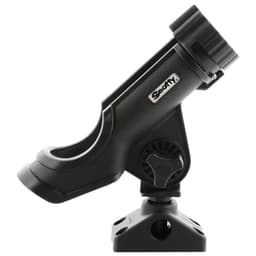
1.95" interior, 360° rotation, locking ring. The default holder.
Published specs
| Interior diameter | 1.95" |
|---|---|
| Mount dimensions | 4" × 2" × 2" |
| Bolt pattern | 1 5/16" × 3 3/16" |
| Rotation | 360° horizontal, adjustable up and down |
| Material | Fiber-reinforced engineering-grade nylon |
| Included | #241 side/deck mount |
Our score, broken out
- Mount8.0
- Adjustability9.5
- Build8.5
- Value8.5
What it gets right
- The front locking ring is the difference between a rod holder and a rod launcher. Open-style holders without one lose rods.
- Publishes its bolt pattern, so you can check it against your existing holes before you drill new ones.
- The mount is in the box. Scotty holders sold without a mount are a common and annoying surprise.
What it gets wrong
- Mounting means drilling the deck, and every hole is a potential leak.
- The open cradle collects grit; it needs rinsing.
Who should skip it
Skip it if your kayak has a factory gear track. A track-mounted holder gives you the same function with zero holes in the hull, and holes in a used boat are the thing you are trying to stop, not start.
#2 · Holder and base together
RAILBLAZA Rod Holder II & StarPort HD
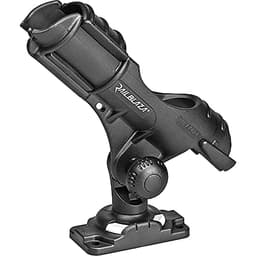
360° around, 90° vertical, and the base is in the box.
Published specs
| Type | Rod holder supplied with its StarPort HD base |
|---|---|
| Adjustment | 360° rotation, 90° vertically |
| Reels | Baitcaster, spinning, offshore and fly |
| Material | UV-stabilized fiberglass-reinforced plastic |
| Weight | 0.86 lb for the kit |
| Parts list | 1 × Rod Holder II; 1 × StarPort HD |
Our score, broken out
- Mount9.0
- Adjustability9.0
- Build8.5
- Value8.0
What it gets right
- The base is in the box, so the price you see is the finished holder rather than one part of a system you keep buying.
- RAILBLAZA publishes the StarPort HD as a rectangular four-point base that lines up with many Scotty, RAM and Cannon patterns, which on a used boat often means mounting to holes somebody already made.
- 360° of rotation and 90° of vertical movement are published figures, so you aim the rod at the cast you are making instead of accepting one fixed angle.
What it gets wrong
- It still needs four fixings. If the previous owner's pattern does not line up, this is a drilled mount like any other.
- Once the base is down it is one fixed position. Sliding a holder fore and aft mid-session is a track's job, not a socket's.
Who should skip it
Skip it if the cheapest holder that does the job is the point. The Scotty holds a rod for less, and its published bolt pattern is the one a used boat is most likely to already carry.
FAQ
Questions people actually ask
Do I have to drill holes for kayak rod holders?
No. If the boat has a factory gear track, track-mounted holders slide on with no holes and move between boats. A milk crate behind the seat with rod tubes attached does the same job and touches the hull not at all.
If you do drill, check the previous owner's holes first — Scotty publishes its 230 mount bolt pattern as 1 5/16 by 3 3/16 inches, so you can measure before making new ones.
What is the best rod holder for a kayak?
For most people, a fixed holder with a front locking ring. Scotty's 230 publishes a 1.95 inch interior diameter that takes essentially any reel, 360-degree horizontal rotation, and the locking ring that stops a rod jumping out over a wake.
If you fish actively from the seat rather than trolling, RAILBLAZA publishes 360 degrees of rotation and 90 degrees of vertical movement for its Rod Holder II, which ships with its StarPort HD base for rather more than the Scotty costs.
How many rod holders do I need on a kayak?
Two behind the seat and one within reach in front is where most kayak anglers end up. The rear pair store rods while you paddle; the forward one is the working position.
More than that is usually a mistake. Every holder is another thing to catch a line on while you are landing a fish.
We have not paddled with any of this gear. Everything above comes from published specifications, cited manuals and live retailer prices. Here is exactly how we pick.
Sources
Read next
Related on Drift & Dime
Fishing Rigging
Rigging a used fishing kayakSealing inherited holes, reusing bolt patterns, and no-drill rigging.
Fishing Rigging
The kayak crate setupBuilding a crate: rod tubes, tackle, strapping — and no holes in the hull.
Fishing Rigging
The kayak fishing accessories checklistWhat to buy to fish from a kayak, in the order that wastes least money.
Outfitting
What to fix on a used kayakWhat matters on a second-hand hull, what is cosmetic, and what to walk away from.