Outfitting
Kayak scupper plugs, and when not to use them
Those holes through the hull are a feature. Plugging them is right on a calm lake and wrong in surf, and the difference is a safety one rather than a preference.
Disclosure: we earn a commission if you buy through the links on this page, at no extra cost to you. It does not change which products we pick or how we rank them. How this site is funded.
The short answer
Quick picks
Ranked for the person outfitting a used boat: what it costs, what it does, and who should skip it. 2 picks.
| # | Product | Best for | Our score | Price |
|---|---|---|---|---|
| 1 | Harmony Scupper StoppersTapered rubber, 0.875" to 1.5", with tether holes in the tabs. | Wilderness Systems hulls | 8.1 | Check price on Amazon |
| 2 |  Attwood Hand Bilge PumpUp to 8 gpm, floating grip. The one that empties a swamped boat. Attwood Hand Bilge PumpUp to 8 gpm, floating grip. The one that empties a swamped boat. | Getting water out | 8.2 | $39.99View on Amazon |
What scuppers are for
One clarification before anything else, because it is the most common confusion in this corner of the site: scupper plugs are a sit-on-top product. The sit-in equivalent — sealing a cockpit against rain and spray — is a spray skirt, and that is a completely different purchase covered on the spray skirt guide.
If you have a sit-on-top, there are holes running right through the hull from the deck to the water. They are not damage and they are not a manufacturing shortcut. They are drains.
A sit-on-top has no cockpit, so any water that comes over the side has to leave somewhere. Scuppers are that somewhere: water flows out under its own weight, continuously, without you doing anything. It is the single design feature that makes a sit-on-top nearly unsinkable and self-recovering.
Plugging them stops the drainage in both directions.
The one-sentence rule
Plug them on flat, calm water if you dislike a wet backside. Take them out for anything with waves, current or surf.
On a still lake in light wind, very little water comes in over the side, and what does come up through the scuppers is just wetting you for no benefit. Plug them and stay dry.
In waves or moving water, water will come over the side. With the scuppers open it drains straight back out. With them plugged it stays in, and the boat gets heavier, lower and less stable with each wave. That is the point at which this stops being a comfort preference.
Sizing: measure, because there is no universal plug
Scupper holes are not standardized across manufacturers, and this is the most common reason a set of plugs arrives and does not fit.
Harmony publishes a fit range of 1 inch to 1 3/8 inch scupper holes for its stoppers, achieved with a taper: the plug measures 0.875 inches at the tip and rises to 1.5 inches at the top, so it wedges at whatever diameter your hull uses within that band. It also publishes compatibility with Wilderness Systems sit-on-tops including all Tarpon and Ride models from 2007 onward.
Measure your holes with a ruler across the widest point of the opening on the deck side before ordering. Two minutes, and it is the difference between plugs that seal and plugs that pop out or fall through.
Fitting them so they stay in
Push firmly until the taper wedges. It should take a bit of effort; a plug that drops in easily will come out on its own.
Tether them. Harmony publishes pre-drilled holes in the finger tabs for exactly this. Run a short length of cord from each plug to a nearby fitting. Untethered scupper plugs are a consumable rather than a purchase — they work loose, they float off, and you replace the set every season.
The tab points up. The finger tab is how you get them out, usually while sitting in the boat with wet hands. Fitted the wrong way round they are genuinely difficult to remove afloat.
Which holes to plug, and which to leave
You do not have to plug all of them, and often you should not.
A common arrangement on a fishing sit-on-top: plug the scuppers under the seat, where the water comes up and wets you, and leave the ones in the footwell and the tankwell open so the boat still drains where water actually collects.
That gets you a dry backside and keeps most of the self-draining behavior. It is a better default than all-in or all-out.
They are also a load-dependent decision
Scuppers only push water up onto the deck when the boat sits low enough for them to be below the waterline. That depends on how heavily loaded it is.
An empty boat with a light paddler often does not need plugs at all — the deck sits above the water and nothing comes up. The same boat with a heavier paddler, a full crate, an anchor and a cooler sits several inches lower, and now the scuppers are underwater and pushing up.
So if you have loaded the boat and are suddenly getting wet, the answer may be less gear rather than more plugs.
The related failure on a used boat
On a second-hand sit-on-top, check the scupper tubes themselves. The tube is the molded plastic sleeve that runs through the hull, and it is a genuine weak point — a cracked tube means water enters the hull cavity rather than passing through it, and the boat slowly fills with water you cannot see.
Symptoms: the boat gets heavier over a season, sloshing when you tip it, and it never quite dries out. Details on what to fix on a used kayak, and if the hull has taken on water you want a bilge pump aboard.
In full
Every pick, in detail
Specs below are the manufacturer's published figures, cited per product. Where a maker does not publish a number, the row says so rather than guessing at it.
#1 · Wilderness Systems hulls
Harmony Scupper Stoppers
Tapered rubber, 0.875" to 1.5", with tether holes in the tabs.
Published specs
| Fits | Sit-on-top kayaks with 1"–1 3/8" scupper holes |
|---|---|
| Plug taper | 0.875" at the tip rising to 1.5" at the top |
| Material | Pliable rubber |
| Tabs | Finger tabs, pre-drilled for tethering |
| Compatibility | Wilderness Systems sit-on-tops incl. Tarpon and Ride, 2007 onward |
| Pack | 4 |
Our score, broken out
- Fit8.0
- Material7.5
- Retention8.5
- Value8.5
What it gets right
- The taper is the reason these work across a range of hole sizes instead of fitting exactly one hull.
- Pre-drilled tabs mean you can tether them. Untethered scupper plugs are consumables.
What it gets wrong
- Only rated for 1"–1 3/8" holes — measure yours before ordering.
- Rubber perishes in UV. These are a repeat purchase, not a lifetime part.
Who should skip it
Skip them entirely if you paddle in surf or moving water. Scuppers exist to drain the boat; plugging them keeps you drier in flat water and keeps the water IN when a wave puts it there.
#2 · Getting water out
Attwood Hand Bilge Pump
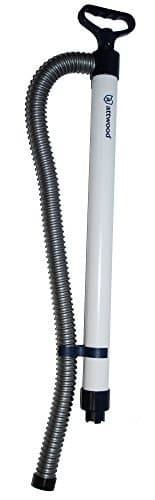
Up to 8 gpm, floating grip. The one that empties a swamped boat.
Published specs
| Flow | Up to 8 gallons per minute |
|---|---|
| Grip | Floating |
| Body | Plastic |
| Hose | Removable 32" discharge hose |
Our score, broken out
- Flow9.5
- Ergonomics8.0
- Stowage6.5
- Value8.5
What it gets right
- 8 gpm is an order of magnitude above the small kayak hand pumps, and volume is the entire point of a bilge pump.
- A floating grip means dropping it in the water is an inconvenience rather than a loss.
What it gets wrong
- The pump body plus a 32" hose is a lot of length for a small cockpit — check it stows where you can reach it while seated.
- Plastic construction; the shaft is the failure point if you lean on it.
Who should skip it
Skip it if it will live in a hatch. A bilge pump you cannot reach while sitting in a swamped boat is decoration. Deck-bungee it or do not buy it.
FAQ
Questions people actually ask
Should I use scupper plugs in my kayak?
On flat, calm water, yes if you dislike a wet backside — very little water comes over the side, so the scuppers are only wetting you for no benefit.
In waves, current or surf, take them out. Water will come over the side, and with plugs in it stays in. The boat gets heavier, lower and less stable with each wave, which is a safety issue rather than a comfort preference.
What size scupper plugs do I need?
Measure the widest point of your scupper openings on the deck side, because sizes are not standardized across manufacturers.
Harmony publishes a 1 inch to 1 3/8 inch fit range, achieved by a taper that measures 0.875 inches at the tip and 1.5 inches at the top so it wedges at whatever diameter is within that band.
Do I have to plug all the scupper holes?
No, and often you should not. A common arrangement on a fishing sit-on-top is to plug the scuppers under the seat, where water comes up and wets you, and leave the footwell and tankwell holes open so the boat still drains where water collects.
That keeps a dry seat and most of the self-draining behavior.
Why is water coming up through my scupper holes?
Because the deck is sitting below the waterline, which is a load question. An empty boat with a light paddler often has its scuppers above the water and nothing comes up at all.
Add a heavier paddler, a full crate, an anchor and a cooler and the same boat sits several inches lower, putting the scuppers underwater. If you have loaded the boat and are suddenly getting wet, the fix may be less gear rather than more plugs.
We have not paddled with any of this gear. Everything above comes from published specifications, cited manuals and live retailer prices. Here is exactly how we pick.
Sources
Read next
Related on Drift & Dime
Outfitting
What to fix on a used kayakWhat matters on a second-hand hull, what is cosmetic, and what to walk away from.
Outfitting
The kayak bilge pump guideFlow rates compared, and why stowage decides whether a pump is any use.
Fishing Rigging
Rigging a used fishing kayakSealing inherited holes, reusing bolt patterns, and no-drill rigging.
Kits
The used kayak rescue kitFor a neglected hull: what perished, what is missing, what to check first.