PFDs & Safety
The best kayak lights
The legal minimum is a flashlight you switch on in time. Being seen is a white light held up above your head, all the way around, and that is what these are ranked on.
Disclosure: we earn a commission if you buy through the links on this page, at no extra cost to you. It does not change which products we pick or how we rank them. How this site is funded.
The short answer
Quick picks
Ranked for the person outfitting a used boat: what it costs, what it does, and who should skip it. 3 picks.
| # | Product | Best for | Our score | Price |
|---|---|---|---|---|
| 1 | 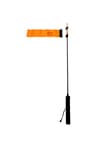 YakAttack VISIPole IIAn LED on a fiberglass mast with a flag, 100 hours on batteries that come in the box. The sensible default for a boat with a track. YakAttack VISIPole IIAn LED on a fiberglass mast with a flag, 100 hours on batteries that come in the box. The sensible default for a boat with a track. | A light up on a mast, for less | 8.0 | $76.95View on Amazon |
| 2 | 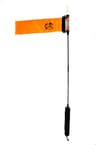 YakAttack VISICarbon ProA carbon mast that runs 48 inches deployed and 14 collapsed, stores inside its own flag, and floats. The one to buy if the light cannot stay on the boat. YakAttack VISICarbon ProA carbon mast that runs 48 inches deployed and 14 collapsed, stores inside its own flag, and floats. The one to buy if the light cannot stay on the boat. | Packing it away between trips | 7.9 | $96.95View on Amazon |
| 3 |  RAILBLAZA Illuminate i360An all-round white light that twists into any StarPort. The least expensive light here, and the lowest-mounted unless you put it on a pole. RAILBLAZA Illuminate i360An all-round white light that twists into any StarPort. The least expensive light here, and the lowest-mounted unless you put it on a pole. | Boats that already have RAILBLAZA ports | 6.5 | $54.32View on Amazon |
What the rule actually asks for
The Coast Guard’s Navigation Center is explicit that kayaks and canoes are vessels under oars, and that they are addressed specifically in Rule 25. Between sunset and sunrise, Rule 25 gives a vessel under oars a choice. It may show the lights prescribed for a sailing vessel, “but if she does not, she shall exhibit an all-round white light or have ready at hand an electric torch or lighted lantern showing a white light which shall be exhibited in sufficient time to prevent collision.”
In plain terms, that is three options:
- Sidelights and a sternlight — red and green ahead, white behind, the same as a small sailboat.
- An all-round white light — one white light showing in every direction at once.
- A flashlight or lantern ready at hand, switched on in time to prevent a collision.
The third is the one most paddlers use without realizing it, and it is why the rest of this site says a headlamp meets the legal minimum. It does. The trouble is the phrase “in sufficient time.” A flashlight works when you have seen the other boat first. A light that is already on works when they have not seen you, which on a dark lake with a bass boat running home is the situation that actually matters.
Rule 20 adds one more thing worth knowing: lights you carry are also to be shown from sunrise to sunset in restricted visibility. A foggy dawn launch counts. The full federal list of what has to be in the boat, and what it costs, is on the kayak safety kit checklist.
The number none of these lights publishes
Rule 22 sets a minimum visibility for every kind of light. On a vessel under 12 meters in length — which is every kayak — an all-round light has to be visible for 2 miles.
None of the three lights ranked here publishes a visibility range on its maker’s product page. YakAttack publishes runtime, battery type and, for one pole, a waterproof depth. RAILBLAZA publishes runtime, an IP67 rating and the fact that the light floats. Neither prints a distance.
That does not mean the lights fall short. It means you cannot confirm from the maker that they meet the 2-mile figure, and we are not going to imply that they do. The practical answer costs almost nothing: run the all-round light so that you are seen, and keep a waterproof flashlight or headlamp within reach as well. Rule 22’s range table lists masthead, side, stern, towing and all-round lights; the flashlight option in Rule 25 is not on it.
How we ranked these
Four criteria, weighted equally and published on how we pick:
- Height. How far above the deck, and above you, the light sits. Rule 21 defines an all-round light as one showing an unbroken light over 360 degrees of horizon, and a light behind your back at deck level is not unbroken from the front.
- Runtime. The maker’s published battery life, and whether the batteries are in the box.
- Mounting. What your boat needs before the light fits, which on a second-hand hull usually means holes.
- Value. What it costs against the flashlight you already own, which is the legal floor.
Why height is most of the job
Sit in a kayak and the top of your head is the highest point on the boat. A light on the deck behind the seat is below it. From anywhere ahead of you, your head and shoulders sit between that light and the person who needs to see it — and ahead of you is exactly where a boat coming toward you is.
That is why the useful kayak lights are masts. A light on a pole clears the paddler, clears a raised fishing seat, and clears the small chop that can hide a deck-level light from a boat whose driver is only a few feet above the water.
It is also why the least expensive light here scores lowest on height. RAILBLAZA’s i360 twists straight into a port on the deck. RAILBLAZA’s own answer to that is its Visibility Kit II, which pairs the i360 with a three-piece ExtendaPole, an orange flag and a StarPort HD mount — worth knowing if you like the light and not its height.
All-round white, or red and green?
Search for kayak lights and a lot of what comes back is small clip-on red and green lights. Those are sidelights, and on their own they are only half of the sailing-vessel option. Rule 25 describes that option as sidelights and a sternlight. A red and green pair with no white light behind it is not one of the three choices the rule gives you.
For a kayak, a single all-round white light is the simpler answer. One light, one set of batteries, one mount, and it covers every direction at once. All three picks on this page are that kind of light.
Mounting a light on a used boat
Every light here needs something to mount to, and none of the listings we link includes that something. YakAttack lists its poles as GearTrac and MightyMount compatible, and notes an adapter is needed on a few brands of boat. RAILBLAZA lists the i360 as fitting any StarPort, SidePort, RailMount or TracMount.
If the boat already has a factory track, a track-ready pole slides on and costs nothing in holes. If it already carries a RAILBLAZA StarPort from a rod holder or a camera, the i360 twists in the same way. If it has neither, a light costs you one set of holes for a surface mount — and on this site the standing position is that holes in a second-hand hull are a decision, not a detail. The standards, what each one accepts, and how to seat the fitting are on the gear track and accessory rail roundup.
The flashlight option needs no holes at all. For a paddler who is only occasionally on the water after sunset, that is not a compromise; it is the right answer, and the mast is for when evening paddles become a habit.
Deck lights, LED strips and headlamps
A good share of “kayak lights for night” shopping is really about seeing rather than being seen: light to rig by, to fish by, or to find the hatch by. That is a different job, and the rules treat it differently.
Rule 20 says that between sunset and sunrise no other lights shall be shown, except lights that cannot be mistaken for the navigation lights in the rules, do not impair their visibility or distinctive character, and do not interfere with keeping a proper lookout. Colored accent strips — red and green especially — are the obvious way for a small boat to run afoul of the first part of that. A bright white work light pointed ahead of you can run afoul of the last part, by costing you the night vision you need to keep that lookout.
A headlamp is the honest middle. It is the flashlight ready at hand, it lets you tie knots, and on a low setting it is far less likely to dazzle anyone you look toward. Just do not mistake it for the light that keeps you from being run over.
Runtime and batteries
Both YakAttack poles publish the same figure: LEDs that burn 100 hours on three AA batteries, with the batteries included. RAILBLAZA publishes up to 25 hours on high for the i360 and over 200 hours in blink mode, on three AAs that are not included.
For one evening, that difference barely matters. Over a season it does, because the light you forget to check is the light that dies halfway across the lake. Whatever you buy, keep spare batteries in a dry bag and change them before a night paddle rather than during one.
The flag is the daytime half
Both YakAttack poles come with an orange flag, and the VISICarbon Pro collapses so that it stores inside its own. RAILBLAZA sells the i360 in a kit with a flag and a pole. At dawn and dusk, when a small light is hard to pick out against a bright sky, the flag is often the more visible of the two, and on a low sit-on-top in a busy channel it is what a powerboat is most likely to notice in daylight too.
It is the same logic that makes a bright-colored life jacket worth choosing over a dark one. Being seen on the water is mostly a matter of height and contrast, and a kayak has very little of either.
Where the mast goes on the boat
Behind the seat, almost always. A mast in front of you is in the arc of every paddle stroke and every cast, and it puts a light directly in your own line of sight for the whole evening, which is the fastest way to lose the night vision you need to spot other boats.
Behind the seat, a mast tall enough to clear your head does the job from every direction, and it stays out of the way of the paddle. On most fishing sit-on-tops that means the rear track or the area around the tankwell. Check that it clears a crate and a rod holder before you commit to holes, because a light pole that fouls a rod tip on every cast gets taken off and left in the car. How to plan a crate around the rest of the rigging is on the kayak crate setup.
Paddling in a group
The rule is written for a vessel, and every kayak is one. Three friends paddling home together after sunset are three vessels under oars, and each one needs its own light or its own flashlight ready at hand. One bright light in the middle of the group tells an approaching boat that something is there; it does not tell it that there are three boats spread across the width of the channel.
It is the same reason each boat in a group carries its own whistle rather than sharing one. A light in someone else’s kayak is not much use once the group has spread out.
What this costs
In relative terms: the i360 on its own is the least expensive light here. The VISIPole II costs more, and brings batteries, a mast and a flag. The VISICarbon Pro is the most expensive of the three, and what the extra buys is a carbon mast that collapses to 14 inches and floats.
None of them is expensive next to the boat. All of them cost more than the headlamp you probably already own, which is the legal minimum. The honest question is not which light is best in the abstract but how often you are on the water after sunset, and how busy that water is.
What we would buy
If the boat has a track, or you are drilling for one anyway, the VISIPole II. A light up on a mast, a flag, and 100 hours on batteries that come in the box.
If the light cannot stay on the boat — because the kayak lives on a roof rack, or on a rack in a shared garage — the VISICarbon Pro. It collapses to 14 inches, stores inside its flag and floats.
If the boat already carries RAILBLAZA StarPorts, the i360, and get it off the deck on a pole rather than leaving it below your head.
And if you are only out after sunset now and then, a waterproof headlamp you already own meets the rule. Put it on your head, not in a hatch, and switch it on the moment you hear an engine.
In full
Every pick, in detail
Specs below are the manufacturer's published figures, cited per product. Where a maker does not publish a number, the row says so rather than guessing at it.
#1 · A light up on a mast, for less
YakAttack VISIPole II
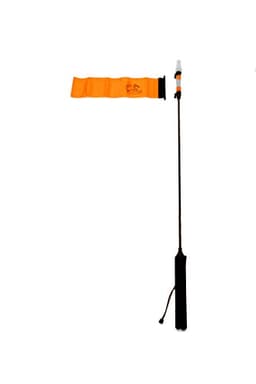
An LED on a fiberglass mast with a flag, 100 hours on batteries that come in the box. The sensible default for a boat with a track.
Published specs
| Mast | 3/8" fiberglass |
|---|---|
| Runtime | LEDs burn 100 hours on 3 AA batteries (included) |
| Lamp life | 10,000+ hours |
| Waterproof | To a depth of 1000 feet |
| Flag | Orange flag included |
| Mounting | MightyMount and GearTrac compatible; mount not included in this version |
| Visibility range | Manufacturer does not publish this |
Our score, broken out
- Height8.0
- Runtime9.0
- Mounting7.0
- Value8.0
What it gets right
- It puts the light on a mast rather than on the deck, which is the whole point: above the paddler, where it can be seen from ahead as well as behind.
- Batteries are in the box, and YakAttack publishes 100 hours on one set of three AAs.
- The orange flag does the daytime half of the job, which on a low sit-on-top in a busy channel matters as much as the light.
What it gets wrong
- No published visibility range. The rule sets 2 miles for an all-round light on a boat this size, and YakAttack does not print a distance, so keep a flashlight within reach as well.
- This version does not include a mount. On a boat with no track, that means buying a MightyMount and drilling for it.
- YakAttack publishes no mast height and no collapsed length for it, unlike the VISICarbon Pro, so you cannot check how it stows before you buy.
Who should skip it
Skip it if the light has to live inside a hatch between trips. The VISICarbon Pro publishes a 14-inch collapsed length; this one publishes nothing.
#2 · Packing it away between trips
YakAttack VISICarbon Pro
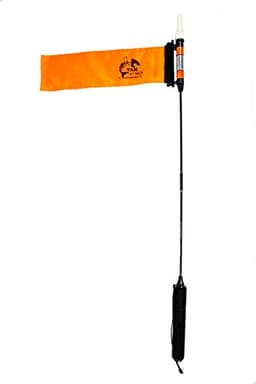
A carbon mast that runs 48 inches deployed and 14 collapsed, stores inside its own flag, and floats. The one to buy if the light cannot stay on the boat.
Published specs
| Length | 48" deployed, 14" collapsed |
|---|---|
| Mast | Carbon fiber tubing |
| Runtime | LEDs burn 100 hours on 3 AA batteries (included) |
| Flag | Included; Silent Snap attachment; collapsed unit stores inside the flag |
| Floats | Yes |
| Mounting | MightyMount and GearTrac ready; mount not included in this version |
| Visibility range | Manufacturer does not publish this |
Our score, broken out
- Height9.0
- Runtime9.0
- Mounting7.0
- Value6.5
What it gets right
- Collapses to 14 inches and stores inside its own flag, so it goes into a hatch or a dry bag instead of staying on a boat that lives on a roof rack.
- A published 48-inch deployed length is the only mast height any maker here actually prints.
- It floats, and it runs the same published 100 hours on three AAs that come in the box.
What it gets wrong
- The most expensive of the three, and what the extra buys is the collapsing carbon mast — not more light and not a longer runtime.
- No published visibility range, and unlike the VISIPole II no published waterproof depth on its product page.
- No mount in this version, and YakAttack notes an adapter is needed on FeelFree, 3 Water Kayaks and Jonny Boats.
Who should skip it
Skip it if the light will stay on the boat all season. A mast that never gets collapsed is paying for a feature you will not use.
#3 · Boats that already have RAILBLAZA ports
RAILBLAZA Illuminate i360
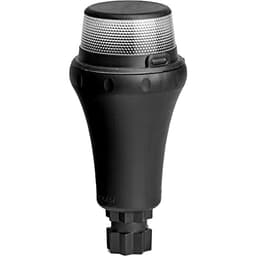
An all-round white light that twists into any StarPort. The least expensive light here, and the lowest-mounted unless you put it on a pole.
Published specs
| Type | All-round white navigation light |
|---|---|
| Runtime | Up to 25 hours on high; over 200 hours blinking |
| Batteries | 3 × AA, not included |
| Modes | High, medium, blink |
| Rating | IP67; floats if dropped overboard |
| Weight | 0.2 lb |
| Mounting | Any RAILBLAZA StarPort, SidePort, RailMount or TracMount (not included) |
| Visibility range | Manufacturer does not publish this on its US product page |
Our score, broken out
- Height4.0
- Runtime6.0
- Mounting7.0
- Value9.0
What it gets right
- If the boat already carries a RAILBLAZA StarPort from a rod holder or a camera, it twists straight in and costs no new holes.
- IP67, floats if you drop it, and a twist on and off with no wiring.
- The least expensive light on this page.
What it gets wrong
- Mounted on a deck port it sits below your head, so from ahead your own body is between the light and the boat that needs to see it. Put it on a pole — RAILBLAZA sells it in a kit with one — or accept that.
- 25 hours on high is a quarter of YakAttack's published figure, and the batteries are not in the box.
- No published visibility range on RAILBLAZA's US product page.
Who should skip it
Skip it if your boat has no RAILBLAZA fittings and a track instead. A track-ready pole is the tidier answer there.
FAQ
Questions people actually ask
Do kayaks need lights at night?
Yes, in the sense the federal Navigation Rules use. The Coast Guard treats kayaks and canoes as vessels under oars, and Rule 25 says a vessel under oars either shows sailing-vessel lights or 'shall exhibit an all-round white light or have ready at hand an electric torch or lighted lantern showing a white light which shall be exhibited in sufficient time to prevent collision.'
So the legal floor is a flashlight or headlamp ready to switch on in time. An all-round white light that is already on is what actually gets you seen.
What color light does a kayak need?
White. The two single-light options in Rule 25 are an all-round white light or a flashlight or lantern showing a white light.
Red and green lights are sidelights. The sailing-vessel option in the rule is sidelights and a sternlight together, so a red and green pair with no white light behind it is not one of the choices the rule gives a kayak.
Is a headlamp enough for kayaking at night?
It meets the legal minimum: a white light ready at hand and shown in time to prevent a collision. It is also genuinely useful for rigging and tying knots.
Its weakness is timing. A headlamp works once you have noticed the other boat. A raised all-round white light is on before anyone has noticed anyone, which is why it is worth having if you are regularly out after sunset near powerboats.
How far does a kayak light need to be visible?
Rule 22 sets 2 miles for an all-round light on a vessel under 12 meters in length, which covers every kayak.
None of the three lights we rank publishes a visibility range on its maker's product page, so none can be confirmed against that figure. Run the light, and keep a waterproof flashlight or headlamp within reach as well — the flashlight option in Rule 25 is not in Rule 22's range table.
Are LED strip lights allowed on a kayak?
Be careful with them. Rule 20 says that between sunset and sunrise no other lights shall be shown except ones that cannot be mistaken for navigation lights, do not impair their visibility or distinctive character, and do not interfere with keeping a proper lookout.
Red and green accent strips are the obvious way to run afoul of that on a small boat. They are also not a substitute for the white light the rule actually asks for.
We have not paddled with any of this gear. Everything above comes from published specifications, cited manuals and live retailer prices. Here is exactly how we pick.
Sources
- U.S. Coast Guard Navigation Center — Navigation Rules FAQ, kayaks and canoes as vessels under oars
- 33 CFR 83.25 — Rule 25, sailing vessels underway and vessels under oars (eCFR)
- 33 CFR 83.22 — Rule 22, visibility of lights (eCFR)
- 33 CFR 83.20 and 83.21 — Rules 20 and 21, application and the all-round light definition (eCFR)
- YakAttack — VISIPole II, GearTrac Ready, Includes Flag, published specifications
- YakAttack — VISICarbon Pro, MightyMount and GearTrac ready, published specifications
- RAILBLAZA — Illuminate i360 published runtime, rating and mount compatibility
- RAILBLAZA — Visibility Kit II published parts list
Read next
Related on Drift & Dime
PFDs & Safety
The kayak safety kit checklistThe required items, the genuinely useful ones, and the padding to skip.
Kits
The legal minimum kayak kitThe three items federal rules require, priced — and nothing else.
Outfitting
The best kayak gear tracks and accessory railsTracks and rails compared on the hardware standard they accept, not the marketing.
Fishing Rigging
The kayak fishing accessories checklistWhat to buy to fish from a kayak, in the order that wastes least money.