Racks & Transport
The best kayak tie-down straps
Two published numbers, and they are not the same number. Plus the reason a ratchet strap is the wrong tool for a polyethylene hull.
Disclosure: we earn a commission if you buy through the links on this page, at no extra cost to you. It does not change which products we pick or how we rank them. How this site is funded.
The short answer
Quick picks
Ranked for the person outfitting a used boat: what it costs, what it does, and who should skip it. 3 picks.
| # | Product | Best for | Our score | Price |
|---|---|---|---|---|
| 1 |  NRS 1" HD Tie-Down Straps1,500 lb breaking strength, 500 lb working load, published. NRS 1" HD Tie-Down Straps1,500 lb breaking strength, 500 lb working load, published. | The strap you buy once | 8.4 | $21.95View on Amazon |
| 2 |  Thule Load Straps750 lb working load looped, 1,125 lb break. Padded buckle. Thule Load Straps750 lb working load looped, 1,125 lb break. Padded buckle. | Rack-brand matching | 8.1 | $44.95View on Amazon |
| 3 |  Malone Standard Kayak Foam Block Kit55 lb, straps included, works on a bare roof. The no-rack answer. Malone Standard Kayak Foam Block Kit55 lb, straps included, works on a bare roof. The no-rack answer. | No crossbars at all | 8.1 | $46.27View on Amazon |
Cam buckles, not ratchets. This is the whole page.
If you read nothing else here: do not use ratchet straps on a kayak.
A ratchet is a winch. It multiplies your arm strength several times over, which is exactly what you want for lumber and exactly what you do not want against a polyethylene hull. A kayak is a thin plastic shell, and a ratchet will pull a permanent dent into it — usually on the first trip, usually unnoticed until the boat is in the water and tracking oddly.
A cam buckle can only be tightened as hard as you can pull the tail. That is enough to hold a kayak and physically cannot crush one. Every strap on this page is a cam strap for that reason.
Two published numbers, and what each one means
Straps quote two figures and people routinely compare the wrong one.
Minimum breaking strength (MBS) is the load at which the strap fails. It is a destruction figure and it is never a design target.
Working load limit (WLL) is the load the manufacturer says you may actually apply. It is typically a fraction of the MBS, and it is the number that matters in use.
Look at what happens when you put the two straps on this page side by side:
| Strap | Published MBS | Published WLL |
|---|---|---|
| NRS 1" HD | 1,500 lb | 500 lb |
| Thule load strap (looped) | 1,125 lb | 750 lb |
The NRS strap has the higher breaking strength. The Thule strap has the higher working load. Neither is simply “stronger,” and a listing that quotes only one of the two numbers is telling you which one flatters it.
For context: both are enormous relative to a kayak. Holding a 50-pound boat against lift and side load does not need 500 pounds of working strength. The reason to buy a strap that publishes real numbers is not that you need the capacity — it is that a manufacturer who publishes both figures is one who tested them.
Length: measure before you order
This is where people get caught. A strap has to go over the hull, down both sides, and reach a buckle you can work.
As a rough guide: a low car with crossbars is comfortable on 9-foot straps. A tall SUV, or a wide boat, or straps passing through the cabin on a bare roof, wants 12 to 15 feet. Malone ships 15-foot straps with its foam block kit precisely because the through-cabin route eats length.
Too long is a minor nuisance — coil and tuck the tail so it cannot flap, because a loose strap end at 70 mph will strip paint. Too short is a trip you do not take.
Bow and stern lines are a separate purchase
Two straps over the hull stop the boat lifting off the bars. They do almost nothing to stop it rotating, and rotation is what a side gust or the pressure wave off an overtaking truck produces. The kits and hood loops that make that purchase easy are on the bow and stern tie-down roundup.
Bow and stern lines fix that, and the kits and hood loops that make them quick are on the bow and stern tie-down roundup. They run from the boat’s grab handles to a metal tow point or recovery eye under the car — not to a plastic bumper, which will simply tear.
These do not need to be rated straps. Any decent line with a tensioner works, and several kits include them: the Malone foam block kit publishes safety tie-downs alongside its two load straps, and the Rightline kit includes end straps. Most J-cradles and saddles do not, so budget for them separately.
Practical things that are not on any spec sheet
- Put a twist in each strap. A flat strap in an airstream hums loudly enough to be genuinely unpleasant on a long drive. One half-twist per span breaks up the vortex and mostly stops it.
- Buckle on the side, not over the hull. A metal cam resting on the deck will scuff it and can crack gelcoat on a composite boat. Position the buckle below the rail.
- Re-check after ten minutes. Straps bed in, foam compresses, and hulls settle. The ten-minute check catches almost every loose load.
- Replace anything with UV damage. Polyester webbing that has lived on a roof for five summers is not the webbing it was. Fading and a chalky, stiff feel are the signs.
In full
Every pick, in detail
Specs below are the manufacturer's published figures, cited per product. Where a maker does not publish a number, the row says so rather than guessing at it.
#1 · The strap you buy once
NRS 1" HD Tie-Down Straps
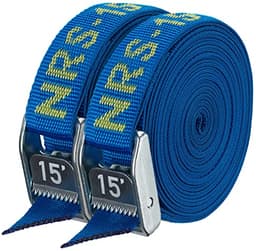
1,500 lb breaking strength, 500 lb working load, published.
Published specs
| Minimum breaking strength | 1,500 lb |
|---|---|
| Working load limit | 500 lb |
| Width | 1" |
| Length | Sold in fixed lengths including 9 ft |
| Buckle | Cam |
Our score, broken out
- Strength9.5
- Hardware9.0
- Length options7.5
- Value7.0
What it gets right
- NRS publishes both MBS and WLL. Most straps sold for kayaks publish neither, and the ones that do usually quote only the number that flatters them.
- Cam buckle, not ratchet — you physically cannot over-tension a plastic hull with a cam.
What it gets wrong
- Costs several times what a supermarket strap costs.
- 9 ft is short for a tall vehicle plus a wide boat; measure before you order a length.
Who should skip it
Skip these if you were about to buy ratchet straps for the same job — but skip the ratchets, not these. A ratchet gives you enough mechanical advantage to dent a polyethylene hull, and people do.
#2 · Rack-brand matching
Thule Load Straps
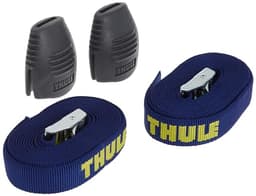
750 lb working load looped, 1,125 lb break. Padded buckle.
Published specs
| Working load limit | 750 lb (strap looped) |
|---|---|
| Maximum load | 1,125 lb break strength (strap looped) |
| Buckle | Cam, with protective housing |
Our score, broken out
- Strength8.5
- Hardware9.5
- Length options8.0
- Value6.5
What it gets right
- Higher published working load than the NRS strap, which matters more than break strength for a load you actually tension.
- The rubber buckle housing stops the metal cam marking the roof — a small thing that keeps a car tidy.
What it gets wrong
- Lower published break strength than the NRS strap. Read both numbers before assuming one strap is simply stronger.
- Priced as an accessory to a rack system rather than as a consumable.
Who should skip it
Skip them if your boat travels on foam blocks. You want longer, cheaper straps you can replace without thinking about it, and the padded buckle buys you nothing when the strap passes through the cabin anyway.
#3 · No crossbars at all
Malone Standard Kayak Foam Block Kit
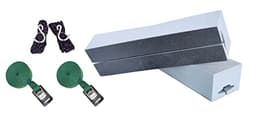
55 lb, straps included, works on a bare roof. The no-rack answer.
Published specs
| Capacity | 55 lb |
|---|---|
| Block size | 14" long × 4.75" wide × 3.75" high |
| Kit weight | 3.3 lb |
| Material | EVA closed-cell foam |
| Included | Two 15' load straps plus safety tie-downs |
| Bar profile | Universal cut-out fits round, square and oval bars |
Our score, broken out
- Capacity6.0
- Fit range9.5
- Ease of loading7.5
- Value9.5
What it gets right
- Works on a completely bare roof, which is the actual situation most people asking about crossbars are in.
- The straps are in the box. Foam blocks sold without straps are not a solution, they are half of one.
- Packs into a boot. Nothing stays on the car.
What it gets wrong
- 55 lb capacity is the lowest here — fine for a recreational kayak, not for a loaded fishing boat.
- Straps pass through the cabin on a bare roof, so the doors have to open before you can unload.
Who should skip it
Skip it for highway distance every weekend. Foam and straps are genuinely safe when rigged properly with bow and stern lines, but they need re-checking at every stop, and after a season of that most people buy bars.
FAQ
Questions people actually ask
Can I use ratchet straps on a kayak?
You should not. A ratchet multiplies your strength several times over and can pull a permanent dent into a polyethylene hull, usually on the first trip and usually unnoticed until the boat tracks oddly on the water.
Use cam buckle straps. A cam can only be tightened as hard as you can pull the tail, which is more than enough for a kayak and cannot crush one.
How long should kayak tie-down straps be?
A low car with crossbars is comfortable on 9-foot straps. A tall SUV, a wide boat, or straps routed through the cabin on a bare roof wants 12 to 15 feet.
Malone ships 15-foot straps with its foam block kit for exactly that reason — the through-cabin route uses a lot of length. Too long just needs the tail coiled and tucked; too short is a trip you cannot take.
What is the difference between breaking strength and working load limit?
Breaking strength is the load at which the strap fails; working load limit is the load the manufacturer says you may actually apply, and it is typically a fraction of the break figure.
They do not rank the same way. NRS publishes 1,500 lb MBS with a 500 lb WLL for its 1-inch HD strap, while Thule publishes 1,125 lb break with a 750 lb working load when looped. Neither is simply stronger.
We have not paddled with any of this gear. Everything above comes from published specifications, cited manuals and live retailer prices. Here is exactly how we pick.
Sources
Read next
Related on Drift & Dime
Racks & Transport
The best budget kayak roof racksRacks ranked on published load capacity and whether you can load solo.
Racks & Transport
A kayak roof rack without crossbarsWhat carries a boat on a bare roof — and why side rails are not crossbars.
Racks & Transport
How to transport a kayak without a roof rackThe six-step rig for a bare roof, and the three mistakes that make it unsafe.