Racks & Transport
The best kayak bow and stern tie-downs
Two straps over the hull stop the boat lifting. The bow and stern lines stop it pivoting, and on a modern car the hard part is finding something to tie them to.
Disclosure: we earn a commission if you buy through the links on this page, at no extra cost to you. It does not change which products we pick or how we rank them. How this site is funded.
The short answer
Quick picks
Ranked for the person outfitting a used boat: what it costs, what it does, and who should skip it. 3 picks.
| # | Product | Best for | Our score | Price |
|---|---|---|---|---|
| 1 |  Thule 855XT QuickdrawTwo 13-foot rope lines on ratchets, with carabiners for a closed loop. The tidy version of the job most people do with knots. Thule 855XT QuickdrawTwo 13-foot rope lines on ratchets, with carabiners for a closed loop. The tidy version of the job most people do with knots. | Bow and stern lines you will actually use | 7.9 | $64.95View on Amazon |
| 2 |  Shoreline Marine Hood and Trunk LoopsWebbing loops that trap under the hood or trunk lid and give bow and stern lines something to pull against. The cheapest fix here. Shoreline Marine Hood and Trunk LoopsWebbing loops that trap under the hood or trunk lid and give bow and stern lines something to pull against. The cheapest fix here. | A car with no tow points | 8.3 | $9.62View on Amazon |
| 3 |  NRS 1" HD Tie-Down Straps1,500 lb breaking strength, 500 lb working load, published. NRS 1" HD Tie-Down Straps1,500 lb breaking strength, 500 lb working load, published. | The strap you buy once | 8.4 | $21.95View on Amazon |
Why these are a separate purchase
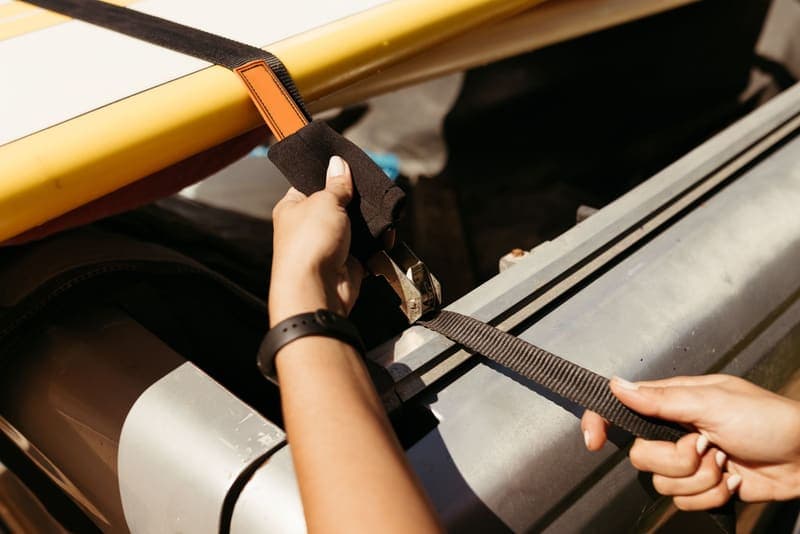
The two straps over the hull hold the boat down onto the bars. They do almost nothing about the boat pivoting around those bars, and on a twelve-foot kayak sitting on crossbars maybe thirty inches apart, most of the boat is hanging outside the supported span.
Bow and stern lines turn those overhangs into supported ends. They also do the job nobody thinks about until it happens: if a rack fitting fails at speed, the end lines are what stops the boat leaving the roof.
Our tie-down strap roundup covers the hull straps and says plainly that end lines are a separate purchase. This page is that purchase.
How we ranked these
Four criteria, weighted equally and published on how we pick:
- Security. How the line closes and what the maker publishes about strength.
- Fit range. Whether it works on the car you actually own, including one with no visible tow points.
- Ease. Because a line that takes five minutes gets skipped on the trip where it matters.
- Value. Against rope and a knot, which is the free alternative.
The anchor point problem
Twenty years ago every car had a steel bumper bracket or a visible tow eye. Today you get a plastic bumper cover, a recovery point hidden behind a pop-out cap, and nothing at all at the back of some hatchbacks.
Three honest options:
- Factory tow points. Best, when they exist. They are rated, they are structural, and they cost nothing. Check the owner’s manual — many are behind a cover in the bumper.
- Hood and trunk loops. Webbing loops that trap under the hood or trunk lid. This is the fix for a car with nothing exposed, and it is cheap enough to fit and forget.
- A hitch, if you have one. The most solid rear anchor on any vehicle that has one.
What is not on that list: suspension components, plastic bumper covers, and anything that moves.
Rope, ratchet or cam?
Rope and a trucker’s hitch is free, infinitely adjustable and how most experienced paddlers do it. The catch is that it is a skill, and an unpracticed knot under a deadline is how boats come loose.
Rope ratchets — the Thule Quickdraw approach — are the tidy middle. Thule publishes two 13-foot rope lines, four hardened steel hooks and two ratchets with carabiners, so you can close a loop rather than trusting a hook to stay hooked.
Cam straps work here too, and if you already own a spare pair of the NRS straps we recommend for the hull, you can use them as end lines. They are stronger than needed for the job, which is fine.
How to actually tie the line
If you are using rope rather than a ratchet kit, one knot covers this whole job.
A trucker’s hitch is a loop in the standing line, the working end passed through the anchor point and back up through the loop, then pulled down to give you a three-to-one purchase and finished with two half hitches. It tensions, it holds, and it unties after a wet drive, which is more than can be said for the granny knot most boats travel on.
Two details that matter more than the knot itself. Put a half twist in the line so it cannot hum in the airflow, and finish the tail properly — a flapping tail at 70 mph marks paint and works the knot loose.
If you would rather not learn a knot, that is exactly what the ratchet kits are for. Thule publishes two 13-foot lines with ratchets and carabiners, which does the same job with no skill required.
Attaching to the boat end
Most people run end lines to the grab handles, and on a lot of boats that is fine. On a used boat it deserves a second look.
Grab handles are rated for carrying, and on a second-hand hull they are usually the original ones, sun-aged and cracking at the fold. If yours look tired, replace them before you trust them at highway speed — published sizes and what to measure are on kayak replacement parts.
The alternative is a dedicated bow tie-down loop — a short strap through a sound fitting, or around the hull itself on a boat with a toggle rather than a handle. What you are looking for is a point that is part of the boat, not a part bonded to it.
The mistake that bends boats
End lines are not supposed to be tight. Their job is to stop movement, not to add load.
A ratchet makes it very easy to crank a bow line down until the hull is bowed against the crossbars. On a plastic kayak in summer heat, that is how you put a permanent dent in the bow. Snug, then a quarter turn, then stop — and check that the line is pulling forward and down rather than straight down.
The angle matters as much as the tension. A bow line that drops almost vertically to a point directly below the bow does very little; run it forward to the front of the car so it resists the boat sliding back.
What the lines are actually resisting
It is worth understanding the forces, because it explains every rule that follows.
At highway speed the air over a kayak on a roof generates lift — the hull is a wing shape in cross-section, and air moving over it does what air moving over a wing does. The hull straps resist that. What they resist poorly is the boat rotating around the bars, which is what a side gust or the pressure wave off an overtaking truck produces.
End lines fix rotation, and they also fix the failure nobody plans for. If a rack tower loosens or a crossbar clamp lets go, the hull straps go with it. Bow and stern lines are attached to the car, not to the rack, which is why they are the reason a boat stays on the roof rather than leaving it.
That is also why the anchor point should be part of the car's structure. A line tied to a plastic bumper cover fails at exactly the moment it is needed.
Line angle: forward and down, not straight down
A bow line dropping almost vertically from the bow to a point directly below it does very little. It cannot resist the boat sliding backward and it barely resists rotation.
Run the line forward to the front of the car so it pulls the bow forward and down. The same applies at the back: the stern line wants to run back and down to a rear anchor. If the angles are shallow, the lines are doing real work; if they are vertical, they are decoration.
On a short car with a long boat, that can mean the lines are the only thing controlling several feet of overhanging hull. That is exactly the situation covered on transporting a kayak on a sedan, where short crossbar spread makes end lines mandatory rather than optional.
Two lines or four?
One line at each end is the standard. Two at each end, forming a V to points on either side of the car, is better and is worth it in two cases: a long boat with a lot of overhang, and a boat carried on a bare roof with foam blocks, where the hull straps alone cannot resist sideways movement.
The foam-block case is covered in detail on how to transport a kayak without a roof rack, where the end lines stop being a backup and become part of the primary system.
Check it at the first stop
Straps and lines settle. The load that felt tight in the driveway is looser after ten miles, because webbing seats, knots bed in, and the hull compresses slightly against the bars.
So the routine is: load, tighten, drive a few miles, and check everything at the first convenient stop. Push the boat sideways and fore-and-aft with a hand. If anything moves, tighten it. That single habit prevents most of what goes wrong with roof-carried boats.
On a long trip, check again whenever you stop for fuel. It takes fifteen seconds and it is the difference between noticing a loose line and finding out about it from the car behind.
Overhang, flags and the legal bit
A kayak on a short car overhangs, and rules on rear overhang and marking vary by state. The practical answer that satisfies most of them is a bright red or orange flag on the stern whenever the boat extends well past the bumper.
It costs almost nothing and it does something more useful than compliance: it makes a narrow, low-contrast stern visible to the driver behind you in traffic. We make the same argument on transporting a kayak in a truck bed, where overhang is the whole problem rather than an edge case.
What about the noise?
A rope under tension at highway speed hums, and a hum at 70 mph gets old fast. Two fixes, both free: put a half twist in the line so it cannot present a flat face to the wind, and tie off the tail rather than letting it flap. A flapping tail is what marks paint.
Rope, webbing or cam straps: what to actually buy
All three work. The differences are about how they fail and how easily you over-tighten them.
| Type | Strength | Main risk |
|---|---|---|
| Rope and a knot | Free, adjustable, compact | Depends on a knot you may not tie often |
| Rope ratchets | One-handed tension, repeatable | Easy to over-tension a hull |
| Cam straps | Hard to over-tighten, published ratings | Bulkier, and buckles mark paint if unpadded |
The published ratings on good cam straps are far beyond what an end line needs — NRS publishes 1,500 lb minimum breaking strength and a 500 lb working load for its 1-inch HD strap, which is the same strap we recommend for the hull on the tie-down strap roundup. Using a spare pair as end lines is a perfectly good answer.
What we would buy
If your car has no tow points, the hood loops first. They are the cheapest thing on this page and they are what makes everything else possible.
If you want end lines you will actually fit every trip, the Thule Quickdraw. Two 13-foot lines on ratchets with carabiners, and the tension is one-handed.
If you already own good cam straps, buy a second pair and use them as end lines. The NRS straps we rank for the hull publish a working load far beyond what an end line needs.
And if you are comfortable with a trucker’s hitch, rope is genuinely fine. Just fit it every time, not only on the long drives.
In full
Every pick, in detail
Specs below are the manufacturer's published figures, cited per product. Where a maker does not publish a number, the row says so rather than guessing at it.
#1 · Bow and stern lines you will actually use
Thule 855XT Quickdraw
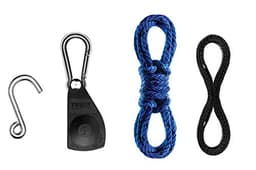
Two 13-foot rope lines on ratchets, with carabiners for a closed loop. The tidy version of the job most people do with knots.
Published specs
| Lines | Two 13 ft heavy-duty rope lines |
|---|---|
| Hooks | 4 hardened steel hooks |
| Tensioning | Two rope ratchets with carabiner hooks |
| Use | Bow and stern tie-downs for a boat on a roof |
Our score, broken out
- Security8.5
- Fit range8.0
- Ease9.0
- Value6.0
What it gets right
- Rope ratchets take the guesswork out of tension. A bow line you can tighten with one hand is a bow line you will bother to fit.
- Carabiners let you close the loop rather than relying on a hook staying hooked, which is the failure people discover on a highway on-ramp.
- 13 feet each is long enough for a tall vehicle, where a short line forces a bad angle.
What it gets wrong
- Ratchets on rope invite over-tightening. Bow and stern lines are there to stop movement, not to bend the boat down onto the bars.
- Four steel hooks want somewhere sound to hook to. On a car with no tow points you still need hood loops.
- It is several times the price of rope and two knots that do the same job.
Who should skip it
Skip it if you already tie a decent trucker's hitch. The knot is free and it does not over-tension.
#2 · A car with no tow points
Shoreline Marine Hood and Trunk Loops
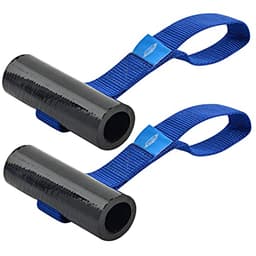
Webbing loops that trap under the hood or trunk lid and give bow and stern lines something to pull against. The cheapest fix here.
Published specs
| Use | Anchor points under a hood or trunk lid |
|---|---|
| Fit | Stated to work with almost any common vehicle with a hood or trunk |
| Design | Stated to reduce the risk of ropes or straps damaging paint |
| Rated strength | Manufacturer does not publish this |
Our score, broken out
- Security6.0
- Fit range9.0
- Ease9.0
- Value9.0
What it gets right
- It solves the specific modern problem: newer cars hide or omit the tow points bow lines used to use.
- Cheap enough to leave permanently installed, which is the only way you will use bow lines every trip rather than the important ones.
- The loop sits on paint under the lid rather than a hook on a painted edge, which is where the scratches come from.
What it gets wrong
- No published breaking strength or working load. For a part in a safety chain, that is a real gap.
- Trapping webbing in a hood means a hood that does not fully seal at one point. Route it where the seal is least critical.
- On a hatchback, the trunk-lid version can put the line at an angle that pulls sideways rather than down.
Who should skip it
Skip it if your vehicle has accessible factory tow points or a hitch. Use them instead — they are rated and these are not.
#3 · The strap you buy once
NRS 1" HD Tie-Down Straps
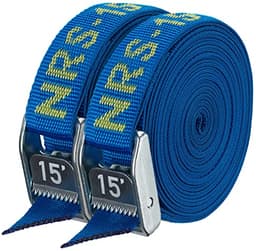
1,500 lb breaking strength, 500 lb working load, published.
Published specs
| Minimum breaking strength | 1,500 lb |
|---|---|
| Working load limit | 500 lb |
| Width | 1" |
| Length | Sold in fixed lengths including 9 ft |
| Buckle | Cam |
Our score, broken out
- Strength9.5
- Hardware9.0
- Length options7.5
- Value7.0
What it gets right
- NRS publishes both MBS and WLL. Most straps sold for kayaks publish neither, and the ones that do usually quote only the number that flatters them.
- Cam buckle, not ratchet — you physically cannot over-tension a plastic hull with a cam.
What it gets wrong
- Costs several times what a supermarket strap costs.
- 9 ft is short for a tall vehicle plus a wide boat; measure before you order a length.
Who should skip it
Skip these if you were about to buy ratchet straps for the same job — but skip the ratchets, not these. A ratchet gives you enough mechanical advantage to dent a polyethylene hull, and people do.
FAQ
Questions people actually ask
Do I need bow and stern tie-downs for a kayak?
On a short trip at low speed with a proper rack, two hull straps will hold the boat. At highway speed, or with a long boat overhanging short crossbars, the end lines are what stops the boat pivoting — and what keeps it on the car if a rack fitting fails.
On a bare roof with foam blocks they are not optional at all: the end lines are part of the primary system there, not a backup.
What do you attach bow and stern lines to?
Factory tow points if the car has them — check the owner's manual, because many are hidden behind a cap in the bumper. A hitch is the best rear anchor if you have one.
If there is nothing exposed, hood and trunk loops trap webbing under the lid and give you a proper anchor. Never tie to suspension parts, plastic bumper covers, or anything that moves.
How tight should bow and stern lines be?
Snug, and no tighter. Their job is to stop movement, not to add load.
Ratchets make it easy to crank a bow line until the hull bows against the crossbars, which on a plastic kayak in summer heat can leave a permanent dent. Tighten until the slack is gone, add a quarter turn, then stop.
Why does my kayak strap hum on the highway?
A flat strap or rope under tension acts like a reed in the airflow. Put a half twist in the line so it cannot present a flat face to the wind and the hum usually stops.
Tie off the loose tail as well. A flapping tail is both the noise you hear at lower speed and the thing that marks your paint.
We have not paddled with any of this gear. Everything above comes from published specifications, cited manuals and live retailer prices. Here is exactly how we pick.
Sources
Read next
Related on Drift & Dime
Racks & Transport
The best kayak tie-down strapsCam straps compared on published MBS and working load — and why not to use ratchets.
Racks & Transport
How to transport a kayak without a roof rackThe six-step rig for a bare roof, and the three mistakes that make it unsafe.
Racks & Transport
The best budget kayak roof racksRacks ranked on published load capacity and whether you can load solo.
Racks & Transport
How to transport a kayak on a sedanShort roofs, long overhangs, and the loading method for a small car.