Racks & Transport
The best budget kayak carts
You buy a cart for the ground it rolls on, not for the boat it carries. Get that backwards and you own a cart that trenches into the sand at your own launch.
Disclosure: we earn a commission if you buy through the links on this page, at no extra cost to you. It does not change which products we pick or how we rank them. How this site is funded.
The short answer
Quick picks
Ranked for the person outfitting a used boat: what it costs, what it does, and who should skip it. 4 picks.
| # | Product | Best for | Our score | Price |
|---|---|---|---|---|
| 1 | Malone Clipper TRX200 lb, never-flat tires, folds to 3" high. The default cart. | Most launches | 8.4 | Check price on Amazon |
| 2 | RAILBLAZA C-Tug300 lb on composite parts that cannot corrode. Strips by hand. | Rust-proof, tool-free | 8.3 | Check price on Amazon |
| 3 |  Malone Clipper TRX-S12" × 7" balloon wheels. The only answer for a beach launch. Malone Clipper TRX-S12" × 7" balloon wheels. The only answer for a beach launch. | Soft sand | 8.0 | $206.95View on Amazon |
| 4 | Suspenz Catch-All Airless Cart300 lb, 12" airless wheels, aluminum frame. Carries anything. | Odd hull shapes | 8.0 | Check price on Amazon |
The cheapest big upgrade in paddling
Carrying a 60-pound boat 300 yards from the car park to the water is the thing that quietly stops people going out. A cart removes that, and it costs less than most of the gear on this site. It also stops the hull wear that sends people shopping for keel guards, which is a symptom of dragging rather than a problem of its own.
It is also the category where the buying rule is least intuitive. Capacity is almost never the deciding number — every cart here publishes 200 pounds or more, and no kayak needs that. What decides it is the wheels and the folded size.
Wheels: match them to your launch, not to the spec sheet
Hard never-flat wheels, like the Malone Clipper TRX’s, are excellent on concrete ramps, gravel and packed dirt. They also cannot go flat, which removes the single most common cart failure — discovering a flat at the water’s edge. On dry soft sand they trench, and you end up carrying the boat and dragging the cart.
Balloon or beach wheels, like the TRX-S’s published 12×7-inch low-pressure tires, float over dry sand because they spread the load across a much wider contact patch. Everywhere else they are simply bulky, and being low-pressure they need checking.
Large-diameter airless wheels — the Suspenz cart publishes 12-inch airless wheels, 2 inches wide — are the compromise for rough ground. Diameter is what gets you over roots and rocks; width is what keeps you on top of sand. Twelve inches by two is good at the first and poor at the second.
Folded size decides whether you use it
This is the spec that gets overlooked and matters most.
If the cart fits in the boat, you launch, paddle, land somewhere else, and re-fit it. If it does not, you have to walk it back to the car before you get on the water, and then walk back for the boat — at which point you have carried the cart the distance you bought it to avoid.
Malone publishes the Clipper TRX folded at 29 × 14 × 3 inches, against 29 × 15 × 16 deployed. Three inches high is flat enough to slide into a hatch or lie in a cockpit. The RAILBLAZA C-Tug strips completely without tools, which achieves the same end differently and also means you can rinse the parts properly after salt water.
Weight, and where it goes
Published cart weights on this page: Clipper TRX 6.5 lb, C-Tug 10 lb, Suspenz 12 lb.
If the cart rides in the boat, that weight is weight you paddle all day. Nearly six pounds between the lightest and heaviest here is not nothing in a boat you are also loading with water, a dry bag and possibly fishing tackle.
Materials, and whether they matter to you
Frames here are marine-grade anodized aluminum (Malone, Suspenz) or reinforced composite (RAILBLAZA). Both are corrosion resistant; composite is the only one with genuinely nothing for salt to attack, which is why the C-Tug is the pick if you launch in salt water and are not diligent about rinsing.
On fresh water this distinction is close to irrelevant, and paying for it is paying for a problem you do not have.
Two things worth knowing before you buy
Onboard straps matter more than they sound. A cart holds the boat by friction and gravity unless it has straps, and a hull that shifts on a slope is how carts get bent. Both Malone carts publish dual onboard cam-style load straps. If a cart does not include them, budget for a strap and remember to bring it.
Scupper carts are a different product. Some carts have upright posts that push into the scupper holes of a sit-on-top rather than cradling the hull. They are quick and stable, and they only fit boats with correctly spaced scuppers. Everything on this page is a cradle cart, which fits essentially anything.
What we would buy
Concrete ramps and gravel, boat under 200 lb: Clipper TRX. Lightest, packs flattest, never-flat wheels.
Salt water, or you want it to strip for rinsing: C-Tug. 300 lb published, composite, no tools.
A soft sand beach: TRX-S. Nothing else on this list works there, and the standard TRX genuinely will not.
Rough, rooty ground and unusual hull shapes: Suspenz. The 12-inch wheels earn their bulk.
In full
Every pick, in detail
Specs below are the manufacturer's published figures, cited per product. Where a maker does not publish a number, the row says so rather than guessing at it.
#1 · Most launches
Malone Clipper TRX
200 lb, never-flat tires, folds to 3" high. The default cart.
Published specs
| Capacity | 200 lb (90 kg) |
|---|---|
| Weight | 6.5 lb (2.9 kg) |
| Deployed | 29" × 15" × 16" high |
| Folded | 29" × 14" × 3" high |
| Frame | Marine-grade anodized aluminum |
| Tires | Never-flat |
| Straps | Dual onboard cam-style load straps |
| Warranty | Lifetime limited |
Our score, broken out
- Capacity9.0
- Terrain7.5
- Packability9.5
- Value7.5
What it gets right
- Folds to 3" high, which means it goes in the boat rather than staying in the car — the difference between a cart you use and a cart you own.
- Never-flat tires remove the single most common cart failure: a flat discovered at the ramp.
- The load straps are built in, so you are not improvising with a bungee.
What it gets wrong
- Hard never-flat tires dig into soft sand where a balloon wheel floats over it.
- Costs several times what the cheapest carts cost.
Who should skip it
Skip it if your launch is soft sand. The TRX-S with balloon wheels exists precisely because this one sinks, and buying the wrong one first is the expensive mistake here.
#2 · Rust-proof, tool-free
RAILBLAZA C-Tug
300 lb on composite parts that cannot corrode. Strips by hand.
Published specs
| Capacity | 300 lb |
|---|---|
| Weight | 10 lb |
| Frame | Reinforced composite; will not corrode |
| Axles | Stainless steel reinforced |
| Wheels | Puncture-free, rubber tread |
| Assembly | Tool-free |
Our score, broken out
- Capacity9.5
- Terrain8.0
- Packability8.5
- Value7.0
What it gets right
- 300 lb is the highest published capacity on this page, and the composite frame has nothing in it for salt water to attack.
- Strips to pieces without tools, so it stows in a hatch and gets rinsed properly.
What it gets wrong
- 10 lb — heavier than the Malone Clipper TRX by more than 3 lb.
- More parts than a welded frame, which is the price of tool-free disassembly.
Who should skip it
Skip it if you only ever paddle fresh water and want the lightest thing that works. The corrosion-proof composite is the reason to pay for this cart, and fresh water never collects on it.
#3 · Soft sand
Malone Clipper TRX-S
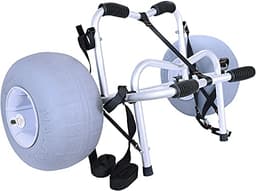
12" × 7" balloon wheels. The only answer for a beach launch.
Published specs
| Capacity | 200 lb (90 kg) |
|---|---|
| Wheels | 12" × 7" low-pressure beach wheels |
| Frame | Marine-grade anodized aluminum |
| Straps | Dual onboard cam-style load straps |
Our score, broken out
- Capacity9.0
- Terrain9.5
- Packability6.0
- Value7.0
What it gets right
- Low-pressure balloon wheels float across dry sand instead of trenching into it.
- Same 200 lb frame and same onboard straps as the standard TRX.
What it gets wrong
- The wheels are bulky. This does not disappear into a hatch the way the standard TRX does.
- Low-pressure tires need checking, unlike the never-flat wheels on the TRX.
Who should skip it
Skip it if you launch from concrete ramps and grass. You are paying for, and carrying, wheel volume that does nothing on hard ground.
#4 · Odd hull shapes
Suspenz Catch-All Airless Cart
300 lb, 12" airless wheels, aluminum frame. Carries anything.
Published specs
| Capacity | 300 lb |
|---|---|
| Weight | 12 lb |
| Wheels | 12" diameter × 2" wide, airless |
| Frame | Anodized no-rust aluminum |
Our score, broken out
- Capacity9.5
- Terrain8.5
- Packability6.5
- Value7.0
What it gets right
- 12" wheels roll over gravel and roots that stop a smaller wheel dead.
- The catch-all cradle takes hull shapes that a fixed V-frame will not sit on.
What it gets wrong
- The heaviest cart here at 12 lb.
- 2" wide wheels are narrow — they cut into sand rather than floating on it.
Who should skip it
Skip it if you portage far. 12 lb in the boat is 12 lb you are paddling, and the lighter Clipper TRX carries the same 200 lb-plus load for most recreational hulls.
FAQ
Questions people actually ask
What size wheels do I need on a kayak cart for sand?
Wide, low-pressure balloon wheels. The Malone Clipper TRX-S publishes 12 x 7 inch low-pressure beach wheels, and the width is the important number — it spreads the load across a big contact patch so the wheel floats rather than trenching.
Hard never-flat wheels and narrow airless wheels both cut into dry sand, and you end up carrying the boat and dragging the cart.
How much weight can a kayak cart carry?
More than any kayak needs, which is why capacity is rarely the deciding number. Malone publishes 200 lb for the Clipper TRX; RAILBLAZA publishes 300 lb for the C-Tug and Suspenz publishes 300 lb for its airless cart.
Buy on wheel type and folded size instead. Those are what determine whether the cart works at your launch and whether it fits in the boat.
Can you take a kayak cart with you in the boat?
If it folds flat enough, yes, and that is the main thing to check. Malone publishes the Clipper TRX folded at 29 x 14 x 3 inches, which slides into a hatch or lies in a cockpit.
The RAILBLAZA C-Tug strips completely without tools, which achieves the same result and also lets you rinse the parts properly after salt water. A cart that will not travel with you has to be walked back to the car before you launch.
We have not paddled with any of this gear. Everything above comes from published specifications, cited manuals and live retailer prices. Here is exactly how we pick.
Sources
Read next
Related on Drift & Dime
Racks & Transport
The best budget kayak roof racksRacks ranked on published load capacity and whether you can load solo.
Kits
The first season kayak kitLegal minimum plus what keeps you paddling — eight lines, priced.
Racks & Transport
How to transport a kayak without a roof rackThe six-step rig for a bare roof, and the three mistakes that make it unsafe.