Paddles
Fiberglass versus carbon kayak paddles
Carbon takes about seven ounces off an entry paddle. Whether that is worth several times the price comes down to one honest question about how you paddle.
Disclosure: we earn a commission if you buy through the links on this page, at no extra cost to you. It does not change which products we pick or how we rank them. How this site is funded.
The short answer
Quick picks
Ranked for the person outfitting a used boat: what it costs, what it does, and who should skip it. 4 picks.
| # | Product | Best for | Our score | Price |
|---|---|---|---|---|
| 1 |  Aqua-Bound Sting Ray Hybrid30 oz on a carbon shaft. Seven ounces lighter than the entry paddles. Aqua-Bound Sting Ray Hybrid30 oz on a carbon shaft. Seven ounces lighter than the entry paddles. | The weight upgrade | 8.0 | $184.95View on Amazon |
| 2 |  Bending Branches Angler ClassicFiberglass shaft, 102.5 sq in blade, and a hook retrieval notch. Bending Branches Angler ClassicFiberglass shaft, 102.5 sq in blade, and a hook retrieval notch. | Fishing | 7.7 | $174.95View on Amazon |
| 3 | Carlisle Magic PlusFiberglass shaft at an entry price. Heavy, and nearly unbreakable. | Rental-tough | 6.8 | Check price on Amazon |
| 4 |  Bending Branches Whisper37 oz, 89 sq in blade, 0 or 60° feather. The honest entry paddle. Bending Branches Whisper37 oz, 89 sq in blade, 0 or 60° feather. The honest entry paddle. | First real paddle | 7.6 | $79.95View on Amazon |
Side by side, on published figures
| Aluminum | Fiberglass | Carbon | |
|---|---|---|---|
| Example | BB Whisper | Carlisle Magic Plus / BB Angler Classic | Aqua-Bound Sting Ray Hybrid |
| Published weight | 37 oz | ~39.8 oz / 35.5–37 oz | 30 oz |
| Cold in the hand | Yes, markedly | No | No |
| Stiffness | Moderate | Moderate, some flex | High |
| Impact tolerance | Dents, does not shatter | Good | Least forgiving of levering |
| Relative price | Lowest | Modest step up | Several times the entry paddle |
The first thing that table shows is that fiberglass is not automatically lighter than aluminum. The Carlisle Magic Plus has a fiberglass shaft and is the heaviest paddle on this site, at roughly 39.8 ounces. Shaft material and total weight are related, not the same thing — blade construction and shaft wall thickness matter just as much.
What you are actually buying at each step
Aluminum to fiberglass is a comfort upgrade, not primarily a weight one. The thing you notice immediately is temperature: an aluminum shaft in April is genuinely unpleasant, and fiberglass simply is not. It is the cheapest improvement in paddling and it is noticed on the first outing.
Fiberglass to carbon is a weight and stiffness upgrade, and it is expensive. Aqua-Bound publishes 30 ounces for the Sting Ray Hybrid’s carbon shaft against 37 for the aluminum Whisper — seven ounces, which is roughly a fifth of the paddle, removed from every stroke.
Stiffness is the less obvious half. A stiff shaft transmits more of your effort into the water instead of into flexing the paddle. Whether you can feel that depends a lot on how hard you paddle; the weight you will feel regardless.
The honest question that decides it
How long is your longest paddle of the year?
Under about 90 minutes, the weight difference is real but not transformative, and the money is better spent elsewhere — a cart, a proper PFD, dry storage. Over three hours, seven ounces is the difference between finishing comfortably and finishing because you have to.
That is the whole calculation. Not skill level, not boat quality, not how serious you are about the hobby. Duration.
Where carbon is genuinely the wrong choice
- Rocky shallow rivers. Carbon is stiff and least forgiving of being used as a lever against a rock, which is exactly what happens when you push off the bottom. Fiberglass or an aluminum shaft takes that abuse better.
- Paddles that get lent out. A carbon shaft in somebody else’s hands, prying off a dock, is an expensive afternoon.
- When it costs more than the boat. Not a rule, but worth saying out loud: if you paid a few hundred dollars for a second-hand kayak, spending the same again on a paddle in week one is a decision to make deliberately, not by accident.
The hybrid middle, which is what most people should buy
Note what the Sting Ray Hybrid actually is: a carbon shaft with fiberglass-reinforced nylon blades. That is deliberate. The shaft is where weight matters most because it is what you hold and swing; the blade is what hits things.
Nylon blades are heavier than full carbon blades and far more tolerant of grounding. Putting the expensive material only where it pays off is exactly the compromise a budget-minded paddler should want.
A full carbon paddle — carbon shaft and carbon blades — is lighter again and considerably more money, and it is genuinely beyond what this site is for.
What to do about it
The sequence that wastes the least money: buy a properly sized entry paddle. Paddle a full season. Notice whether your longest days are 45 minutes or 4 hours.
If it is 45 minutes, you already own the right paddle and you saved the difference. If it is 4 hours, buy the light one and keep the first as a spare — and every boat should have a spare paddle anyway. Which light one, on published weight, is on the lightest kayak paddles.
Before either, get the length right on what size kayak paddle you need. Material is a refinement; length is a requirement.
In full
Every pick, in detail
Specs below are the manufacturer's published figures, cited per product. Where a maker does not publish a number, the row says so rather than guessing at it.
#1 · The weight upgrade
Aqua-Bound Sting Ray Hybrid
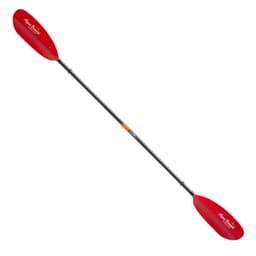
30 oz on a carbon shaft. Seven ounces lighter than the entry paddles.
Published specs
| Weight | 30 oz (850 g) |
|---|---|
| Shaft | Carbon |
| Blade material | Fiberglass-reinforced nylon |
| Ferrule | Posi-Lok, 2-piece or 4-piece |
Our score, broken out
- Weight9.0
- Blade8.0
- Adjustability8.5
- Value6.5
What it gets right
- 30 oz is the number that changes a paddling day. Seven ounces off a 37 oz paddle is a fifth of the weight, lifted every stroke.
- The 4-piece Posi-Lok version breaks down small enough to travel, which no aluminum entry paddle does.
What it gets wrong
- Costs several times the Whisper.
- A carbon shaft is stiff and unforgiving of being levered against a rock.
Who should skip it
Skip it if the boat cost less than the paddle would. Spending more on the paddle than the kayak is a defensible choice — but make it deliberately, in year two, not on day one.
#2 · Fishing
Bending Branches Angler Classic
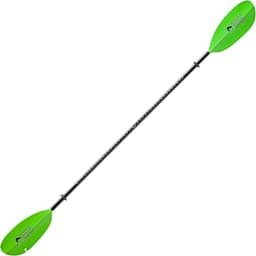
Fiberglass shaft, 102.5 sq in blade, and a hook retrieval notch.
Published specs
| Weight | 35.5 oz (snap-button); 37 oz (Versa-Lok) |
|---|---|
| Blade | 7.5" × 18", 102.5 sq in |
| Blade material | Fiberglass-reinforced nylon |
| Shaft | Fiberglass |
| Lengths | 220–260 cm in 10 cm increments (snap-button) |
| Feature | Grooved blade for retrieving a snagged lure |
Our score, broken out
- Weight6.0
- Blade8.5
- Adjustability8.0
- Value8.0
What it gets right
- Fiberglass shaft rather than aluminum: warmer in the hand, and it does not conduct the cold out of your fingers in April.
- Lengths up to 260 cm, which is what a wide fishing sit-on-top actually needs and what most budget paddles do not offer.
- The lure groove sounds like marketing until the first time it saves a crankbait.
What it gets wrong
- 102.5 sq in is a big blade — more bite, more shoulder load.
- Only 1.5 oz lighter than the Whisper in the snap-button version, despite costing considerably more.
Who should skip it
Skip it if you do not fish and your boat is under 30 inches wide. You are buying blade area and length you will not use, and paying for a groove that retrieves lures you are not casting.
#3 · Rental-tough
Carlisle Magic Plus
Fiberglass shaft at an entry price. Heavy, and nearly unbreakable.
Published specs
| Weight | 2 lb 7.8 oz (about 39.8 oz) |
|---|---|
| Shaft | Wrapped fiberglass |
| Blade material | Fiberglass-reinforced polypropylene |
Our score, broken out
- Weight4.5
- Blade7.0
- Adjustability6.5
- Value8.5
What it gets right
- A fiberglass shaft at close to aluminum-paddle money — warmer to hold and it does not dent.
- The paddle liveries and rental fleets buy, which tells you what it survives.
What it gets wrong
- The heaviest paddle here at roughly 39.8 oz.
- Polypropylene blades flex more than the nylon blades on the Angler Classic.
Who should skip it
Skip it if weight is your complaint. It is heavier than the Whisper, so it solves the shaft-material problem and makes the weight problem slightly worse.
#4 · First real paddle
Bending Branches Whisper
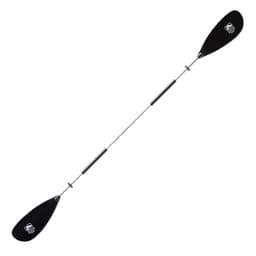
37 oz, 89 sq in blade, 0 or 60° feather. The honest entry paddle.
Published specs
| Weight | 37 oz |
|---|---|
| Blade | 6.75" × 18" (17 × 46 cm), 89 sq in surface area |
| Blade material | Polypropylene |
| Shaft | Aluminum |
| Lengths | 210, 220, 230, 240 cm |
| Ferrule | Two-piece, 0° or 60° feather |
| Blade shape | Asymmetrical with dihedral |
Our score, broken out
- Weight5.5
- Blade8.0
- Adjustability7.0
- Value9.5
What it gets right
- A genuine asymmetrical dihedral blade at the bottom of the market — that shape is what stops the paddle fluttering through the stroke.
- Four published lengths, so you can actually size it rather than buying one-size-fits-nobody.
- 89 sq in is a modest blade, which is the right call for a beginner's shoulders.
What it gets wrong
- 37 oz is heavy. Over a three-hour paddle you lift that difference thousands of times.
- An aluminum shaft is cold in spring and hot in August.
Who should skip it
Skip it if you already know you paddle more than a few times a month. The weight is the one thing you cannot fix later, and the Sting Ray Hybrid is 7 oz lighter for real money but not silly money.
FAQ
Questions people actually ask
Is a carbon kayak paddle worth it?
It depends on one thing: how long your longest paddles are. Aqua-Bound publishes 30 oz for the carbon-shaft Sting Ray Hybrid against 37 oz for the aluminum-shaft Whisper — about a fifth of the paddle removed from every stroke.
Under about 90 minutes the difference is real but not transformative. Over three hours it is the difference between finishing comfortably and finishing because you have to.
Is fiberglass lighter than aluminum for a kayak paddle?
Not necessarily. The Carlisle Magic Plus has a fiberglass shaft and is the heaviest paddle on this site at roughly 39.8 oz, while the aluminum-shafted Bending Branches Whisper is 37 oz.
Shaft material and total weight are related but not the same thing — blade construction and shaft wall thickness matter just as much. The real fiberglass advantage over aluminum is that it is not cold in your hands.
What is a hybrid kayak paddle?
A carbon or fiberglass shaft paired with cheaper, tougher blades — the Aqua-Bound Sting Ray Hybrid uses a carbon shaft with fiberglass-reinforced nylon blades.
That puts the expensive material where weight matters most, in the part you hold and swing, and keeps the impact-tolerant material where the paddle actually hits things. For a budget-minded paddler it is usually the right compromise.
We have not paddled with any of this gear. Everything above comes from published specifications, cited manuals and live retailer prices. Here is exactly how we pick.
Sources
Read next
Related on Drift & Dime
Paddles
The best budget kayak paddlesPaddles ranked on published weight and blade area — a 10 oz spread.
Paddles
What size kayak paddle do I need?Height crossed with boat width — the sizing table, in inches and centimeters.
Paddles
Kayak paddle versus canoe paddleDouble blade or single, and why the boat decides rather than you.