Paddles
Kayak paddle versus canoe paddle
Two blades or one, and it is not a preference. The seating position in each boat makes the other paddle genuinely hard to use.
Disclosure: we earn a commission if you buy through the links on this page, at no extra cost to you. It does not change which products we pick or how we rank them. How this site is funded.

The short answer
Quick picks
Ranked for the person outfitting a used boat: what it costs, what it does, and who should skip it. 3 picks.
| # | Product | Best for | Our score | Price |
|---|---|---|---|---|
| 1 |  Bending Branches Whisper37 oz, 89 sq in blade, 0 or 60° feather. The honest entry paddle. Bending Branches Whisper37 oz, 89 sq in blade, 0 or 60° feather. The honest entry paddle. | First real paddle | 7.6 | $79.95View on Amazon |
| 2 |  Bending Branches Angler ClassicFiberglass shaft, 102.5 sq in blade, and a hook retrieval notch. Bending Branches Angler ClassicFiberglass shaft, 102.5 sq in blade, and a hook retrieval notch. | Fishing | 7.7 | $174.95View on Amazon |
| 3 |  Aqua-Bound Sting Ray Hybrid30 oz on a carbon shaft. Seven ounces lighter than the entry paddles. Aqua-Bound Sting Ray Hybrid30 oz on a carbon shaft. Seven ounces lighter than the entry paddles. | The weight upgrade | 8.0 | $184.95View on Amazon |
The short answer
A kayak paddle has a blade at each end and is used with both hands on a single shaft, alternating sides. A canoe paddle has one blade and a grip, and is used on one side at a time. They are not interchangeable, and the reason is where you sit rather than the paddle itself.
Side by side
| Kayak paddle | Canoe paddle | |
|---|---|---|
| Blades | Two, one at each end | One, with a T or palm grip opposite |
| Typical length | 210–260 cm | Roughly 130–150 cm |
| Paddler position | Seated low, legs forward | Kneeling or seated high |
| Stroke | Alternating, both sides continuously | One side, with a correction built into the stroke |
| Grip | Both hands on the shaft | One hand on the shaft, one on the grip |
| Blade shape | Asymmetrical, often with a dihedral spine | Symmetrical |
Why seat height decides it
This is the part that explains everything else.
In a kayak you sit low, almost on the waterline, with your legs stretched forward. The water is close on both sides, and swapping a single blade from side to side from that position is slow and awkward. A double blade lets you alternate without ever moving your hands, which is why kayak paddles have two blades.
In a canoe you kneel or sit high on a bench, well above the water. From up there, reaching over the side with a long double blade is uncomfortable and it drips water down the shaft into the boat on every stroke. A single blade with a grip you push down on suits the height.
Can you use one in the other?
A kayak paddle in a canoe: yes, and people do, particularly in solo canoes and inflatable canoes where you sit low. You will want a longer paddle than you would use in a kayak — canoes are wider and you sit higher — and you will get wet, as water runs down the shaft from the raised blade. Drip rings help, partially.
A canoe paddle in a kayak: technically possible and genuinely unpleasant. From a low kayak seat you have to lean out to get the blade in cleanly, you swap sides constantly to hold a line, and your boat will wander. As an emergency spare it will get you home. As a choice it is not one.
Why the asymmetrical blade matters
Look closely at a decent kayak paddle blade and it is not symmetrical — one edge is longer than the other, and there is often a raised spine down the middle. Bending Branches publishes both features for the Whisper: an asymmetrical shape with a dihedral.
Both exist to solve the same problem. A kayak blade enters the water at an angle, not vertically, so a symmetrical blade has more area on one side of the shaft than the other during the stroke — and that imbalance makes the paddle flutter and twist in your hands. The asymmetrical shape equalizes it. The dihedral spine splits water evenly off both faces to the same end.
A canoe blade enters vertically, so it does not need either. That is why canoe blades are symmetrical, and it is a real design difference rather than a stylistic one.
Where the confusion usually comes from
Two products blur the line and cause most of the questions:
Inflatable “kayaks” that are really canoes. Many inflatable boats sold as kayaks have high seats and canoe-like width. They come with a double blade, which is correct for how you sit in them, but you need a longer one than the boat length suggests — often 240 cm or more. Size by beam width, not by what the box says.
Sit-on-top fishing kayaks with raised seats. A raised fishing seat puts you higher above the water, which is exactly why the Bending Branches Angler Classic runs to 260 cm while the recreational Whisper stops at 240. It is still a kayak paddle; it is just a longer one.
Both cases are handled by measuring properly rather than guessing. The table is on what size kayak paddle you need.
The other single-blade question people arrive with is the stand-up paddle board one, and the answer runs differently — a SUP paddle is sized for hands five feet above the water, which is why it sweeps the boat around when you use it seated. That comparison is on kayak paddle versus SUP paddle, and the fishing-length case is on the fishing paddle roundup.
In full
Every pick, in detail
Specs below are the manufacturer's published figures, cited per product. Where a maker does not publish a number, the row says so rather than guessing at it.
#1 · First real paddle
Bending Branches Whisper
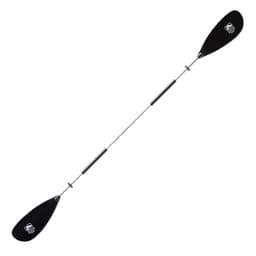
37 oz, 89 sq in blade, 0 or 60° feather. The honest entry paddle.
Published specs
| Weight | 37 oz |
|---|---|
| Blade | 6.75" × 18" (17 × 46 cm), 89 sq in surface area |
| Blade material | Polypropylene |
| Shaft | Aluminum |
| Lengths | 210, 220, 230, 240 cm |
| Ferrule | Two-piece, 0° or 60° feather |
| Blade shape | Asymmetrical with dihedral |
Our score, broken out
- Weight5.5
- Blade8.0
- Adjustability7.0
- Value9.5
What it gets right
- A genuine asymmetrical dihedral blade at the bottom of the market — that shape is what stops the paddle fluttering through the stroke.
- Four published lengths, so you can actually size it rather than buying one-size-fits-nobody.
- 89 sq in is a modest blade, which is the right call for a beginner's shoulders.
What it gets wrong
- 37 oz is heavy. Over a three-hour paddle you lift that difference thousands of times.
- An aluminum shaft is cold in spring and hot in August.
Who should skip it
Skip it if you already know you paddle more than a few times a month. The weight is the one thing you cannot fix later, and the Sting Ray Hybrid is 7 oz lighter for real money but not silly money.
#2 · Fishing
Bending Branches Angler Classic
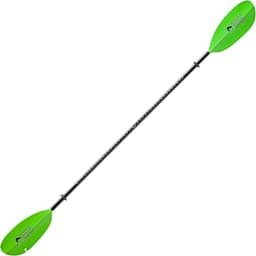
Fiberglass shaft, 102.5 sq in blade, and a hook retrieval notch.
Published specs
| Weight | 35.5 oz (snap-button); 37 oz (Versa-Lok) |
|---|---|
| Blade | 7.5" × 18", 102.5 sq in |
| Blade material | Fiberglass-reinforced nylon |
| Shaft | Fiberglass |
| Lengths | 220–260 cm in 10 cm increments (snap-button) |
| Feature | Grooved blade for retrieving a snagged lure |
Our score, broken out
- Weight6.0
- Blade8.5
- Adjustability8.0
- Value8.0
What it gets right
- Fiberglass shaft rather than aluminum: warmer in the hand, and it does not conduct the cold out of your fingers in April.
- Lengths up to 260 cm, which is what a wide fishing sit-on-top actually needs and what most budget paddles do not offer.
- The lure groove sounds like marketing until the first time it saves a crankbait.
What it gets wrong
- 102.5 sq in is a big blade — more bite, more shoulder load.
- Only 1.5 oz lighter than the Whisper in the snap-button version, despite costing considerably more.
Who should skip it
Skip it if you do not fish and your boat is under 30 inches wide. You are buying blade area and length you will not use, and paying for a groove that retrieves lures you are not casting.
#3 · The weight upgrade
Aqua-Bound Sting Ray Hybrid
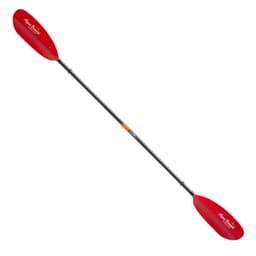
30 oz on a carbon shaft. Seven ounces lighter than the entry paddles.
Published specs
| Weight | 30 oz (850 g) |
|---|---|
| Shaft | Carbon |
| Blade material | Fiberglass-reinforced nylon |
| Ferrule | Posi-Lok, 2-piece or 4-piece |
Our score, broken out
- Weight9.0
- Blade8.0
- Adjustability8.5
- Value6.5
What it gets right
- 30 oz is the number that changes a paddling day. Seven ounces off a 37 oz paddle is a fifth of the weight, lifted every stroke.
- The 4-piece Posi-Lok version breaks down small enough to travel, which no aluminum entry paddle does.
What it gets wrong
- Costs several times the Whisper.
- A carbon shaft is stiff and unforgiving of being levered against a rock.
Who should skip it
Skip it if the boat cost less than the paddle would. Spending more on the paddle than the kayak is a defensible choice — but make it deliberately, in year two, not on day one.
FAQ
Questions people actually ask
Can you use a kayak paddle in a canoe?
Yes, and it is common in solo and inflatable canoes where you sit low. Two adjustments: buy longer than you would for a kayak, because canoes are wider and you sit higher, and expect to get wet as water runs down the shaft from the raised blade.
Drip rings help with the second problem but do not eliminate it.
Can you kayak with one paddle blade?
A single-blade canoe paddle will get you home in an emergency, but it is genuinely awkward from a kayak seat. You sit low, so you have to lean out to plant the blade cleanly, and you swap sides constantly to hold a line.
The boat will wander. As a spare it is fine; as a choice it is not one.
Why are kayak paddle blades asymmetrical?
Because a kayak blade enters the water at an angle rather than vertically. On a symmetrical blade that means unequal area either side of the shaft during the stroke, which makes the paddle flutter and twist in your hands.
The asymmetrical shape equalizes it, and the raised dihedral spine that Bending Branches publishes on the Whisper splits water evenly off both faces for the same reason. A canoe blade enters vertically, which is why it does not need either.
We have not paddled with any of this gear. Everything above comes from published specifications, cited manuals and live retailer prices. Here is exactly how we pick.
Sources
Read next
Related on Drift & Dime
Paddles
The best budget kayak paddlesPaddles ranked on published weight and blade area — a 10 oz spread.
Paddles
What size kayak paddle do I need?Height crossed with boat width — the sizing table, in inches and centimeters.
Paddles
Do kayaks come with paddles?What package paddles are worth, and using a missing one to negotiate.