Paddles
Kayak paddle vs SUP paddle
They are not interchangeable, and the reason has nothing to do with the blades. It is that you sit down in one and stand up in the other.
Disclosure: we earn a commission if you buy through the links on this page, at no extra cost to you. It does not change which products we pick or how we rank them. How this site is funded.
The short answer
Quick picks
Ranked for the person outfitting a used boat: what it costs, what it does, and who should skip it. 3 picks.
| # | Product | Best for | Our score | Price |
|---|---|---|---|---|
| 1 | Bending Branches Whisper37 oz, 89 sq in blade, 0 or 60° feather. The honest entry paddle. | First real paddle | 7.6 | Check price on Amazon |
| 2 | Aqua-Bound Sting Ray Hybrid30 oz on a carbon shaft. Seven ounces lighter than the entry paddles. | The weight upgrade | 8.0 | Check price on Amazon |
| 3 | Carlisle Magic PlusFiberglass shaft at an entry price. Heavy, and nearly unbreakable. | Rental-tough | 6.8 | Check price on Amazon |
The short answer
A SUP paddle has one blade and a handle on top. A kayak paddle has two blades and no handle. You can physically get down a lake with either in the wrong boat, and neither substitution is one you would choose twice.
The reason is not blade shape or material. It is height. Standing on a board, your hands are roughly five feet above the water and the paddle needs to be taller than you are. Sitting in a kayak, your hands are about a foot above the water and the paddle reaches out sideways rather than down.
The length difference, in numbers
Kayak paddles are published in centimeters, SUP paddles in inches or in a height-plus formula, which tells you how separately the two categories evolved.
| Kayak paddle | SUP paddle | |
|---|---|---|
| Blades | Two, opposed | One |
| Top of shaft | Open — you grip the shaft | T-grip or palm handle |
| Typical published length | 210–240 cm recreational; to 260 cm and beyond for wide fishing hulls | Sized from the paddler’s standing height |
| Stroke | Alternating, both sides, seated | Single side, switched deliberately, standing |
| Shaft is held | Two hands, both on the shaft | One hand on the grip, one on the shaft |
Bending Branches publishes the Whisper at 210–240 cm and the Angler Classic to 260. Even the longest kayak paddle here is short for standing, and a SUP paddle is far too long to swap sides with while seated.
Using a SUP paddle in a kayak
It works, badly, and it is worth understanding why so you can judge whether your situation is the exception.
You can only paddle one side at a time, so you switch hands every few strokes to go straight. Seated, with a long shaft and a T-grip, that switch is awkward in a way it is not when standing.
The shaft is too long for a seated stroke, so the blade enters the water far out from the boat and the stroke becomes a sweep. The kayak turns. You correct. Repeat.
The grip has nowhere to go. Standing, the top hand pushes down on the handle. Seated, that hand ends up somewhere around your ear.
The exception is a genuinely short trip on an inflatable or a sit-on-top where the paddle you already own beats not going out. Nobody should buy a SUP paddle for a kayak.
Using a kayak paddle on a paddle board
This direction works better than the other, and a lot of people do it deliberately.
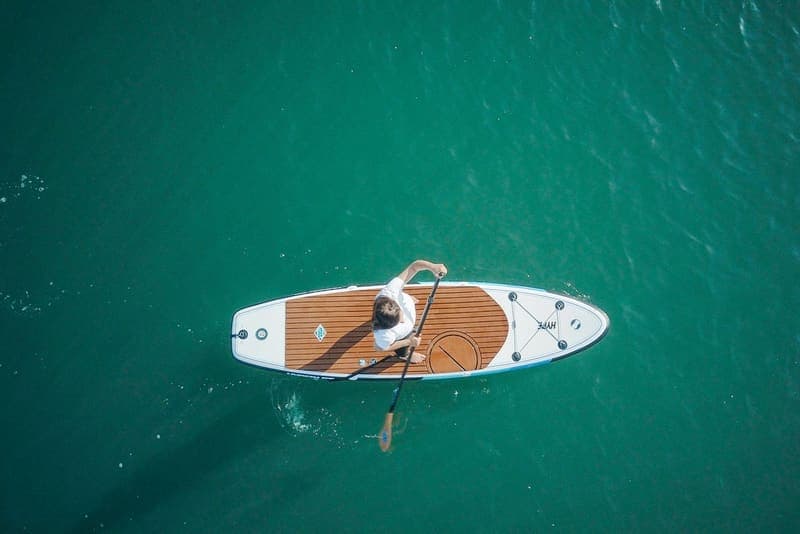
Sitting or kneeling on a board with a kayak paddle is a completely reasonable way to travel, and it is what most inflatable board packages assume when they include a convertible paddle. It is also more stable in wind than standing, and faster into a headwind.
Standing on a board with a kayak paddle is a different story: the paddle is too short to reach the water comfortably at full height, and you end up stooping. If you are standing, you want a SUP paddle.
The grip is the difference you feel first
Blade shape is the visible difference. Hand position is the one your body notices within a hundred strokes.
On a kayak paddle both hands are on the shaft, roughly shoulder width apart, and they stay there. The stroke is a rotation of your torso with the arms mostly along for the ride, and the grip barely changes from one side to the other.
On a SUP paddle the top hand is wrapped over a T-grip or a palm handle, pushing down, and the lower hand is on the shaft pulling back. Switching sides means swapping which hand does which job, every time. Standing that is natural. Seated, with a longer shaft, it is a two-handed rearrangement you do every four strokes.
This is why the substitution feels worse than the physics suggests it should. It is not that a SUP paddle moves water badly in a kayak. It is that you are re-gripping constantly, and re-gripping is exactly what a double-bladed paddle was invented to stop.
Convertible paddles: what they actually give up
A convertible paddle splits at the top, so you can add a second blade in place of the handle. Almost every inflatable board sold as a package includes one, and they are a genuine convenience.
What they give up, honestly:
- Weight. An extra ferrule, an extra blade and the hardware to swap them all add up. Published weights on dedicated kayak paddles here run 30 to 39.8 ounces; a convertible is carrying more parts than any of them.
- A compromise length. One shaft cannot be the right length for standing on a board and the right length for sitting in a kayak. Adjustable ones split the difference, and split differences are what you feel at hour three.
- More joints to seize. Every ferrule is a place grit gets in. A convertible has more of them.
If you own a board and occasionally sit on it, a convertible is exactly right. If you own a kayak and occasionally borrow a board, buy a proper kayak paddle and borrow theirs.
Blade shape, and why it differs so much
The blades are the most visibly different part and the least important reason not to swap them. It is still worth understanding what each shape is solving.
A kayak blade is asymmetrical and often dihedral. It enters the water at an angle because you are seated and reaching out sideways, so the blade is cut on a slant to present an even face during the stroke. Dihedral — a shallow ridge down the middle — splits water evenly off both sides so the blade does not flutter. Both features exist because the stroke is a diagonal pull past your hip.
A SUP blade is symmetrical and angled forward on the shaft. You are standing over it and pulling nearly vertically down, so there is no diagonal to correct for. The forward angle — usually a few degrees of rake — keeps the blade vertical in the water at the point of the stroke where it is doing most work.
Put a SUP blade in a kayak stroke and the rake is now pointing the wrong way through most of the pull. It still moves water. It just moves it slightly sideways as well as backward, which is part of why the boat wanders.
What about an inflatable kayak?
This is where the question usually comes from, because inflatable boats are the crossover point: they are sold in the same aisle as inflatable boards, often by the same brands, and often bundled with a convertible paddle.
Two things about inflatables change the paddle answer. They sit higher on the water than a hard-shell kayak, because the tubes have volume rather than draft. And they are usually wider. Both push you toward a longer paddle than the same paddler would use in a comparable hard boat.
That is the one case where a convertible paddle's compromise length works in your favor, because a shaft sized halfway between a SUP paddle and a kayak paddle is close to what a high, wide inflatable wants anyway.
If you paddle an inflatable and nothing else, keep the bundled convertible and spend the money on a pump or a seat instead. If you own a hard-shell kayak too, size that paddle properly on what size kayak paddle you need and treat the inflatable as the boat that tolerates the compromise.
What to buy if you do both
The honest answer for someone with a used kayak and an inflatable board in the garage is two paddles, and it is less extravagant than it sounds because the board almost certainly came with one.
Buy a real kayak paddle for the kayak, sized from your height and the boat’s beam rather than from a chart on a box. Keep the board’s convertible paddle for the board. That is one purchase, not two, and you end up with the right tool in each boat.
If money only stretches to one, and you spend most days in the kayak, the kayak paddle wins — because a kayak paddle on a board while kneeling is a workable day out and a SUP paddle in a kayak is a chore. Which kayak paddle depends on how long you paddle, and that is settled on the budget paddle roundup.
The same logic applies one category over: a canoe paddle is also a single blade with a grip, and the differences there are covered on kayak paddle versus canoe paddle.
In full
Every pick, in detail
Specs below are the manufacturer's published figures, cited per product. Where a maker does not publish a number, the row says so rather than guessing at it.
#1 · First real paddle
Bending Branches Whisper
37 oz, 89 sq in blade, 0 or 60° feather. The honest entry paddle.
Published specs
| Weight | 37 oz |
|---|---|
| Blade | 6.75" × 18" (17 × 46 cm), 89 sq in surface area |
| Blade material | Polypropylene |
| Shaft | Aluminum |
| Lengths | 210, 220, 230, 240 cm |
| Ferrule | Two-piece, 0° or 60° feather |
| Blade shape | Asymmetrical with dihedral |
Our score, broken out
- Weight5.5
- Blade8.0
- Adjustability7.0
- Value9.5
What it gets right
- A genuine asymmetrical dihedral blade at the bottom of the market — that shape is what stops the paddle fluttering through the stroke.
- Four published lengths, so you can actually size it rather than buying one-size-fits-nobody.
- 89 sq in is a modest blade, which is the right call for a beginner's shoulders.
What it gets wrong
- 37 oz is heavy. Over a three-hour paddle you lift that difference thousands of times.
- An aluminum shaft is cold in spring and hot in August.
Who should skip it
Skip it if you already know you paddle more than a few times a month. The weight is the one thing you cannot fix later, and the Sting Ray Hybrid is 7 oz lighter for real money but not silly money.
#2 · The weight upgrade
Aqua-Bound Sting Ray Hybrid
30 oz on a carbon shaft. Seven ounces lighter than the entry paddles.
Published specs
| Weight | 30 oz (850 g) |
|---|---|
| Shaft | Carbon |
| Blade material | Fiberglass-reinforced nylon |
| Ferrule | Posi-Lok, 2-piece or 4-piece |
Our score, broken out
- Weight9.0
- Blade8.0
- Adjustability8.5
- Value6.5
What it gets right
- 30 oz is the number that changes a paddling day. Seven ounces off a 37 oz paddle is a fifth of the weight, lifted every stroke.
- The 4-piece Posi-Lok version breaks down small enough to travel, which no aluminum entry paddle does.
What it gets wrong
- Costs several times the Whisper.
- A carbon shaft is stiff and unforgiving of being levered against a rock.
Who should skip it
Skip it if the boat cost less than the paddle would. Spending more on the paddle than the kayak is a defensible choice — but make it deliberately, in year two, not on day one.
#3 · Rental-tough
Carlisle Magic Plus
Fiberglass shaft at an entry price. Heavy, and nearly unbreakable.
Published specs
| Weight | 2 lb 7.8 oz (about 39.8 oz) |
|---|---|
| Shaft | Wrapped fiberglass |
| Blade material | Fiberglass-reinforced polypropylene |
Our score, broken out
- Weight4.5
- Blade7.0
- Adjustability6.5
- Value8.5
What it gets right
- A fiberglass shaft at close to aluminum-paddle money — warmer to hold and it does not dent.
- The paddle liveries and rental fleets buy, which tells you what it survives.
What it gets wrong
- The heaviest paddle here at roughly 39.8 oz.
- Polypropylene blades flex more than the nylon blades on the Angler Classic.
Who should skip it
Skip it if weight is your complaint. It is heavier than the Whisper, so it solves the shaft-material problem and makes the weight problem slightly worse.
FAQ
Questions people actually ask
Can you use a SUP paddle on a kayak?
Physically yes, practically no. A SUP paddle has one blade and a T-grip and is sized for standing, so seated you must switch sides every few strokes, the shaft is too long for a clean stroke, and the top hand ends up near your ear.
The result is a sweep stroke that turns the boat, followed by constant correction. It is fine as a way to get home if it is the paddle you have. It is not a reason to buy one.
Can you use a kayak paddle on a paddle board?
Yes, and it works well if you are sitting or kneeling — which is also more stable in wind and faster into a headwind than standing. Most inflatable board packages include a convertible paddle precisely because this is a normal way to use a board.
Standing is the exception. A kayak paddle is too short to reach the water at full standing height, so you end up stooping over it.
Are convertible SUP and kayak paddles any good?
They are a real convenience and they cost you three things: weight, because of the extra blade and ferrule hardware; length, because one shaft cannot be right for both standing and sitting; and reliability, because every extra joint is somewhere grit can seize.
If you mainly own a board and sometimes sit down, a convertible is right. If you mainly own a kayak, buy a kayak paddle sized to your boat's beam.
How is a SUP paddle sized compared to a kayak paddle?
By completely different methods, which is the clearest sign they are not interchangeable. A SUP paddle is sized from the paddler's standing height, because your hands are about five feet above the water.
A kayak paddle is sized from your seated height and the boat's width, in centimeters — commonly 210 to 240 cm for recreational hulls and up to 260 cm and beyond for wide fishing kayaks. Boat width matters more than paddler height.
We have not paddled with any of this gear. Everything above comes from published specifications, cited manuals and live retailer prices. Here is exactly how we pick.
Sources
Read next
Related on Drift & Dime
Paddles
What size kayak paddle do I need?Height crossed with boat width — the sizing table, in inches and centimeters.
Paddles
Kayak paddle versus canoe paddleDouble blade or single, and why the boat decides rather than you.
Paddles
The best budget kayak paddlesPaddles ranked on published weight and blade area — a 10 oz spread.
Paddles
Do kayaks come with paddles?What package paddles are worth, and using a missing one to negotiate.