Racks & Transport
Can you use a kayak rack for a paddle board?
Usually yes, if the rack holds the hull flat. Saddles and padded crossbars carry a paddle board fine; a J-cradle is the wrong shape for one, and the Abahub pads are the cheapest thing that carries both.
Disclosure: we earn a commission if you buy through the links on this page, at no extra cost to you. It does not change which products we pick or how we rank them. How this site is funded.

The short answer
Quick picks
Ranked for the person outfitting a used boat: what it costs, what it does, and who should skip it. 4 picks.
| # | Product | Best for | Our score | Price |
|---|---|---|---|---|
| 1 |  Abahub Roof Rack Pads, 30 inPads, straps and bow lines in one box. No cradle needed. | Letting the hull ride on the bars | 8.5 | $39.99View on Amazon |
| 2 |  Malone SeaWing70 lb, boat sits flat and low. The easiest solo load on crossbars. | Loading on your own | 7.8 | $161.95View on Amazon |
| 3 |  Malone Standard Kayak Foam Block Kit55 lb, straps included, works on a bare roof. The no-rack answer. | No crossbars at all | 8.1 | $46.27View on Amazon |
| 4 |  NRS 1" HD Tie-Down Straps1,500 lb breaking strength, 500 lb working load, published. | The strap you buy once | 8.4 | $21.95View on Amazon |
The short answer
A kayak rack carries a paddle board if it holds the boat flat, and does not if it holds the boat on edge. Saddles, padded crossbars and foam blocks all take a board. A J-cradle is built around a hull with a keel and a board has neither, so it sits badly and strap tension lands in the wrong place.
If you own both and want one answer, buy pads. A set of crossbar pads with straps and hood loops carries a kayak deck-up, a board deck-down, or both stacked, and costs less than any cradle. It is the first pick here for exactly that reason.
Why the shape of the carrier decides it
A kayak and a paddle board are different problems dressed up as the same one. A kayak is a rigid hull with a defined keel line and two sensible support points. A board is a flat slab, usually wider than a kayak and far less deep, and the thing that holds it best is a flat surface.
That is why saddles cross over and cradles do not. A saddle presents a broad curved pad under the hull, and a board sits on it happily. A J-cradle presents two support lines at an angle for a boat standing on its side — a board stood in one touches at the wrong points and rocks.
Stackers are a separate case again. A stacker post holds boats on edge against it, and a board on edge against a post is both unstable and needlessly tall.
How we judged these
Three criteria for the person who owns a kayak and a board rather than one of each kind of rack, published on how we pick:
- Does it hold both shapes? A carrier that takes a hull and a slab without an adapter, or does not.
- What is in the box. Boards almost always need more strap length and more tie-down points than a kayak does.
- Roof width used. The constraint when two craft go on one car.
What works, and what it costs you
| Carrier | Kayak | Paddle board | Both at once |
|---|---|---|---|
| Padded crossbars | Yes, deck up | Yes, deck down | Yes, stacked or side by side |
| Saddles | Yes, hull down | Yes, flat on the pads | One set, one craft at a time |
| Foam blocks | Yes | Yes | Yes, with enough strap |
| J-cradle | Yes, on edge | Poorly — wrong shape | Kayak in the J, board on the bar |
| Stacker post | Yes, two on edge | No | No |
The one combination worth knowing about in the J-cradle row: a kayak on edge in a J leaves most of the bar free, and a board will lie flat on padded bar next to it. So if you already own J-cradles, you are not stuck — you need pads for the empty half of the bar, not a new carrier.
Deck up or deck down?
Boards go deck down, fin up. The hull side of a board is the strong, smooth, continuous surface, and the deck pad is the part you do not want compressed under a strap for three hours in the sun.
Fin up also means the fin is not the thing taking the load, which is the mistake that snaps a fin box. If the fin is removable, take it off for the drive — it is two minutes and it removes the only fragile thing on the board.
Kayaks are the opposite. A kayak goes hull down on a saddle, or deck up on padded bars, because a plastic kayak deck is the flexible side and the hull is the structural one.
Both on one roof
This is the case people actually have, and it is a width problem before it is anything else.
A board is usually 30 to 34 inches wide. A recreational kayak is 28 to 34 inches. Two of those laid flat side by side is wider than almost any crossbar, so flat-and-flat is out on most cars.
The two arrangements that do work: stacked, with the board flat on padded bars and the kayak on top of it, strapped as one package — which is fine for a short drive and a light boat; or kayak on edge in a cradle with the board flat beside it, which is the better arrangement and the one to aim for if you do this often.
Either way, the straps get longer and the tie-down count goes up. Two craft want four straps, not two, and both want their own bow line.
Straps are the part that changes
A board is slippery, low-profile and has nothing to hook around. That makes the strapping different from a kayak in two specific ways.
Cam buckles, never ratchets. Same rule as a kayak, more so. A ratchet applies enough force to dent a board’s rail or crush an inflatable, and you will not feel it happening. That argument, with the published strap figures, is on the tie-down strap roundup.
Nose-down bow line. A board is a wing. Air under a leading edge at highway speed generates real lift, and the bow line is what stops the front of the board rising off the bar. This matters more on a board than on a kayak, and it is the one step people skip.
Inflatable boards, briefly
If the board is inflatable, the roof problem mostly disappears — deflate it, roll it, and it rides in the car. That is the honest answer and it is free.
If you carry it inflated to save the pump-up time, treat it as a more fragile rigid board: pads, cam straps only, modest tension, and check it at the first stop. An over-tensioned strap on a drum-tight inflatable will stretch the drop-stitch seams.
One thing specific to inflatables: pressure rises in the sun. A board pumped hard in a cool morning and then strapped to a black roof for three hours of afternoon driving is a board at a materially higher pressure than the one you tensioned the straps around. Run it a little soft if it is going on the roof inflated, and re-check the strap tension when you stop rather than assuming it has stayed where you left it.
Twenty miles in, check everything
Twenty miles in, pull over and put a hand on everything. This is the single habit that separates people who have lost a load from people who have not, and it costs two minutes.
What you are feeling for: strap tension that has dropped as webbing settled around the pads, a board that has crept sideways on a slippery hull surface, and a bow line that has gone slack because the nose settled. All three are normal on the first leg and all three are trivial to fix before they matter.
What about the paddles?
A kayak paddle and a SUP paddle are different lengths and not interchangeable in any comfortable way, which surprises people who assume owning both craft means owning one paddle. We go through the numbers on kayak paddle versus SUP paddle.
For transport, both go inside the car. A paddle strapped to a roof is a paddle you will eventually drive away without.
Measure the bar, not the craft
The number that decides what fits on your roof is the usable length of the crossbar, and it is shorter than the bar you bought.
A 52-inch bar does not give you 52 inches of load space. The clamps or towers sit inboard of the ends, the end caps take a little more, and on most cars you lose several inches at each side before anything can be strapped down. Measure between the mounts with a tape and work from that figure.
Then measure both craft at their widest point. Add the two numbers. If the total is more than the usable bar, flat-and-flat is out and you are choosing between stacking them and turning the kayak on edge. That is the whole decision, and it takes two minutes with a tape.
Soft racks, and when they are the right answer
There is a category of carrier sold specifically for boards that solves a problem the kayak world does not have: a car with no bars at all.
A soft rack is a pair of padded tubes that sit on the roof with straps running through the door openings — the same principle as the foam block kits on this site, built a little differently. For a board on a bare roof it works, and it is the cheapest way to carry one.
The honest limitation is the same as for foam blocks: the straps go through the car, so the doors have to be opened to release the load, and it is a method for occasional trips rather than a rack that lives on the car. If you are in that situation for both craft, the foam block page covers it in detail.
What two craft do to the drive
Worth knowing before the first long trip, because none of it is in a product listing.
Noise. A board lying flat is quiet. A kayak on edge in a cradle is noisier, and both together on a short-spread roof produce a low boom at certain speeds that is purely aerodynamic and entirely normal. It is not the straps failing.
Fuel. Two craft on a roof is a real penalty, not a rounding error. Expect it, and take the load off when the trip is over rather than leaving it up all season.
Height. A kayak stacked on top of a board is surprisingly tall. Measure the loaded height once and remember the number, because the car park barrier and the garage door do not care how well it is strapped.
Loading two things alone
The order matters and it is not obvious. Board first, flat on the bars, strapped down properly on its own. Kayak second.
Doing it the other way round means lifting a board over a kayak, and a board is an awkward sail in any wind. Loading the flat thing first also means the heavy thing goes on last, which is the easier lift to do from a standing position beside the car.
If the kayak is going on edge in a cradle beside the board, load the kayak first instead — it needs the cradle arm, and sliding a board along a bar past a loaded cradle is easier than lifting a boat over a loaded board.
Who each of these is for
Owning both and buying once: the Abahub rack pads. Pads, two straps, two ropes and two hood loops in one box. Carries either craft, needs no carrier, comes off in seconds.
A kayak you carry most and a board occasionally: the Malone SeaWing saddles. A proper kayak saddle that a board will also lie on, and the one carrier here that is genuinely good at both.
No crossbars at all: the Malone foam block kit. Blocks and straps for a bare roof, and they do not care which of the two you put on them.
Whatever else you buy: the NRS HD straps. Two craft need four straps, and these publish the figures that matter.
What we would buy
Pads and four straps. For a person with one kayak, one board and one car, that combination carries either craft or both, costs less than a single cradle, and leaves nothing on the roof between trips.
Add saddles later if the kayak becomes the thing you carry every weekend. Add a J-cradle only when you want the roof width back for a second boat, which is the point at which the two-kayak page takes over.
In full
Every pick, in detail
Specs below are the manufacturer's published figures, cited per product. Where a maker does not publish a number, the row says so rather than guessing at it.
#1 · Letting the hull ride on the bars
Abahub Roof Rack Pads, 30 in
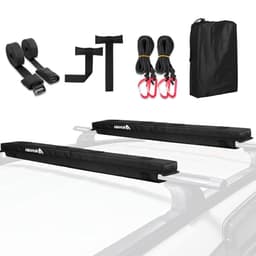
Pads, straps and bow lines in one box. No cradle needed.
Published specs
| Pad length | 30", sold as a pair |
|---|---|
| Fits | Over a crossbar |
| Contents | 2 pads, 2 tie-down straps, 2 tie-down ropes, 2 hood loops, storage bag |
| Published load rating | Manufacturer does not publish this |
| Also sold as | 32 inch pads |
Our score, broken out
- Protection7.5
- Fit range9.0
- Included kit9.0
- Value8.5
What it gets right
- It turns bars you already own into a kayak carrier for less than any cradle, which on a used-boat budget is the entire point.
- The hood loops are in the box. Bow and stern lines are normally a separate purchase and the thing people skip.
- Nothing to fit, nothing to leave on the car — the pads come off in seconds and live in the supplied bag.
What it gets wrong
- No published load figure anywhere on the listing, so the capacity you are working to is the bars' rating and your own judgment.
- A hull lying flat on padded bars takes more roof width than a boat on edge, so two kayaks or a kayak plus a bike is usually out.
- Pads slide if the straps are loose. This is the setup that most rewards checking the straps at the first stop.
Who should skip it
Skip it if you carry two boats. Padded bars hold one hull flat; a stacker or J-cradle is what frees up the width for a second.
#2 · Loading on your own
Malone SeaWing
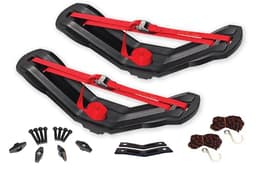
70 lb, boat sits flat and low. The easiest solo load on crossbars.
Published specs
| Capacity | 70 lb |
|---|---|
| Style | Saddle, hull carried flat |
| Requires | Crossbars |
Our score, broken out
- Capacity7.5
- Fit range6.5
- Ease of loading9.0
- Value8.0
What it gets right
- The hull sits flat and low, so you slide the boat up from the back rather than lifting it over your head.
- Least drag and least wind noise of the three Malone styles here, because the boat lies down.
What it gets wrong
- 70 lb is the lowest capacity of the three — check a loaded fishing kayak against it.
- Uses the full bar width, so nothing else shares the roof.
Who should skip it
Skip it if you need two boats up there. Saddles carry one, flat, and that is the whole design.
#3 · No crossbars at all
Malone Standard Kayak Foam Block Kit
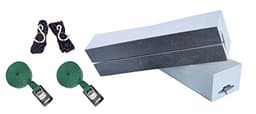
55 lb, straps included, works on a bare roof. The no-rack answer.
Published specs
| Capacity | 55 lb |
|---|---|
| Block size | 14" long × 4.75" wide × 3.75" high |
| Kit weight | 3.3 lb |
| Material | EVA closed-cell foam |
| Included | Two 15' load straps plus safety tie-downs |
| Bar profile | Universal cut-out fits round, square and oval bars |
Our score, broken out
- Capacity6.0
- Fit range9.5
- Ease of loading7.5
- Value9.5
What it gets right
- Works on a completely bare roof, which is the actual situation most people asking about crossbars are in.
- The straps are in the box. Foam blocks sold without straps are not a solution, they are half of one.
- Packs into a boot. Nothing stays on the car.
What it gets wrong
- 55 lb capacity is the lowest here — fine for a recreational kayak, not for a loaded fishing boat.
- Straps pass through the cabin on a bare roof, so the doors have to open before you can unload.
Who should skip it
Skip it for highway distance every weekend. Foam and straps are genuinely safe when rigged properly with bow and stern lines, but they need re-checking at every stop, and after a season of that most people buy bars.
#4 · The strap you buy once
NRS 1" HD Tie-Down Straps
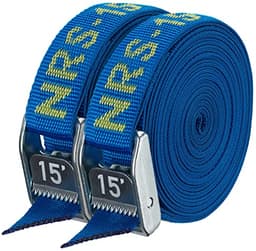
1,500 lb breaking strength, 500 lb working load, published.
Published specs
| Minimum breaking strength | 1,500 lb |
|---|---|
| Working load limit | 500 lb |
| Width | 1" |
| Length | Sold in fixed lengths including 9 ft |
| Buckle | Cam |
Our score, broken out
- Strength9.5
- Hardware9.0
- Length options7.5
- Value7.0
What it gets right
- NRS publishes both MBS and WLL. Most straps sold for kayaks publish neither, and the ones that do usually quote only the number that flatters them.
- Cam buckle, not ratchet — you physically cannot over-tension a plastic hull with a cam.
What it gets wrong
- Costs several times what a supermarket strap costs.
- 9 ft is short for a tall vehicle plus a wide boat; measure before you order a length.
Who should skip it
Skip these if you were about to buy ratchet straps for the same job — but skip the ratchets, not these. A ratchet gives you enough mechanical advantage to dent a polyethylene hull, and people do.
FAQ
Questions people actually ask
Can you use a kayak rack for a paddle board?
If the rack holds the craft flat, yes. Saddles, padded crossbars and foam blocks all carry a paddle board without modification.
If the rack holds the craft on edge, no. A J-cradle is shaped around a hull with a keel line, and a board has neither the depth nor the shape to sit in one properly. A stacker post is worse again. If you own J-cradles, the fix is a set of pads for the free half of the bar rather than a new carrier.
Should a paddle board go deck up or deck down on a car?
Deck down, fin up. The hull side is the strong continuous surface, and it keeps the deck pad from being compressed under a strap in the sun.
Fin up also keeps the fin from carrying load, which is what breaks fin boxes. If the fin is removable, take it off for the drive.
Can you carry a kayak and a paddle board on the same roof?
Yes, but not both lying flat on most cars. A board is 30 to 34 inches wide and a recreational kayak is similar, which is wider than almost any crossbar.
The two arrangements that work are the board flat with the kayak stacked on top of it as one strapped package, or — better — the kayak on edge in a cradle with the board flat beside it. Either way plan on four straps and a bow line for each craft.
Do you need a bow line for a paddle board?
More than for a kayak. A board is effectively a wing, and air under the leading edge at highway speed generates genuine lift. The bow line is what stops the nose rising off the bar.
It is the step most often skipped and the one that matters most on a flat craft. Hood loops give you an anchor point on a car with no tow eye, and good pad sets include a pair.
We have not paddled with any of this gear. Everything above comes from published specifications, cited manuals and live retailer prices. Here is exactly how we pick.
Sources
Read next
Related on Drift & Dime
Racks & Transport
How to choose crossbars for a kayakThe bars themselves: which ones fit your roof, what they are rated for, and how far apart they need to be.
Racks & Transport
The best budget kayak roof racksRacks ranked on published load capacity and whether you can load solo.
Racks & Transport
Kayak J-rack versus saddleOn edge or flat: roof space, loading height and hull support compared.
Racks & Transport
The best kayak tie-down strapsCam straps compared on published MBS and working load — and why not to use ratchets.
Paddles
Kayak paddle vs SUP paddleWhy the two are not interchangeable, and when a convertible is worth it.