Racks & Transport
How to choose crossbars for a kayak
If your car has raised side rails with a gap underneath, buy the MaxxHaul 50220: 150 lb published, 52 inches, locks in the box. Every other answer on this page is for a roof that cannot take a clamp bar.
Disclosure: we earn a commission if you buy through the links on this page, at no extra cost to you. It does not change which products we pick or how we rank them. How this site is funded.
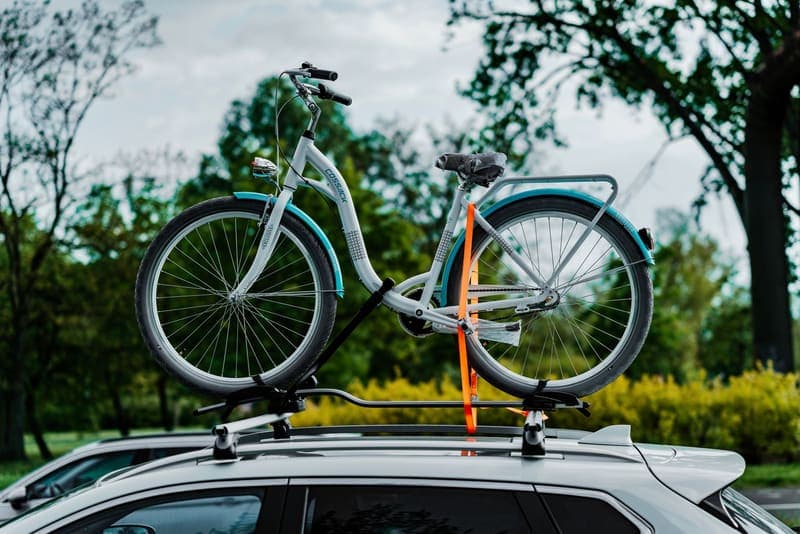
The short answer
Quick picks
Ranked for the person outfitting a used boat: what it costs, what it does, and who should skip it. 5 picks.
| # | Product | Best for | Our score | Price |
|---|---|---|---|---|
| 1 |  MaxxHaul 50220 Crossbars150 lb published, 52 inches, locks included. The value answer. | Raised rails, on a budget | 7.8 | $50.57View on Amazon |
| 2 |  Amazon Basics Cross Rail Roof RackPublishes the span it fits, which is the figure that decides fit. | A wide span between rails | 6.9 | $64.19View on Amazon |
| 3 |  Thule SquareBar Evo 135220 lb published. Needs feet and a fit kit, which is the catch. | A published 220 lb rating | 7.6 | $179.95View on Amazon |
| 4 |  Thule Evo Clamp Foot PackFour feet for a bare roof. The part nobody budgets for. | A roof with nothing on it | 6.6 | $264.94View on Amazon |
| 5 |  Abahub Roof Rack Pads, 30 inPads, straps and bow lines in one box. No cradle needed. | Letting the hull ride on the bars | 8.5 | $39.99View on Amazon |
The short answer
If your roof has raised side rails you can get a finger under, buy the MaxxHaul 50220. It publishes 150 lb, it is 52 inches long, and the locks are included rather than sold separately — which is the whole value argument against a branded system that costs four times as much and carries the same boat.
If the rails sit flush with the roof, or there are no rails at all, no clamp bar on this page fits yours. You have two honest options: a branded foot pack like the Thule Evo Clamp with bars on top, which is a serious amount of money, or foam blocks and good straps, which is a legitimate solution rather than a compromise and has its own page here.
And if you already have bars, you may not need a carrier at all. A pair of padded bars and two cam straps will carry one hull perfectly well. That is the last pick on this page, and it is the cheapest thing on it.
Why this page exists
Every rack recommendation on the internet starts after the hard part. “Fit a J-cradle to your crossbars” assumes crossbars. Most cars do not have them, and the carrier you were reading about will not clamp to a bare roof or to a rail that runs front to back.
So before the cradle, the saddle or the stacker, there is a purchase nobody writes about: the bars. They are the part everything else bolts to, they are the part with the load rating that actually matters, and they are the part where the fit goes wrong.
Four roofs, and only one of them is easy
Go and look at your car before reading another word. You are in one of four situations and they have different answers.
- Raised side rails with a gap underneath. Two rails run front to back and you can pass a finger between the rail and the roof. This is the easy case: a universal clamp bar spans them and you are done for well under a hundred dollars.
- Flush rails. The rails are there but bonded down onto the roof with no gap. Nothing clamps under them. You need a vehicle-specific foot pack made for flush rails.
- Fixed points. The car has threaded or capped mounting points under plastic covers in the roof. These take a manufacturer foot pack and nothing else.
- Bare roof. No rails, no points, nothing. Either a clamp-to-the-door-frame foot pack, or foam blocks.
The measurement that matters in the first case is the gap. The MaxxHaul publishes a minimum of 13 mm beneath the rail for its clamp, and a surprising number of factory rails are tighter than that. If you cannot get a finger under the rail, treat yourself as a flush-rail car.
How we judged these
Four criteria, weighted equally, and published on how we pick:
- Published capacity. Does the maker print a load figure at all? On a part holding a boat over a highway, that is the number you check your loaded hull against.
- Fit range. Which roofs it actually works on, and whether the listing publishes the span or makes you guess.
- What is in the box. Locks, straps, hood loops — the things that turn a list price into a real price.
- Total system cost. Not the bar price. The price of every part you need before a kayak is on the roof.
The numbers that decide fit
| Spec | MaxxHaul 50220 | Amazon Basics Cross Rail | Thule SquareBar Evo 135 |
|---|---|---|---|
| Published capacity | 150 lb | Not published on the listing | 220 lb |
| Length | 52", pair | 52", pair (56" also sold) | 53", pair (43" to 60" sold) |
| Fits | Raised rails 35–55 mm, 13 mm gap | Spans up to 46" between raised rails | Any roof, with the matching foot pack |
| Material | Aluminum | Not published on the listing | Galvanized steel, polymer coated |
| Locks | Included | Not published on the listing | Sold separately for the bars |
| Feet needed? | No — clamps to the rail | No — clamps to the rail | Yes, and they cost more than the bars |
Two rows in that table do all the work, and they point in opposite directions. Thule publishes the highest capacity by a wide margin. MaxxHaul publishes a capacity at all, includes the locks, and needs no feet — which on a used-boat budget is the row that decides it.
150 lb is more bar than any kayak here needs
It is worth saying plainly, because the instinct is to buy the biggest number available.
A recreational sit-on-top is 50 to 70 lb. A rigged fishing sit-on-top with a seat and a loaded crate in it runs 70 to 100 lb. The MaxxHaul publishes 150 lb. The bar is not your constraint, and paying for 220 lb of published capacity buys you headroom you will never use on a kayak.
What the extra money does buy is fit range, a lock system that matches the rest of a brand’s catalog, and a bar that fits a roof a clamp bar cannot touch. Those are real reasons. A bigger number is not.
Your roof has a rating, and it is the real limit
The bar rating is the easy one. The figure almost nobody checks is the car’s own dynamic roof load — the weight it is rated to carry while moving — and it has to cover the bars, the carrier and the boat together.
It is usually far lower than people assume, and it does not change because you bought better bars. Subaru, for example, publishes separate static and dynamic figures for the Outback’s roof rails, and the dynamic one is the one that applies on the highway. We go through that arithmetic properly on kayak racks for an SUV.
How far apart should the bars be?
This is the question we get asked in the form “what spread do I need”, and the honest answer is that you mostly do not choose it. The car does.
A kayak wants its two support points somewhere around a third of the way in from each end — on a 12-foot boat, roughly four feet apart. Plenty of hatchbacks and compact SUVs put their bars 24 to 30 inches apart, which supports the middle third of the hull and lets both ends cantilever.
One boat tolerates that, and bow and stern lines are what make it safe rather than merely legal. What a short spread does rule out is some carriers: Yakima publishes a minimum crossbar spread of 24 inches for the HandRoll, and load-assist carriers tend to publish the longest minimums of all. Measure your spread with a tape before you buy a carrier, not after.
If your spread is at the short end, the two things that matter more than the bars are bow and stern lines and not stacking a second boat on top of the problem, which is the argument on the two-kayak rack page.
Can the kayak just sit on the bars?
Yes. This is the question that saves people the most money and almost nobody answers it directly.
A kayak hull laid deck-up across two padded bars, strapped down and tied at bow and stern, is a perfectly sound way to carry one boat. Bare metal bars will mark a hull and squeak the whole drive, so the pads are not optional — but a set of pads with straps and hood loops in the box costs a fraction of any cradle.
What you give up is roof width. A hull lying flat takes up most of the bar, which rules out a second kayak or a bike. The moment you want two of anything, a cradle or a stacker earns its place by turning the boat on edge, and that is the whole argument on J-rack versus saddle.
Aero, square or round
Three bar profiles exist and the difference matters less than the marketing suggests, with one exception.
Square is the easiest thing in the world to clamp a carrier to, and essentially every kayak cradle, saddle and stacker is designed around it. Round is the old Yakima standard and equally well supported. Aero bars are quieter and more efficient, and they are the profile where a carrier sometimes needs a specific adapter — check before you assume.
The exception is noise. An empty square bar in the airflow whistles, and you will hear it every day you drive without a boat, which for most people is most days. That is the practical case for an aero bar if the rack is going to live on the car.
What the bars actually cost, all in
The honest arithmetic, because this is where a branded system surprises people.
A clamp bar for raised rails is one purchase. Bars, clamps and locks arrive in one box and the total is the price you saw.
A Thule or Yakima system is not one purchase. It is bars, plus a foot pack, plus — depending on the vehicle — a vehicle-specific fit kit, and the feet alone can cost more than the bars. Work it out before you start, on the maker’s own fit guide, because the number is often three times the bar price.
On a site about used boats that math has a line in it: a rack system costing more than a third of what you paid for the kayak needs a specific reason. A roof that physically cannot take a clamp bar is a very good reason. Brand preference is not.
Locks, and whether they matter
A locked bar stops the bars being lifted off the car. It does nothing about the boat, which is held on by straps anybody can unbuckle.
So the value of a lock is really about where the car lives overnight and whether the bars stay on it between trips. If the rack comes off and goes in the garage, locks are an irrelevance. If it lives on the car in a street or a car park, they stop the easiest kind of theft — and the MaxxHaul including them is worth real money against the branded systems, where lock cores are a separate line item.
Buying bars used
Bars hold their value and turn up second-hand constantly, which on a used-boat budget is worth a look. Three things to check.
That the hardware is complete. Clamps, bolts and end caps are model-specific and expensive to replace, and a set missing its fit kit is a set you cannot use.
That the bar is straight. Sight down it. A bar that has been over-loaded or dropped can be bowed in a way that is hard to see and impossible to fix.
What car it came off. A branded foot pack is fitted to a specific roof. A set that fits the seller’s car may need a different fit kit for yours, which is sometimes most of the price again.
Who each of these is for
Raised rails and a budget: the MaxxHaul 50220. 150 lb published, locks in the box, one purchase, done.
A wide roof where the span is the question: the Amazon Basics Cross Rail. It publishes the span it covers in inches, which is the figure that decides fit, and a longer 56-inch version exists. It does not publish a capacity, and that is the trade.
A published rating and a system you will extend: the Thule SquareBar Evo 135. 220 lb, five lengths, and the profile every carrier is designed around. Remember the feet.
A roof with nothing on it: the Thule Evo Clamp foot pack. 75 kg published, four feet, One-Key locks included. It is the proper answer to a bare roof and it is not cheap.
Bars you already own: the Abahub rack pads. Pads, straps, ropes and hood loops in one box, and no carrier needed for a single hull.
What we would buy
For the person this site is written for — a used kayak, a normal car, no wish to spend rack money twice — the order is simple.
Check the gap under your rails. If there is one, the MaxxHaul and a set of pads carries your boat for less than a hundred dollars all in, and you can add a cradle later if you ever want the roof width back.
If there is no gap and no rail, price the branded foot pack honestly before you commit, then read the foam block page and decide which of the two you actually want. Both are correct answers. Only one of them costs more than the kayak.
In full
Every pick, in detail
Specs below are the manufacturer's published figures, cited per product. Where a maker does not publish a number, the row says so rather than guessing at it.
#1 · Raised rails, on a budget
MaxxHaul 50220 Crossbars
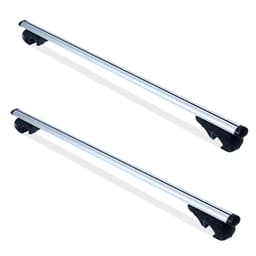
150 lb published, 52 inches, locks included. The value answer.
Published specs
| Published capacity | 150 lb |
|---|---|
| Bar length | 52", sold as a pair |
| Fits | Raised side rails 35–55 mm wide, with at least a 13 mm gap beneath for the clamp |
| Material | Aluminum |
| Locks | Locking anti-theft system included |
| Model | 50220 |
Our score, broken out
- Capacity8.0
- Fit range5.5
- Install8.0
- Value9.0
What it gets right
- It publishes a load figure, which most universal bars at this price do not. 150 lb is more than any kayak this site is about, seat and crate included.
- Locks are in the box. On branded systems the lock cores are a separate purchase that can cost more than these bars.
- Aluminum, so the bar that lives outdoors all year is not the part that rusts first.
What it gets wrong
- Raised rails only. If your roof is bare, or the rails are flush with the roof skin, these do not fit and no adapter makes them fit.
- The 13 mm gap requirement under the rail is a real measurement, not a formality — some factory rails sit too tight to the roof for any clamp bar.
- No aero profile, so expect wind noise at highway speed that a shaped bar does not make.
Who should skip it
Skip it if you cannot get a finger under your roof rail. The clamp needs that gap, and a rail bonded flat to the roof needs a fixed-point or clamp-to-door-frame system instead.
#2 · A wide span between rails
Amazon Basics Cross Rail Roof Rack
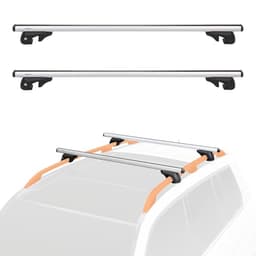
Publishes the span it fits, which is the figure that decides fit.
Published specs
| Bar length | 52", pack of 2 |
|---|---|
| Fits | Spans up to 46" between raised side rails with a gap |
| Published capacity | Manufacturer does not publish this on the listing |
| Finish | Black and silver |
| Also sold as | 56" bars for spans up to 49.6" |
Our score, broken out
- Capacity5.0
- Fit range7.0
- Install8.0
- Value7.5
What it gets right
- It publishes the span it covers in inches, which is the single number that decides whether a clamp bar fits your car. Most listings make you guess.
- A longer 56 inch version exists for wide roofs, so a big SUV is not stuck buying a bar that barely reaches.
What it gets wrong
- No published load rating. On a part that holds a boat over a highway, that is the figure you most want and this listing does not print it.
- Raised rails with a gap only, same constraint as every clamp bar.
Who should skip it
Skip it if you want a number to check your loaded boat against. Buy the bars that publish a capacity instead — the comparison on this page is mostly about that one row.
#3 · A published 220 lb rating
Thule SquareBar Evo 135
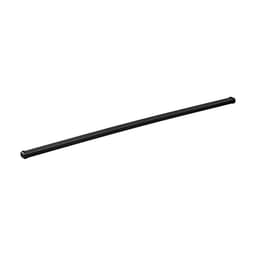
220 lb published. Needs feet and a fit kit, which is the catch.
Published specs
| Published maximum load | 220 lb |
|---|---|
| Bar length | 135 cm (53"), sold as a pair |
| Other lengths | 108 cm (43"), 118 cm (47"), 127 cm (50"), 150 cm (60") |
| Profile | Square |
| Material | Corrosion-resistant galvanized steel with a black polymer coating |
| Model | 712400 |
Our score, broken out
- Capacity9.5
- Fit range9.0
- Install7.0
- Value5.0
What it gets right
- 220 lb published on the bar, which is three times the weight of most of the boats this site is about and far above any universal clamp bar here.
- A square profile is the easiest shape to clamp a carrier to, and almost every kayak cradle, saddle and stacker is designed around it.
- Five lengths, so the bar matches the roof rather than overhanging it.
What it gets wrong
- The bars are not a rack. You still need feet, and usually a car-specific fit kit, and together those cost more than the bars.
- Steel rather than aluminum, so a scratched coating is a rust site in a few seasons of salt.
- No aero shaping, which means more wind noise than Thule's own WingBar at a fraction less money than it.
Who should skip it
Skip it if the total system price is more than a third of what the kayak cost. That is the honest line on a used boat, and a clamp bar with a published 150 lb rating carries the same hull.
#4 · A roof with nothing on it
Thule Evo Clamp Foot Pack
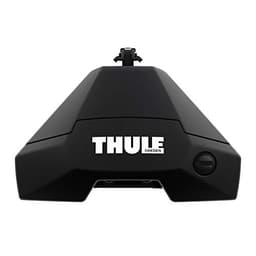
Four feet for a bare roof. The part nobody budgets for.
Published specs
| Published maximum load | 75 kg (165 lb) |
|---|---|
| Weight | 2.47 kg |
| Contents | A pack of four feet |
| Roof type | Vehicles without pre-existing roof rack attachment points or factory-installed racks |
| Locks | Thule One-Key locks included |
| System | Thule Evo roof rack system |
| Model | 710500 |
Our score, broken out
- Capacity8.0
- Fit range7.5
- Install7.5
- Value3.5
What it gets right
- It is the honest answer for a bare roof: a clamp that grips the door frame, rated and locked, rather than foam blocks and hope.
- Thule publishes both a load figure and a weight for it, so the feet are a known quantity rather than an unlabeled bracket.
- One-Key locks are included here rather than extra, which is unusual in Thule's catalog.
What it gets wrong
- It is feet only. Bars are separate, fit depends on the vehicle, and the parts together are a serious amount of money next to a second-hand kayak.
- 165 lb published against the 220 lb of the bars it carries, so the feet are the limit of the system, not the bars.
- Fit is vehicle-specific, which means working through Thule's own compatibility guide before ordering and starting again if you change cars.
Who should skip it
Skip it if you carry a boat a handful of times a season. Foam blocks and good straps do that job for a tenth of the price, and we say so on the no-crossbar page.
#5 · Letting the hull ride on the bars
Abahub Roof Rack Pads, 30 in
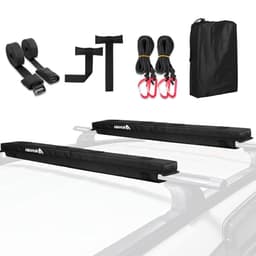
Pads, straps and bow lines in one box. No cradle needed.
Published specs
| Pad length | 30", sold as a pair |
|---|---|
| Fits | Over a crossbar |
| Contents | 2 pads, 2 tie-down straps, 2 tie-down ropes, 2 hood loops, storage bag |
| Published load rating | Manufacturer does not publish this |
| Also sold as | 32 inch pads |
Our score, broken out
- Protection7.5
- Fit range9.0
- Included kit9.0
- Value8.5
What it gets right
- It turns bars you already own into a kayak carrier for less than any cradle, which on a used-boat budget is the entire point.
- The hood loops are in the box. Bow and stern lines are normally a separate purchase and the thing people skip.
- Nothing to fit, nothing to leave on the car — the pads come off in seconds and live in the supplied bag.
What it gets wrong
- No published load figure anywhere on the listing, so the capacity you are working to is the bars' rating and your own judgment.
- A hull lying flat on padded bars takes more roof width than a boat on edge, so two kayaks or a kayak plus a bike is usually out.
- Pads slide if the straps are loose. This is the setup that most rewards checking the straps at the first stop.
Who should skip it
Skip it if you carry two boats. Padded bars hold one hull flat; a stacker or J-cradle is what frees up the width for a second.
FAQ
Questions people actually ask
How do I choose the correct load bars for mounting a heavy kayak on an SUV?
Start with the roof, not the bars. If the SUV has raised side rails with a gap beneath them, a universal clamp bar fits — the MaxxHaul 50220 publishes 150 lb and 52 inches, which covers any kayak including a rigged fishing sit-on-top at 70 to 100 lb. If the rails are flush to the roof, a clamp bar will not fit and you need a vehicle-specific foot pack.
For a heavy boat the bar is rarely the limit. The limit is the vehicle's own dynamic roof load rating, which has to cover the bars, the carrier and the boat together, and is usually lower than people expect. Check that figure in the owner's manual before buying anything.
How far apart should crossbars be for a kayak?
As far apart as the car allows, within reason. A kayak is best supported at points roughly a third of the way in from each end, which on a 12-foot boat is about four feet — and most cars cannot give you that.
Many hatchbacks and compact SUVs put the bars 24 to 30 inches apart, which is workable for one boat provided you use bow and stern lines. Spread matters more for the carrier than the boat: Yakima publishes a minimum crossbar spread of 24 inches for the HandRoll, and load-assist carriers publish longer minimums. Measure your spread with a tape before you buy a carrier.
Do you need crossbars for a kayak rack?
For almost every cradle, saddle and stacker, yes — that is what they clamp to, and side rails running front to back are not a substitute.
You do not need them to carry a kayak at all, though. Foam blocks on a bare roof with cam straps through the doors, plus bow and stern lines, is a sound method that we cover separately. The honest dividing line is frequency: a few trips a season suits foam blocks, while a boat that goes out most weekends justifies bars.
Can you put a kayak directly on crossbars?
Yes, with pads. A hull laid deck-up across two padded bars, strapped down and tied at bow and stern, carries fine. Bare metal bars will mark the hull and squeak for the whole drive, so pads are not optional — a set with straps and hood loops included costs a fraction of any cradle.
What you lose is roof width. A hull lying flat occupies most of the bar, so a second kayak or a bike is out. That is when a cradle or stacker earns its price by carrying the boat on edge.
Are roof rack crossbars universal?
The bars mostly are; what attaches them to the car is not. Almost every kayak carrier fits round, square and aero bars, sometimes with an included adapter, so the carrier is rarely the compatibility problem.
The fit problem is at the roof. A universal clamp bar needs raised rails of a particular width with a gap underneath — MaxxHaul publishes 35 to 55 mm rails and a minimum 13 mm gap. Flush rails, fixed points and bare roofs each need their own foot pack, and those are vehicle-specific rather than universal.
We have not paddled with any of this gear. Everything above comes from published specifications, cited manuals and live retailer prices. Here is exactly how we pick.
Sources
- MaxxHaul — 50220 published 150 lb capacity and 52 inch bar length, via the Home Depot listing
- Amazon Basics — Cross Rail roof rack published bar length and the span it fits between raised rails (via its retail listing; the brand has no manufacturer site)
- Thule — SquareBar Evo published 220 lb maximum load, bar lengths and material
- Thule — Evo Clamp published 75 kg maximum load, weight, four-foot pack contents, roof type and included One-Key locks
- Abahub — roof rack pad published length and kit contents (via its retail listing; the brand has no manufacturer site)
- Yakima — HandRoll (8004082) published weight, crossbar spread and contents
Read next
Related on Drift & Dime
Racks & Transport
A kayak roof rack without crossbarsWhat carries a boat on a bare roof — and why side rails are not crossbars.
Racks & Transport
The best budget kayak roof racksRacks ranked on published load capacity and whether you can load solo.
Racks & Transport
The best kayak racks for an SUVRear loaders, rollers and a lift assist, ranked on the lift each removes.
Racks & Transport
The best kayak roof rack for two kayaksStacker vs two cradles vs two saddles on published ratings and bar width.
Racks & Transport
The best kayak tie-down strapsCam straps compared on published MBS and working load — and why not to use ratchets.