Racks & Transport
The best kayak racks for an SUV
On a tall roof the carrier is not the hard part. Getting the boat up there is, so these are ranked on how much of that lift each one actually takes away.
Disclosure: we earn a commission if you buy through the links on this page, at no extra cost to you. It does not change which products we pick or how we rank them. How this site is funded.
The short answer
Quick picks
Ranked for the person outfitting a used boat: what it costs, what it does, and who should skip it. 4 picks.
| # | Product | Best for | Our score | Price |
|---|---|---|---|---|
| 1 |  Malone SeaWing/Stinger ComboSaddles plus a loader reaching 25 inches behind the rear bar, rated 75 lb. The cheapest complete answer to a tall roof. Malone SeaWing/Stinger ComboSaddles plus a loader reaching 25 inches behind the rear bar, rated 75 lb. The cheapest complete answer to a tall roof. | A complete rear-loading setup | 8.0 | $260.95View on Amazon |
| 2 |  Malone Stinger Load Assist ModuleThe same 25-inch loader, sold alone for saddles you already have. It fits the SeaWing and nothing else. Malone Stinger Load Assist ModuleThe same 25-inch loader, sold alone for saddles you already have. It fits the SeaWing and nothing else. | You already own SeaWings | 7.5 | $124.95View on Amazon |
| 3 |  Thule Hullavator ProArms lower the kayak up to 3 feet and gas struts carry 40 lb of it back up. The only pick here that removes the lift instead of shortening it. Thule Hullavator ProArms lower the kayak up to 3 feet and gas struts carry 40 lb of it back up. The only pick here that removes the lift instead of shortening it. | Not lifting the boat at all | 7.0 | $899.95View on Amazon |
| 4 |  Yakima HandRollRubber rollers on the rear bar take the drag out of sliding a boat on. But one box is one bar's worth, and Yakima publishes no capacity. Yakima HandRollRubber rollers on the rear bar take the drag out of sliding a boat on. But one box is one bar's worth, and Yakima publishes no capacity. | Rolling the boat on from behind | 6.0 | $168.95View on Amazon |
On an SUV, the rack is not the problem. The roof height is.
Once the boat is up there, a carrier on an SUV does exactly the job a carrier on a sedan does. What changes is getting it up there. A tall roof puts the crossbars at or above head height for a lot of people, and a kayak has to go over the top of them.
The rest of this site keeps running into the same wall. J-cradles end up unused on SUVs because the boat has to be lifted over the cradle arm. Stackers become a two-person job. Even saddles, the easiest carrier to load, still ask you to get one end of the boat onto a bar you may not be able to see over. This page is about that one problem and the hardware that addresses it.
It is not a general roof rack roundup. That is the budget roof rack roundup, and if you can already load your boat comfortably, the cheaper carriers there are the right answer and nothing below is worth the money.
How we ranked these
Four criteria, weighted equally and published on how we pick:
- Lift removed. How much of the overhead lift the product actually takes away. Shortening the lift and removing it are different things, and they are scored differently.
- Fit. What it needs from your car and your crossbars, and what it rules out.
- Published capacity. The load rating the manufacturer prints. A product that prints nothing scores low here, whatever it probably holds.
- Value. What the fix costs against the boat it carries, which on a second-hand kayak is often not very much.
Three ways to get a boat onto a tall roof
Every product in this category does one of three things. Knowing which one you need is most of the decision.
Shorten the lift. A loader that reaches back behind the rear crossbar gives the bow somewhere to rest that is further back than the bar itself, clear of the roof edge and the rear glass. You lift one end, set it down, walk to the stern and push. You only ever carry one end of the boat, and never the whole thing overhead. Malone’s Stinger does this, and Malone publishes its reach as up to 25 inches back from the center of the rear crossbar.
Reduce the friction. Rollers on the rear bar do not change the height, but they change what happens once the bow is on the bar. A boat on pads has to be shoved forward; a boat on rollers can be pushed. The Yakima HandRoll does this.
Remove the lift. A lift-assist carrier brings the cradles down to you, you strap the boat in at waist height, and gas struts help raise it. Thule publishes that the Hullavator Pro lowers the kayak by up to 3 feet and that its struts lift and lower 40 lb of the kayak’s weight.
The price climbs steeply with each step, and most people only need the first one.
Try the free method first
Before any of this, the rear-slide method works on a lot of SUVs with nothing more than saddles and a towel. It is worth an honest try.
- Lay a folded towel or a rubber-backed mat over the rear edge of the roof, where the bow will touch.
- Stand the kayak on its stern behind the car and walk your hands up the hull until the bow leans on the towel.
- Go to the stern, lift it, and push the boat forward onto the rear crossbar and then on to the front one.
It breaks down in two places. If the rear of the roof has a spoiler, an antenna or anything else in the way, the bow has nowhere sensible to rest — which is exactly the gap a loader fills. And if the last foot of reach is the problem rather than the weight, a sturdy step stool behind the car does more than any accessory on this page, for almost nothing.
The method is the same one we describe for small cars, and the detail of it is on transporting a kayak on a sedan. The only difference on an SUV is that the rear edge of the roof is higher, which makes the first lean harder and the rest the same.
Your roof has a rating, and there are two of them
SUVs look as if they could carry anything. The roof has a published limit, and it comes as two numbers that are easy to confuse.
Static load is what the roof holds while the car is parked. Dynamic load is what it holds while the car is moving — braking, cornering, crosswinds — and it is the number that applies to a kayak on the way to the water.
To give a real example: Subaru publishes an 800-pound static load capacity and a 220-pound dynamic load rating for the standard raised roof rails on the 2026 Outback. The 800 matters when the car is parked. The 220 is the one that applies to your boat on the highway. Look up the figure for your own vehicle and model year in the owner’s manual rather than borrowing anyone else’s, because it is specific to both.
Then add it up. The dynamic rating has to cover the crossbars, the carrier and the boat together. Thule publishes a unit weight of 39.7 lb for the Hullavator Pro, so on a lift-assist setup a real slice of the roof’s rating is spent before the boat goes on. Malone publishes 15.6 lb for its whole saddle-and-loader combo.
Raised rails are not crossbars
Many SUVs ship with rails running front to back along the roof. Those are side rails, and every product on this page needs crossbars running across them. It is the most common surprise in this category: the car looks as if it has a roof rack, and it does not have the part a kayak carrier clamps to.
The fix is a set of crossbars that clamp to the rails, and the vehicle maker’s own accessory catalog is a sensible place to start — Subaru, for one, sells crossbar sets for the Outback. If the roof is bare, what works instead and why a foam-block kit is sometimes the better answer anyway is on a kayak roof rack without crossbars.
Measure the crossbar spread before you buy
The distance between the front and rear crossbars matters for two reasons: some carriers publish a minimum, and it decides how well the hull is supported.
Yakima publishes a minimum crossbar spread of 24 inches for the HandRoll. If the bars on your car sit closer together than that, it is the wrong product regardless of anything else on the box. A tape measure between the centers of the two bars takes thirty seconds and saves a return.
The spread also matters to the boat. A kayak wants its two support points reasonably far apart, and a short spread leaves both ends hanging out unsupported — which is when bow and stern lines stop being optional. The detail, with the numbers, is on the best roof rack for two kayaks.
Bow and stern lines on a tall vehicle
On an SUV the lines run a long way down from the boat to the front and rear of the car, and they need something to attach to. What each product includes for that is worth checking before the first trip, not at the launch:
- Malone includes bow and stern lines in the SeaWing/Stinger combo.
- Thule includes its QuickDraw bow and stern tie-downs with the Hullavator Pro.
- Yakima includes a bow and stern tie-down with the HandRoll, and notes that a HoodAnchor, sold separately, is required on vehicles with no attachment points.
Straps are a separate question from lines, and a tall roof generally wants longer ones. Lengths, cam buckles against ratchets, and what the published break strengths actually mean are on the tie-down strap roundup.
Saddles, not cradles, on a tall roof
Three of the four picks here are built around carrying the boat flat, and that is not a coincidence. A saddle lets you slide the boat on from behind. A J-cradle holds the boat on edge, which means lifting it higher than the cradle arm and setting it down inside — manageable at chest height, and miserable above your head.
J-cradles still have one real advantage: carrying on edge leaves the rest of the bar free for a second boat or a bike. If you need that space, you need a cradle, and the honest trade on a tall vehicle is that you are signing up for a harder load every time. The full comparison is on J-rack versus saddle.
If you searched for your exact model
A lot of people arrive at this question with a particular car in mind — an Outback, a RAV4, a CR-V. The carriers on this page clamp to crossbars rather than to the car, so your model matters through four things, and every one of them is in the owner’s manual or a tape measure away:
- What is on the roof now — raised rails, flush rails, factory crossbars, or nothing at all.
- The dynamic roof load rating for your model year, not the static one.
- The crossbar spread you can actually get, measured center to center.
- What sits at the back of the roof — a spoiler or an antenna that leaves the bow nowhere to rest.
Answer those four and the right product here more or less picks itself. A listing that says a carrier fits your model is telling you it will clamp to the bars. It is not telling you whether you will be able to load it.
What this costs against the boat
The spread in this category is extreme, and on a used-kayak budget it is worth being plain about it.
The Stinger on its own is the least expensive fix on this page. The Malone combo costs more, and includes the saddles. A complete Yakima setup — two boxes, because one HandRoll is one bar’s worth — ends up above the combo. The Hullavator Pro is in a different bracket altogether, several times the price of anything else here and more than a lot of people paid for the kayak.
None of that makes the expensive one a bad product. It makes it a product for a specific person: someone who cannot get a bow to shoulder height and would otherwise stop paddling. For everyone else, the order is towel first, loader second, and the lift assist only if both of those genuinely failed.
When the roof is the wrong answer
Everything above assumes the boat goes on the roof. For some people it should not. A trailer keeps the boat at waist height permanently, and there are two specific situations where that is worth the cost, laid out on kayak roof rack versus trailer. For everyone else the roof is still the answer, and the job is simply to make it reachable.
What we would buy
If you already own Malone SeaWings, the Stinger. It is the smallest purchase that changes the job, and it turns the rack you have into a rear-loading one.
If you are starting from bare crossbars, the SeaWing/Stinger combo. Saddles, loader, straps and lines in one box, a published 75 lb rating, and the cheapest complete answer here.
If your bars already carry Yakima gear, the HandRoll — budgeting for the second box, measuring for the 24-inch minimum spread, and accepting that Yakima does not print a capacity.
If lifting the bow to shoulder height is not something you can do, the Hullavator Pro. It is expensive, and for that person it is the difference between paddling and not.
And if you have not tried the towel and the rear-slide method yet, try it this weekend. It costs nothing, and it may be all your SUV needs.
In full
Every pick, in detail
Specs below are the manufacturer's published figures, cited per product. Where a maker does not publish a number, the row says so rather than guessing at it.
#1 · A complete rear-loading setup
Malone SeaWing/Stinger Combo
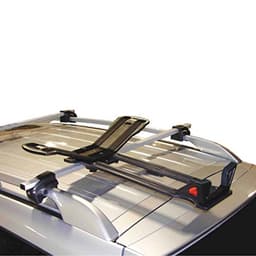
Saddles plus a loader reaching 25 inches behind the rear bar, rated 75 lb. The cheapest complete answer to a tall roof.
Published specs
| Capacity | 75 lb |
|---|---|
| Loader reach | Extends up to 25" back from the center of the rear crossbar |
| Kit weight | 15.6 lb |
| In the box | 2 SeaWing carriers, Stinger loader, 2 JAWZ kits with hardware, 2 × 11 ft cam buckle straps, bow and stern lines |
| Model | MPG113 |
Our score, broken out
- Lift removed7.5
- Fit8.0
- Published capacity7.5
- Value9.0
What it gets right
- The loader is the point. You rest the bow on a frame that sits behind the car rather than on the roof edge or the rear glass, then push the boat forward from the ground. You never hold the whole kayak above your head.
- Everything is in one box — saddles, loader, straps and bow and stern lines. If the car already has crossbars, there is nothing else to buy.
- The boat rides flat on saddles, which is the low, low-drag way to carry a single kayak.
What it gets wrong
- 75 lb covers most recreational kayaks but not every rigged fishing kayak. Weigh the boat you actually own, seat and crate included, before you trust it.
- Saddles use the full width of the bars, so nothing else shares the roof.
- The loader is another fitting on the rear bar. It retracts, but it stays up there unless you unbolt it.
Who should skip it
Skip it if you carry two boats, or if your kayak with its seat and gear is heading past 75 lb.
#2 · You already own SeaWings
Malone Stinger Load Assist Module
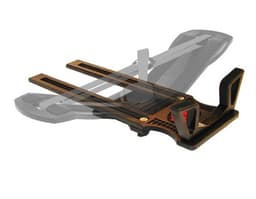
The same 25-inch loader, sold alone for saddles you already have. It fits the SeaWing and nothing else.
Published specs
| Loader reach | Extends up to 25" back from the center of the rear crossbar |
|---|---|
| Capacity | 75 lb |
| Weight | 4.6 lb |
| Requires | Malone SeaWing carrier |
| Model | MPG350 |
Our score, broken out
- Lift removed7.5
- Fit6.0
- Published capacity7.5
- Value9.0
What it gets right
- If you bought SeaWings for a lower car and now drive something taller, this is the whole fix, without replacing a rack that still works.
- Malone describes it as a no-tools installation onto the existing SeaWing.
- Same loader and same published 75 lb rating as the combo, so buying it separately gives nothing up.
What it gets wrong
- It requires the SeaWing. On anyone else's saddles, or on a J-cradle, it is no use at all.
- If you do not already own SeaWings, compare it against the combo before buying the two separately — the combo box exists for exactly that buyer.
- 4.6 lb of loader stays on the rear bar unless you take it off.
Who should skip it
Skip it if you do not already own Malone SeaWings. Buy the combo instead.
#3 · Not lifting the boat at all
Thule Hullavator Pro
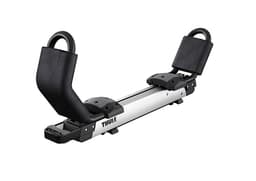
Arms lower the kayak up to 3 feet and gas struts carry 40 lb of it back up. The only pick here that removes the lift instead of shortening it.
Published specs
| Capacity | 75 lb |
|---|---|
| Lift assist | Gas struts lift and lower 40 lb of the kayak's weight |
| Lowers | Up to 3 ft, to load and strap at waist height |
| Unit weight | 39.7 lb |
| Tie-downs | Thule QuickDraw bow and stern tie-downs for 1 kayak; 2 × 9.5 ft straps |
| Crossbar requirements | Manufacturer does not publish this on the product page (vehicle-specific fit lookup) |
Our score, broken out
- Lift removed10.0
- Fit6.5
- Published capacity7.5
- Value4.0
What it gets right
- You load and strap the boat at waist height, and the struts take 40 lb of it back up to the roof. With a heavy boat and a tall roof, nothing else on this page is in the same category.
- Eight padded touch points, and cradles Thule says expand to fit wide kayaks — relevant if yours is a broad fishing hull.
- It is the one option here that still works if you physically cannot lift the bow to shoulder height.
What it gets wrong
- It sits in the top price bracket of anything on this site and costs more than a lot of used kayaks. It only makes sense if the alternative is not paddling.
- 39.7 lb of hardware on the roof before the boat goes on, which counts against your roof's dynamic rating every trip.
- One kayak, 75 lb — the same ceiling as the Malone combo. You are paying for the lift, not for capacity.
Who should skip it
Skip it if you can already get the bow onto the rear bar. A loader that shortens the lift costs a fraction of one that removes it.
#4 · Rolling the boat on from behind
Yakima HandRoll
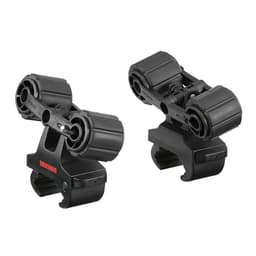
Rubber rollers on the rear bar take the drag out of sliding a boat on. But one box is one bar's worth, and Yakima publishes no capacity.
Published specs
| Sold as | A pair of roller mounts — Yakima says to combine with a second HandRoll or a DeckHand to complete the set |
|---|---|
| Weight | 4.00 lb |
| Minimum crossbar spread | 24.00 in |
| Included | Heavy-duty strap and bow and stern tie-down |
| Capacity | Manufacturer does not publish this |
| Locks | SKS Lock Cores, sold separately |
Our score, broken out
- Lift removed7.0
- Fit7.5
- Published capacity3.0
- Value6.5
What it gets right
- Rollers rather than pads: the hull rolls across the rear bar instead of dragging over it, which is the difference between pushing a boat and shoving one.
- Yakima states the rollers pivot to adjust to the boat's shape, so the same mount holds a range of hulls without adjustment.
- Tool-free installation and a limited lifetime warranty.
What it gets wrong
- No published load capacity. Yakima prints a weight, a minimum crossbar spread and a warranty, and not what the rollers will carry.
- One box is half a carrier. Yakima's own copy says to combine it with a second HandRoll or a DeckHand to complete the set, so the real price is two boxes.
- Locks are extra, and so is a HoodAnchor if the vehicle has no attachment points for the bow and stern lines.
Who should skip it
Skip it if your crossbars sit less than 24 inches apart — that is Yakima's published minimum spread, so measure before you buy.
FAQ
Questions people actually ask
What is the best kayak rack for an SUV?
One that lets you load from behind the car instead of lifting the boat over your head. For most people with crossbars already fitted, that means saddles with a rear loader: Malone publishes 75 lb for its SeaWing/Stinger combo and a loader that extends up to 25 inches back from the center of the rear crossbar.
If you cannot lift the bow to shoulder height at all, Thule's Hullavator Pro lowers the kayak by up to 3 feet so you load it at waist height, and its gas struts lift and lower 40 lb of the weight. It costs several times more.
How do you load a kayak onto a tall SUV by yourself?
Lay a towel over the rear edge of the roof, stand the kayak on its stern behind the car, walk your hands up the hull until the bow leans on the towel, then lift the stern and push the boat forward onto the crossbars. You only ever carry one end.
If something on the rear of the roof leaves the bow nowhere to rest, a loader that reaches back behind the rear crossbar solves that. If the last foot of reach is the problem, a sturdy step stool is the cheapest fix there is.
Can I put a kayak rack on my SUV's roof rails?
Not directly. Rails running front to back are side rails, and kayak carriers clamp to crossbars running across them. You need a set of crossbars that fit your rails first.
The vehicle maker's accessory catalog is a sensible place to start. If the roof is completely bare, a foam-block kit that straps through the cabin is the no-crossbar alternative.
How much weight can an SUV roof carry?
It depends on the vehicle and model year, and there are two figures. Static load is what the roof holds parked; dynamic load is what it holds while moving, and that is the one that applies to a kayak. Subaru, for example, publishes 800 lb static and 220 lb dynamic for the raised roof rails on the 2026 Outback.
The dynamic figure has to cover the crossbars, the carrier and the boat together. A lift-assist carrier like the Hullavator Pro weighs a published 39.7 lb on its own.
Are J-cradles a bad idea on an SUV?
Not bad, but hard to load. A J-cradle holds the boat on edge, so you have to lift it higher than the cradle arm and set it down inside, which on a tall roof means above your head. That is the most common reason cradles end up unused on SUVs.
A saddle lets you slide the boat on from behind instead. The one thing a cradle does better is leave the rest of the bar free for a second boat or a bike.
We have not paddled with any of this gear. Everything above comes from published specifications, cited manuals and live retailer prices. Here is exactly how we pick.
Sources
- Malone — SeaWing/Stinger Combo (MPG113) published capacity, loader reach and contents
- Malone — Stinger Load Assist Module (MPG350) published specifications
- Thule — Hullavator Pro (898010) published load capacity, lift assist and weight
- Yakima — HandRoll (8004082) published weight, crossbar spread and contents
- Subaru of America — 2026 Outback debut release, roof rail static and dynamic load ratings
Read next
Related on Drift & Dime
Racks & Transport
The best budget kayak roof racksRacks ranked on published load capacity and whether you can load solo.
Racks & Transport
Kayak J-rack versus saddleOn edge or flat: roof space, loading height and hull support compared.
Racks & Transport
A kayak roof rack without crossbarsWhat carries a boat on a bare roof — and why side rails are not crossbars.
Racks & Transport
The best kayak tie-down strapsCam straps compared on published MBS and working load — and why not to use ratchets.