Fishing Rigging
Kayak anchor versus stakeout pole versus drift sock
Three ways to stop moving, and they are not competitors. Depth decides between two of them, and the third does something entirely different.
Disclosure: we earn a commission if you buy through the links on this page, at no extra cost to you. It does not change which products we pick or how we rank them. How this site is funded.
The short answer
Quick picks
Ranked for the person outfitting a used boat: what it costs, what it does, and who should skip it. 2 picks.
| # | Product | Best for | Our score | Price |
|---|---|---|---|---|
| 1 | Gradient Fitness Anchor Kit3.5 lb folding grapnel, 25 ft of rope, buoy and hook in the box. | A complete kit | 8.6 | Check price on Amazon |
| 2 |  Extreme Max BoatTector Grapnel KitSame grapnel idea, more rode. Buy on rope length, not anchor weight. Extreme Max BoatTector Grapnel KitSame grapnel idea, more rode. Buy on rope length, not anchor weight. | Deeper water | 8.0 | $39.99View on Amazon |
Side by side
| Grapnel anchor | Stakeout pole | Drift sock | |
|---|---|---|---|
| What it does | Stops you | Stops you | Slows you |
| Depth | Any, with enough rope | Roughly under 6 ft | Any |
| Bottom needed | Sand, mud, rock to bite | Soft enough to push into | None |
| Deploy time | Slow — pay out scope | Seconds | Seconds |
| Noise | Chain and hull knock | Near silent | Silent |
| Snag risk | Real — carry a buoy | None | None |
| Stowed size | Folds to about 12" × 3" | Long — 6 to 8 ft | Packs very small |
Depth decides between anchor and pole
These two do the same job by opposite means, and the choice is almost entirely a depth question.
Under about six feet, take the pole. You push it into the bottom through a scupper or clip it to the boat, and you are held in seconds. There is no rope to pay out, no scope to calculate, nothing to snag, and it is nearly silent — which matters more in shallow water than anywhere else, because that is where fish are most easily spooked.
Deeper than that, take the anchor, and take enough rope. Scope has to be several times the depth for the flukes to bite, which is why the Gradient Fitness kit’s published 25 feet of line is comfortable in six feet of water and inadequate in fifteen.
A pole also needs a bottom soft enough to push into. Over rock or hard shell it will not hold, and that is the case where an anchor wins in shallow water too.
A drift sock is not doing the same job at all
People compare drift socks with anchors and the comparison does not really hold, because a sock is not trying to stop you. Which size to buy, and how to rig it so the boat does not slew sideways, is on the kayak drift sock roundup.
It is an underwater parachute on a bridle. It fills with water and drags, slowing your wind-driven drift to something like a fishable pace. You keep covering ground — which is what you want when you are searching rather than working a known spot.
It also does something an anchor cannot: it holds your angle. A kayak drifting free in wind spins slowly, so your casts end up in random directions. A sock streams behind and keeps the boat pointing consistently, which makes drift fishing genuinely workable.
The failure mode is light wind. With not enough drift the sock collapses and does nothing at all.
The safety point that outranks all of this
Any of the three can turn a kayak over in current if it is attached to the side of the boat.
The mechanism is the same each time: the boat turns broadside to the flow, the current pushes against the whole length of the hull, and a single fixed point holds one spot. It rolls, and it does so quickly.
Always attach at the bow or the stern in moving water. An anchor trolley — a loop of cord along the side with a pulley at each end — exists so you can move the attachment point fore and aft while seated, and it is the right way to do this. Fitting one, and the pulley detail that decides whether the ring actually slides, is on the anchor trolley guide.
Carry a knife you can reach one-handed, clipped to your PFD. If you carry an anchor line, a drift sock bridle or a paddle leash, you have something aboard that can trap you.
Which to buy first
Shallow flats, ponds, small rivers under six feet: a stakeout pole, and nothing else at first. Faster, quieter, cannot snag.
Lakes and mixed depths: an anchor kit with a buoy. The buoy is what lets you recover a wedged grapnel without pulling the bow of a small boat down — see the best budget kayak anchors.
Big open water and wind: a drift sock. It is also the cheapest of the three and packs to nothing, so it is an easy addition later.
Most kayak anglers end up owning two. Pole and sock is a common pair and cheaper than either plus an anchor, because between them they cover shallow-and-still and deep-and-windy without any snag risk at all.
In full
Every pick, in detail
Specs below are the manufacturer's published figures, cited per product. Where a maker does not publish a number, the row says so rather than guessing at it.
#1 · A complete kit
Gradient Fitness Anchor Kit
3.5 lb folding grapnel, 25 ft of rope, buoy and hook in the box.
Published specs
| Anchor | 3.5 lb, 4-fluke folding grapnel, rust resistant |
|---|---|
| Rope | 25 ft marine-grade, 7 mm |
| Included | PVC flotation buoy and stainless steel snap hook |
| Folded size | 12" × 3" |
Our score, broken out
- Hold7.5
- Kit completeness9.5
- Stowage9.0
- Value9.0
What it gets right
- A complete kit. Buying an anchor without rope, a buoy and a clip means three more orders and the same money.
- Folds to 12" × 3", which fits a milk crate alongside everything else.
- The buoy is what lets you cut loose from a snagged anchor and come back for it — worth having before you need it.
What it gets wrong
- 25 ft of rope limits you to shallow water. The working rule is several times the depth, not equal to it.
- 3.5 lb holds a kayak in modest current and not much more.
Who should skip it
Skip it if you fish water deeper than about 8 feet. 25 ft of rode is not enough scope out there, and you will be buying a longer line immediately.
#2 · Deeper water
Extreme Max BoatTector Grapnel Kit
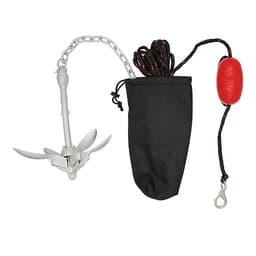
Same grapnel idea, more rode. Buy on rope length, not anchor weight.
Published specs
| Anchor | Folding grapnel, sold in multiple weights |
|---|---|
| Kit | Anchor, rope, buoy and hardware |
| Rope length | Varies by kit — check the listing before buying |
Our score, broken out
- Hold8.0
- Kit completeness7.5
- Stowage8.5
- Value8.0
What it gets right
- Sold in several anchor weights and rope lengths, so you can match the kit to your water instead of taking what comes.
- Grapnel flukes fold flat for stowage, same as the Gradient.
What it gets wrong
- Specifications vary between kits under the same product name — you have to read the listing carefully.
- Heavier anchor options are a real weight penalty in a small boat.
Who should skip it
Skip it if you are buying your first anchor and want a known quantity. The variable kit contents are a genuine trap; the Gradient kit publishes exactly what is in the box.
FAQ
Questions people actually ask
Can you anchor a kayak?
Yes, and in still or slow water a 1.5 to 3.5 lb folding grapnel with enough rope is straightforward.
The rule that matters is where you attach it. In current, anchor from the bow or stern so the boat lies along the flow. A kayak anchored from its side turns broadside and can roll, which is the main capsize risk in kayak fishing.
Is a stakeout pole better than an anchor for a kayak?
Under about six feet of water, usually yes. It holds you in seconds with no rope to pay out, nothing to snag, and it is near silent — which matters most in shallow water where fish spook easily.
Deeper than that it cannot reach, and over rock or hard shell it will not push in. That is where an anchor with enough scope wins.
What does a kayak drift sock do?
It is an underwater parachute that slows your wind-driven drift to a fishable pace rather than stopping you. You keep covering water, which is what you want when searching rather than working a known spot.
It also holds your angle: a free-drifting kayak spins slowly in wind, so casts end up in random directions. A sock streams behind and keeps the boat pointing consistently. In very light wind it collapses and does nothing.
We have not paddled with any of this gear. Everything above comes from published specifications, cited manuals and live retailer prices. Here is exactly how we pick.
Sources
- Gradient Fitness — anchor kit contents and folded dimensions, as published on the retailer product listing
- Extreme Max — BoatTector grapnel anchor kit published contents
Read next
Related on Drift & Dime
Fishing Rigging
The best budget kayak anchorsAnchor kits compared on rope length and contents — buy scope, not weight.
Fishing Rigging
The kayak fishing accessories checklistWhat to buy to fish from a kayak, in the order that wastes least money.
Fishing Rigging
Rigging a used fishing kayakSealing inherited holes, reusing bolt patterns, and no-drill rigging.