PFDs & Safety
How to fit a kayak PFD
A vest that rides up over your ears in the water is a vest that is too loose, not too small. Six steps, in the order that actually works.
Disclosure: we earn a commission if you buy through the links on this page, at no extra cost to you. It does not change which products we pick or how we rank them. How this site is funded.

The short answer
Quick picks
Ranked for the person outfitting a used boat: what it costs, what it does, and who should skip it. 3 picks.
| # | Product | Best for | Our score | Price |
|---|---|---|---|---|
| 1 |  Stohlquist Fit16 lb of published buoyancy and a 30–52" range on one jacket. Stohlquist Fit16 lb of published buoyancy and a 30–52" range on one jacket. | Sharing one vest | 8.2 | $49.99View on Amazon |
| 2 | 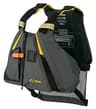 Onyx MoveVent DynamicMesh back panel clears a kayak seat, which is the whole job. Onyx MoveVent DynamicMesh back panel clears a kayak seat, which is the whole job. | Most used boats | 8.4 | $66.32View on Amazon |
| 3 | Stohlquist Fit OversizeThe published 48–60" range, with the buoyancy figure to match. | Chests to 60" | 8.3 | Check price on Amazon |
Size by chest, not by body weight
Adult PFDs are sized by chest circumference. The weight figure you see on the label — typically “90 lb and over” — is a minimum user weight for the approval, not a sizing guide.
Measure around the fullest part of your chest, over the layer you would actually paddle in. In spring that is a fleece, and a jacket sized to a bare torso in July will not close over it in April.
Published ranges to check against: Stohlquist’s Fit Universal is 30–52 inches with 16 lb of buoyancy, its Oversize is 48–60 inches with 18 lb, and Onyx’s MoveVent Dynamic covers 28–56 inches across three bands.
The six-step fit, in order
The order matters more than anything else on this page. Most people tighten the shoulders first, which is precisely backwards and produces a jacket that rides up.
- Loosen everything before you put it on. All straps fully out.
- Put it on and close the front — zip, or all buckles fastened.
- Tighten the waist strap first. This is the anchor. Snug, not crushing.
- Then the side straps, evenly, left and right. These are what stop the jacket lifting, and they are the ones people leave slack.
- Then the shoulder straps, last, and only enough to remove slack. Shoulder straps position the jacket; they do not hold it down.
- Do the lift test. Have someone grip both shoulder straps and pull firmly upward. The jacket should move barely an inch or two.
Reading the lift test
It rises past your ears. Too loose. Go back to step four and take up the sides — not the shoulders. If the sides are already at their limit, the jacket is too big.
It barely moves and you can breathe deeply. Correct.
It barely moves and you cannot breathe deeply. Too tight, or the wrong size down. Paddling is aerobic, and a vest that restricts your ribs will come off within the hour.
The reason this test is the whole game: in the water, the jacket floats and you hang beneath it. Anything loose on land becomes a jacket around your ears, obscuring your vision and your airway, at the exact moment you need neither.
The three kayak-specific checks
Do these sitting down, ideally in the boat, because a jacket that fits standing up can fail all three seated.
1. The seat back. Sit against your kayak seat. If the jacket rides up, forward, or pushes the collar toward your chin, the lower-back foam is fighting the seat. This is not adjustable — you need a vest with a mesh or cut-away back panel, which is exactly the feature the paddle-specific jackets publish and the generic boating vests do not.
2. Rotation. Seated, do a full paddling motion with both arms. If the armholes bind at the shoulder, the cut is wrong for you. That is a return, not something to tune out.
3. The hem against your thighs. Seated, the bottom of the jacket should not push into your thighs or ride up your ribs. This is where women’s-specific cuts, with their shorter front length, make the most difference — see women’s kayak life jackets.
What to do if you fall between sizes
Budget vests are sold in coarse bands: Onyx uses three to cover 28 to 56 inches. Landing between two of them is common rather than unlucky.
Size up, then take in the sides. A larger jacket with the side straps drawn in fits correctly. A smaller jacket at the limit of its adjustment has nothing left to give for a cold-weather layer, and it will restrict your breathing on a hard paddle.
The exception is if sizing up means the armholes gape enough that the jacket can slide over your shoulders even with the sides fully drawn. At that point neither size works and you want a brand with finer sizing, or the Oversize line if you are near the top of the range.
Children are a different rule
Child PFDs are sized by weight, not chest, and they are separately rated. An adult jacket on a child is not equipped for the purposes of the carriage requirement and is genuinely dangerous, because a child can slip straight out of the bottom.
Child jackets should have a crotch strap and, for younger children, a grab handle behind the neck. Do the lift test the same way, and be stricter about the result.
The published weight bands, which brands print a buoyancy figure, and why the leg strap is the whole product under about 55 pounds are on the best kayak life jackets for kids. If the vest is instead for fishing from a raised seat, the cutaway back and the pocket trade-offs are on the fishing life jacket roundup.
In full
Every pick, in detail
Specs below are the manufacturer's published figures, cited per product. Where a maker does not publish a number, the row says so rather than guessing at it.
#1 · Sharing one vest
Stohlquist Fit
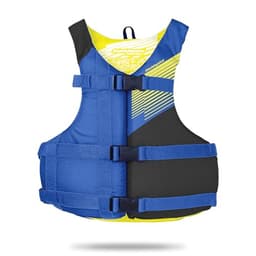
16 lb of published buoyancy and a 30–52" range on one jacket.
Published specs
| Approval | USCG approved Type III |
|---|---|
| Buoyancy | 16 lb (Universal); 18 lb (Oversize) |
| Chest range | 30–52" (Universal); 48–60" (Oversize) |
| Weight | 1.6 lb |
| Shell | 200-denier nylon outer shell and liner |
| Flotation | Polyethylene foam |
Our score, broken out
- Fit range9.5
- Mobility8.0
- Ventilation7.0
- Value8.0
What it gets right
- Stohlquist publishes the buoyancy figure, which most budget vests do not. 16 lb is comfortably above the 15.5 lb Type III minimum.
- A single Universal jacket covers 30–52", so one vest genuinely fits most adults who might borrow your boat.
- Sculpted front and back foam panels rather than one slab, so it does not fight a seat back.
What it gets wrong
- Front-entry three-buckle design takes longer to put on than a side-entry vest.
- Pocket layout is not published, so plan to carry a whistle on a lanyard rather than in the jacket.
Who should skip it
Skip it if you want a vest that is easy to shrug on and off at the ramp. Three buckles is three buckles, every single time.
#2 · Most used boats
Onyx MoveVent Dynamic
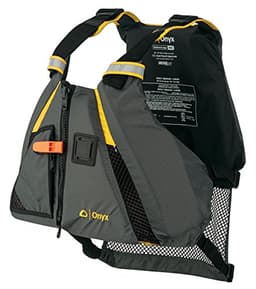
Mesh back panel clears a kayak seat, which is the whole job.
Published specs
| Approval | USCG approved; Transport Canada approved |
|---|---|
| Chest range | 28–56" across three sizes |
| Shell | Nylon ripstop outer shell |
| Back panel | Mesh, to sit above a kayak seat back |
| Expandable zippered pocket with mesh drainage | |
| Reflective | SOLAS grade |
| Buoyancy | Manufacturer does not publish this |
Our score, broken out
- Fit range7.5
- Mobility9.0
- Ventilation8.5
- Value8.5
What it gets right
- The lower-back mesh is the feature that matters on a sit-in kayak — solid foam there fights the seat back and pushes you forward all day.
- Shoulder and side adjustment plus neoprene shoulder pads, which is more adjustment than the cheapest approved vests offer.
- A whistle is included, and a sound-producing device is separately required by the USCG on most waters.
What it gets wrong
- Onyx does not publish a buoyancy figure, so you cannot compare it numerically against vests that do.
- Three broad sizes rather than fine-grained sizing — the fit is good, not tailored.
Who should skip it
Skip it if your chest is at the very top of a size band. The three-size split means you land between sizes more often than with a vest sold in five, and a loose PFD rides up over your ears in the water.
#3 · Chests to 60"
Stohlquist Fit Oversize
The published 48–60" range, with the buoyancy figure to match.
Published specs
| Approval | USCG approved Type III |
|---|---|
| Chest range | 48–60" |
| Buoyancy | 18 lb |
| Shell | 200-denier nylon outer shell and liner |
| Flotation | Polyethylene foam |
Our score, broken out
- Fit range9.5
- Mobility8.0
- Ventilation7.0
- Value8.0
What it gets right
- One of the few budget-market vests that publishes both a 60" chest ceiling and a buoyancy figure, so you can check the fit before you buy rather than after.
- 18 lb of buoyancy rather than the 16 lb Universal — the extra foam is where the extra size goes.
What it gets wrong
- Sold as a separate size line, so stock is thinner than the Universal.
- Front-entry buckles, same as the standard Fit.
Who should skip it
Skip it if your chest is under 48". You will be swimming in it, and a loose PFD is a PFD that rides up.
FAQ
Questions people actually ask
How tight should a kayak life jacket be?
Snug enough that it barely moves when someone pulls firmly up on both shoulder straps, and loose enough that you can take a full deep breath.
Tighten in this order: waist first, then the side straps, then the shoulders last and only enough to remove slack. Most people tighten the shoulders first, which is what makes a jacket ride up.
What size PFD do I need?
Adult PFDs are sized by chest circumference, measured over the layer you actually paddle in. The weight figure on the label — usually '90 lb and over' — is an approval minimum, not a sizing guide.
If you fall between two size bands, size up and take in the side straps. A jacket at the very top of its adjustment has no room for a fleece in cold weather.
Why does my PFD ride up over my ears in the water?
Because the side straps are too loose. In the water the jacket floats and you hang beneath it, so any slack on land becomes several inches of lift in the water.
The fix is the side straps, not the shoulders. If the sides are already fully drawn and it still lifts, the jacket is simply too big for you.
Can a child wear an adult life jacket?
No. Child PFDs are sized by weight rather than chest and are separately rated, and a child can slip straight out of the bottom of an adult jacket.
An adult jacket does not satisfy the carriage requirement for a child either. Look for a crotch strap, and a grab handle behind the neck for younger children.
We have not paddled with any of this gear. Everything above comes from published specifications, cited manuals and live retailer prices. Here is exactly how we pick.
Sources
Read next
Related on Drift & Dime
PFDs & Safety
The best budget kayak life jacketsSix approved vests ranked on fit, mesh back panels and published buoyancy figures.
PFDs & Safety
The best kayak PFDs for bigger paddlersVests with a published chest range past 48 inches — and the buoyancy to match.
PFDs & Safety
The best women's kayak life jacketsWomen's-cut PFDs compared on published flotation, entry style and fit.
PFDs & Safety
Are life jackets required on kayaks?The federal rule, what 'readily accessible' means on a kayak, and where wear is mandatory.