PFDs & Safety
Inflatable versus foam kayak PFDs
An inflatable gives you more buoyancy and less bulk. It also has published limits that rule it out of exactly the water where you most need it.
Disclosure: we earn a commission if you buy through the links on this page, at no extra cost to you. It does not change which products we pick or how we rank them. How this site is funded.
The short answer
Quick picks
Ranked for the person outfitting a used boat: what it costs, what it does, and who should skip it. 3 picks.
| # | Product | Best for | Our score | Price |
|---|---|---|---|---|
| 1 |  Onyx A/M-2422.5 lb inflated — and explicitly not approved for whitewater. Onyx A/M-2422.5 lb inflated — and explicitly not approved for whitewater. | Flat water, warm days | 8.0 | $124.99View on Amazon |
| 2 |  Onyx MoveVent DynamicMesh back panel clears a kayak seat, which is the whole job. Onyx MoveVent DynamicMesh back panel clears a kayak seat, which is the whole job. | Most used boats | 8.4 | $66.32View on Amazon |
| 3 |  Stohlquist Fit16 lb of published buoyancy and a 30–52" range on one jacket. Stohlquist Fit16 lb of published buoyancy and a 30–52" range on one jacket. | Sharing one vest | 8.2 | $49.99View on Amazon |
The short answer
An inflatable PFD is a legitimate choice for flat water in warm weather, and the wrong choice for moving water, cold water, or anyone who will not maintain it. That is not a matter of opinion — the manufacturer’s own published approval limits say so.
Side by side, on published figures
| Inflatable (Onyx A/M-24) | Foam (Type III paddle vest) | |
|---|---|---|
| Approval | Type V with Type III performance | Type III |
| Buoyancy | 22.5 lb, inflated | 15.5 lb minimum; 16–18 lb where published |
| Buoyancy before it fires | None | All of it, always |
| Whitewater | Not approved | Approved |
| Minimum user | Over 16 years, over 80 lb | Typically 90 lb and over |
| Maintenance | Cylinder and bobbin, checked and replaced | Visual inspection only |
| Bulk on the torso | Minimal until deployed | Constant |
What the inflatable genuinely wins
Buoyancy. 22.5 pounds inflated is materially more than any foam jacket on this site, and Onyx publishes the number.
Heat. This is the real reason people buy them. A foam vest in August is hot, and a hot vest comes off. An inflatable you will actually keep on beats a foam vest sitting behind your seat, and that comparison — not inflatable versus foam-worn-perfectly — is the one that matters for a lot of paddlers.
Mobility. Nothing under your arms, nothing against a seat back, no interference with rotation.
What foam wins, and why it is not close on moving water
It works without doing anything. Foam has no failure mode. No cylinder to corrode, no bobbin past its date, no re-arming after a deployment, nothing to forget.
It works for an unconscious paddler. A manual inflatable does nothing at all if you are not awake to pull the cord. An automatic fires on immersion, which is better, but there is still a delay and still a mechanism.
It works in whitewater, and the inflatable is not approved for it. This is the decisive point. Onyx explicitly lists whitewater paddling among the activities the A/M-24 is not approved for, alongside personal watercraft and towed sports. In moving water you can be recirculated, held under, or hit an obstacle in the seconds an inflatable takes to deploy — and it may deploy under a strainer, which is worse than useless.
Cold water. Cold shock takes your breath and your coordination in the first minute. That is the worst possible moment to need to find and pull a cord.
Choose by water, not by preference
Wear foam if you paddle rivers with any current, anything classed as whitewater, cold water, or water where a capsize could knock you against something. Wear it if you are under 16 or under 80 pounds, because the inflatable’s approval excludes you. Wear it if you would not reliably check a cylinder every season.
An inflatable is reasonable if you paddle flat, warm, open water; you are within the published age and weight limits; and the honest alternative in your case is not wearing anything at all.
The compromise most people land on: a foam vest for spring and fall and moving water, an inflatable for flat summer days. Two jackets sounds extravagant until you notice that the cheapest approved foam vest is not expensive, and the whole point is having one on.
If you buy an inflatable, the maintenance is not optional
Check the green indicator before every trip — it tells you the cylinder is engaged and unpierced. Weigh or inspect the CO₂ cylinder annually, because a slow leak is invisible. Replace the automatic bobbin on the schedule printed on it, typically every one to three years. Re-arm immediately after any deployment, including an accidental one in the boot of a car.
Every one of those is a step a foam vest does not have, and every one of them is a step somebody skips. That is the real argument for foam on a budget boat: it fails safe, and it does not depend on you.
In full
Every pick, in detail
Specs below are the manufacturer's published figures, cited per product. Where a maker does not publish a number, the row says so rather than guessing at it.
#1 · Flat water, warm days
Onyx A/M-24
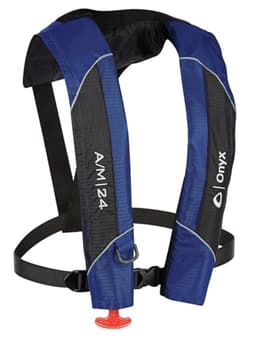
22.5 lb inflated — and explicitly not approved for whitewater.
Published specs
| Approval | USCG approved Type V with Type III performance |
|---|---|
| Buoyancy | 22.5 lb when fully inflated |
| User limits | Over 16 years of age and over 80 lb |
| Chest range | 30–52", universal |
| Inflation | Water-activated or pull cord; convertible to manual only; oral backup tube |
| Shell | 200D nylon ripstop and 200D nylon oxford |
| Not approved for | Personal watercraft, whitewater paddling, water skiing, kneeboarding or similar towed activities |
Our score, broken out
- Fit range8.0
- Mobility9.5
- Ventilation9.5
- Value6.0
What it gets right
- 22.5 lb inflated is more buoyancy than any foam vest on this page, and Onyx publishes the number.
- Almost nothing on your torso until it fires, which is why people who refuse to wear a PFD will actually wear this one.
What it gets wrong
- It only works if it inflates. That means a cylinder to check, a bobbin to replace, and a jacket to re-arm after every deployment.
- It does nothing at all for an unconscious paddler until it fires.
Who should skip it
Skip it for whitewater — Onyx's own published limitations exclude it — and skip it for anyone under 16 or under 80 lb, which is also in the approval. On moving water, wear foam.
#2 · Most used boats
Onyx MoveVent Dynamic
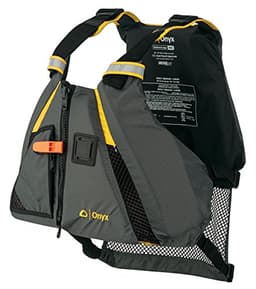
Mesh back panel clears a kayak seat, which is the whole job.
Published specs
| Approval | USCG approved; Transport Canada approved |
|---|---|
| Chest range | 28–56" across three sizes |
| Shell | Nylon ripstop outer shell |
| Back panel | Mesh, to sit above a kayak seat back |
| Expandable zippered pocket with mesh drainage | |
| Reflective | SOLAS grade |
| Buoyancy | Manufacturer does not publish this |
Our score, broken out
- Fit range7.5
- Mobility9.0
- Ventilation8.5
- Value8.5
What it gets right
- The lower-back mesh is the feature that matters on a sit-in kayak — solid foam there fights the seat back and pushes you forward all day.
- Shoulder and side adjustment plus neoprene shoulder pads, which is more adjustment than the cheapest approved vests offer.
- A whistle is included, and a sound-producing device is separately required by the USCG on most waters.
What it gets wrong
- Onyx does not publish a buoyancy figure, so you cannot compare it numerically against vests that do.
- Three broad sizes rather than fine-grained sizing — the fit is good, not tailored.
Who should skip it
Skip it if your chest is at the very top of a size band. The three-size split means you land between sizes more often than with a vest sold in five, and a loose PFD rides up over your ears in the water.
#3 · Sharing one vest
Stohlquist Fit
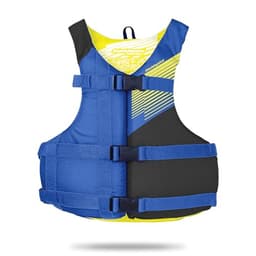
16 lb of published buoyancy and a 30–52" range on one jacket.
Published specs
| Approval | USCG approved Type III |
|---|---|
| Buoyancy | 16 lb (Universal); 18 lb (Oversize) |
| Chest range | 30–52" (Universal); 48–60" (Oversize) |
| Weight | 1.6 lb |
| Shell | 200-denier nylon outer shell and liner |
| Flotation | Polyethylene foam |
Our score, broken out
- Fit range9.5
- Mobility8.0
- Ventilation7.0
- Value8.0
What it gets right
- Stohlquist publishes the buoyancy figure, which most budget vests do not. 16 lb is comfortably above the 15.5 lb Type III minimum.
- A single Universal jacket covers 30–52", so one vest genuinely fits most adults who might borrow your boat.
- Sculpted front and back foam panels rather than one slab, so it does not fight a seat back.
What it gets wrong
- Front-entry three-buckle design takes longer to put on than a side-entry vest.
- Pocket layout is not published, so plan to carry a whistle on a lanyard rather than in the jacket.
Who should skip it
Skip it if you want a vest that is easy to shrug on and off at the ramp. Three buckles is three buckles, every single time.
FAQ
Questions people actually ask
Are inflatable life jackets good for kayaking?
For flat, warm, open water they are a reasonable choice: the Onyx A/M-24 publishes 22.5 lb of buoyancy inflated, which is more than any foam vest, with almost no bulk until it fires.
For moving water they are not. Onyx's published approval explicitly excludes whitewater paddling, and in current you can be held under or hit something in the seconds a jacket takes to deploy.
Does an inflatable PFD count as required equipment?
Yes, if it is Coast Guard approved and worn in accordance with its approval. Most inflatables are approved as Type V with Type III performance, and a Type V only counts toward the carriage requirement when it is actually being worn.
A foam Type III counts whether worn or stowed within reach, which is a real practical difference.
How often do you have to service an inflatable life jacket?
Check the green status indicator before every trip. Inspect the CO2 cylinder annually, since a slow leak is invisible. Replace the automatic bobbin on the schedule printed on it, typically every one to three years.
Re-arm immediately after any deployment, including an accidental one. A foam vest has none of these steps, which is the strongest argument for foam on a budget setup.
We have not paddled with any of this gear. Everything above comes from published specifications, cited manuals and live retailer prices. Here is exactly how we pick.
Sources
Read next
Related on Drift & Dime
PFDs & Safety
The best budget kayak life jacketsSix approved vests ranked on fit, mesh back panels and published buoyancy figures.
PFDs & Safety
Are life jackets required on kayaks?The federal rule, what 'readily accessible' means on a kayak, and where wear is mandatory.
PFDs & Safety
The kayak safety kit checklistThe required items, the genuinely useful ones, and the padding to skip.