Racks & Transport
The best kayak hoists
A hoist gets the boat off the garage floor and out of the way of the car. What you are actually buying is a brake that holds when you let go of the rope.
Disclosure: we earn a commission if you buy through the links on this page, at no extra cost to you. It does not change which products we pick or how we rank them. How this site is funded.

The short answer
Quick picks
Ranked for the person outfitting a used boat: what it costs, what it does, and who should skip it. 3 picks.
| # | Product | Best for | Our score | Price |
|---|---|---|---|---|
| 1 |  StoreYourBoard Kayak and Canoe Ceiling Hoist150 lb, a 2:1 pull and a center strap that stops the hull swinging. The sensible middle of this category. StoreYourBoard Kayak and Canoe Ceiling Hoist150 lb, a 2:1 pull and a center strap that stops the hull swinging. The sensible middle of this category. | Most garages | 8.1 | $49.99View on Amazon |
| 2 |  RAD Sportz Kayak Storage Hoist125 lb, 52 feet of rope and an automatic rope brake, for about the price of a tank of gas. Basic, and mostly enough. RAD Sportz Kayak Storage Hoist125 lb, 52 feet of rope and an automatic rope brake, for about the price of a tank of gas. Basic, and mostly enough. | The cheapest way off the floor | 7.6 | $29.71View on Amazon |
| 3 |  Harken HoisterA sailing-hardware company's pulley system with a self-locking cleat and a five-year warranty. The one that feels like equipment rather than a kit. Harken HoisterA sailing-hardware company's pulley system with a self-locking cleat and a five-year warranty. The one that feels like equipment rather than a kit. | The hoist you stop thinking about | 7.1 | $113.95View on Amazon |
What you are actually buying
Every hoist in this category is the same four parts: two ceiling brackets, a pair of pulleys, a length of rope, and straps or hooks that take the hull. The prices run from about the cost of a paddle leash to about the cost of a decent paddle, and the parts list barely changes.
What changes is the brake. A hoist without a reliable locking mechanism is a rope you are holding, and the moment you let go with a 60-pound boat overhead, the failure mode is your car roof. The systems here handle that three different ways, and it is the single spec worth paying for.
If the boat can live on the floor or against a wall instead, a rack is simpler and cheaper — that is the kayak storage rack roundup. A hoist earns its place when the floor and the walls are already spoken for and the ceiling is the only space left.
How we ranked these
Four criteria, weighted equally and published on how we pick:
- Capacity. Published maximum load against a rigged fishing kayak, which is heavier than people remember.
- Safety. The locking mechanism, and what the maker says about what happens when you drop the rope.
- Install. Ceiling height range, joist compatibility, and what is in the box.
- Value.
The published numbers, side by side
| Spec | StoreYourBoard | RAD Sportz | Harken Hoister |
|---|---|---|---|
| Capacity | 150 lb | 125 lb | 60 lb (this listing) |
| Mechanical advantage | 2:1 | Not published | 3:1 on the 4-point system |
| Ceiling height | 8–10 ft | Up to 12 ft | 10, 12 or 16 ft versions |
| Warranty | Lifetime | Not published | 5 years |
Read that table and the expensive one looks worst, which is exactly why the table is not the whole story.
Capacity is not the number you think
150 lb sounds like twice as much hoist as 60 lb. In practice every system here carries a kayak, because a kayak is not heavy — a recreational sit-in is typically under 50 lb and a rigged fishing sit-on-top is usually somewhere near 70 to 100.
The Harken’s 60 lb limit is the one that genuinely rules boats out. A loaded fishing kayak exceeds it, and a limit you exceed is not a margin, it is a fault. Weigh your boat — with the seat and the crate in, because that is how it will go up — before you choose.
The other end matters too. Harken publishes a minimum working load of 15 lb on its 4-point Hoister system. These are load-operated systems; below a certain weight they do not behave.
The brake is the product
Three approaches, in descending order of how much I would trust them with a boat above a car:
A self-locking cleat. Harken’s system grips instantly if the rope is dropped, and the company states the load lifts evenly regardless of weight distribution. Harken makes sailing hardware for a living, and this is the version of the mechanism that reads like equipment rather than a hardware-store kit.
A cam or rope brake. RAD Sportz publishes an automatic locking brake that pinches the rope with every pull, plus a wall cleat to tie off. It works; it is also the part to test deliberately with the boat a foot off the ground before you trust it at ceiling height.
A cleat and your knot. The floor of the category. If a hoist relies on you tying off correctly every time, the failure is eventually a human one.
Installing it: the parts that are not in the box
The hoist comes with brackets, pulleys, rope and hardware. What it does not come with is a plan for your garage, and that is where these go wrong.
Find the joists and mark them both. Brackets screw into structure, never into drywall alone. Both StoreYourBoard and RAD Sportz publish that their brackets mount either parallel or perpendicular to joists, which is the flexibility you need when the joist spacing does not match the boat.
Set the bracket spacing to the boat, not the ceiling. The two lift points want to be roughly a third of the boat's length in from each end — the same support positions you would use on crossbars. Too close together and the ends cantilever; too far apart and the boat is unstable as it rises.
Check the swing of the garage door before you drill. The most common mistake in this whole category is hoisting a kayak straight into the arc of an opening sectional door. StoreYourBoard publishes that a stowed kayak sits roughly four to six inches below the ceiling, which is the figure to measure against your door track.
Mount the cleat where you can reach it safely. Not behind where the car parks, and not so high you are reaching over your head to tie off a loaded line.
Raising and lowering without damaging anything
A hoist is a slow, boring device when used properly and an exciting one when rushed.
- Move the car first. Every time. The failure mode of this category is a boat landing on a roof.
- Balance the boat before it leaves the ground. Lift a foot, check it hangs level, adjust the straps, then continue. A boat that hangs nose-down will slide.
- Pull hand over hand, not in jerks. Shock loads are what find the weak link in a cheap system.
- Tie off to the cleat even if the brake holds. Belt and suspenders, on a device suspending sixty pounds over your car.
Lowering is the same in reverse, and it is where most people get careless because the boat is coming down anyway.
Straps, not hooks, under a plastic hull
Most cheap hoists ship with two hooks. Two hooks under a polyethylene hull put the entire weight of the boat on two small contact points, for months at a time, and polyethylene creeps.
The better arrangement is wide straps carrying the hull at two points roughly a third in from each end, with a center strap linking them so the boat cannot rotate. StoreYourBoard publishes exactly that setup, including the center connecting strap, and it is the reason it is the pick for most garages.
Whatever you buy, do not hang a kayak by its grab handles. They are rated for carrying, not for hanging, and on a used boat they are the part most likely to be perished already — which is one of the checks on what to fix on a used kayak.
Rope, and the part that wears
The rope is the consumable in a hoist, and it is the part nobody inspects.
Harken publishes double-braided rope and ball-bearing pulleys; RAD Sportz publishes 52 feet of rope supplied. Whatever yours came with, the wear happens where the rope passes through the pulley under load and where it sits on the cleat. Run the rope through your hand twice a season and look for flattening, glazing or a core that feels different under the cover.
Replace rather than repair. Rope is cheap and it is the single component holding a boat above your car.
Which way up, and for how long
Hull down, deck up is wrong for long storage. A hull resting on two straps for a whole winter will take a set, and the flat spot that results is very hard to reverse.
The better options are on edge, or deck-down with the weight spread across a wide strap. Either way, slacken and re-position the boat once or twice over a long storage season, and check the hull in spring before you decide the boat handles oddly.
The same logic governs every long-term storage decision, indoors or out; the outdoor version, where UV joins the problem, is on how to store a kayak outside.
Installing into an actual garage
Three things decide whether this goes well, and none of them is the hoist.
Find the joists. Brackets go into structure, not into drywall, and both StoreYourBoard and RAD Sportz publish that their brackets mount either parallel or perpendicular to joists. Spacing the brackets to the boat matters more than spacing them to convenient joists.
Check the garage door. The most common mistake is hoisting a boat into the arc of an opening door. StoreYourBoard publishes that a stowed kayak sits roughly four to six inches below the ceiling, which is the number to measure against your door track.
Check the rope length. RAD Sportz supplies 52 feet and states ceilings up to 12 ft; the Harken comes in 10, 12 and 16 ft versions. Buying the version that matches your ceiling avoids a coil of surplus rope in the one place you walk past every day.
When a hoist is not the right answer
Three situations where something else is better, and it is worth checking before you drill into a ceiling.
You use the boat weekly. A hoist adds a few minutes at each end of every trip. A wall rack or a freestanding rack lets you grab the boat and go, and those are compared on the kayak storage rack roundup.
You cannot lift the boat at all. A 2:1 hoist halves the effort; it does not remove it. If getting the boat onto a car roof is already at your limit, the honest answer may be a lighter boat or a different storage location rather than more rope.
Your ceiling is not sound. Old garages, finished ceilings with unknown structure, and rafters that are already carrying storage are all reasons to stop. A hoist concentrates the whole load on two small areas of your roof structure.
Two boats, one garage
Two hoists side by side work, and StoreYourBoard sells its system in a two-pack for exactly that. The thing to plan is not the hoists but the gap between them: two kayaks hanging close together will knock against each other every time you raise one.
Stagger them front to back if the garage is long enough, or hang one hull-up and one hull-down so the widest parts are not at the same height. And add the weights together before you trust a single ceiling area with both.
What we would buy
For most garages, the StoreYourBoard. 150 lb, a published 2:1 pull, a center connecting strap that stops the hull swinging, and a lifetime warranty at a mid-range price.
If you want this to cost almost nothing, the RAD Sportz. 125 lb, 52 ft of rope, an automatic brake and rubber-coated hooks — test the brake low before you trust it high, and sling the boat in straps rather than hooking the handles.
If the boat is light and you want the best mechanism, the Harken — but only if your kayak and its gear are under 60 lb. It is the one system here built by a company whose day job is load-bearing hardware.
In full
Every pick, in detail
Specs below are the manufacturer's published figures, cited per product. Where a maker does not publish a number, the row says so rather than guessing at it.
#1 · Most garages
StoreYourBoard Kayak and Canoe Ceiling Hoist
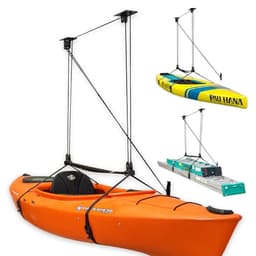
150 lb, a 2:1 pull and a center strap that stops the hull swinging. The sensible middle of this category.
Published specs
| Capacity | 150 lb |
|---|---|
| Mechanical advantage | 2:1 |
| Ceiling height | Fits ceilings 8 ft to 10 ft |
| Materials | Solid alloy steel components, high-strength loading straps, cam buckles |
| Joists | Mounts parallel or perpendicular to joists |
| Stowed clearance | Top of the kayak sits roughly 4–6 in below the ceiling |
Our score, broken out
- Capacity8.5
- Safety7.5
- Install8.0
- Value8.5
What it gets right
- The center connecting strap ties the two pulley points together, which is what stops a hull rotating or sliding out sideways in long-term storage.
- 150 lb covers any kayak this site is about, including a rigged fishing sit-on-top with a crate still in it.
- Published ceiling range and published stowed clearance, so you can work out whether the boat clears your garage door track before you buy.
What it gets wrong
- 2:1 halves the effort and no more. Lifting a 70 lb boat still feels like lifting 35 lb, over your head, on a rope.
- The 8–10 ft ceiling range rules out tall garages and barns; StoreYourBoard sells a longer-lift version for those instead.
- Straps hold the hull by compression. Leave a boat slung for a whole winter and check the hull for flat spots in spring.
Who should skip it
Skip it if your ceiling is over 10 feet — you will run out of rope, and the longer version exists for exactly that.
#2 · The cheapest way off the floor
RAD Sportz Kayak Storage Hoist
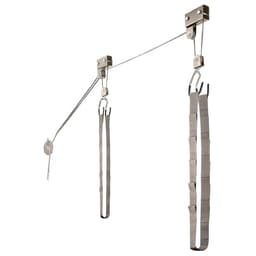
125 lb, 52 feet of rope and an automatic rope brake, for about the price of a tank of gas. Basic, and mostly enough.
Published specs
| Capacity | 125 lb |
|---|---|
| Rope | 52 ft supplied |
| Ceiling height | Up to 12 ft |
| Brake | Automatic locking rope brake; wall cleat supplied |
| Hooks | Rubber-coated |
| Size | 14" × 12.75" × 10" |
Our score, broken out
- Capacity7.5
- Safety6.0
- Install7.5
- Value9.5
What it gets right
- Cheapest route to getting a boat off a garage floor, and getting it off the floor is most of the benefit.
- A published 125 lb capacity and 52 ft of rope means it suits a 12-foot ceiling without a separate rope purchase.
- Rubber-coated hooks, which matters when the thing they touch is a polyethylene hull you do not want dented.
What it gets wrong
- The rope brake is the only thing between a loaded hoist and your car. Test it with the boat a foot off the ground before you trust it overhead.
- RAD Sportz publishes no mechanical advantage figure, so how hard this pulls is unknown until it is on your ceiling.
- Bare hooks under a hull concentrate load in two places. Sling the boat in straps rather than hooking it by its grab handles.
Who should skip it
Skip it if you want a load-tested, warrantied system rather than a value one. Harken and StoreYourBoard publish more, and warranty more.
#3 · The hoist you stop thinking about
Harken Hoister
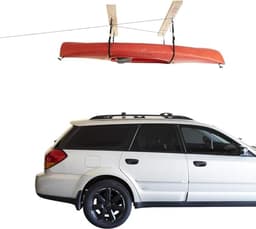
A sailing-hardware company's pulley system with a self-locking cleat and a five-year warranty. The one that feels like equipment rather than a kit.
Published specs
| Maximum load | 60 lb (this listing) |
|---|---|
| Lift height | 16 ft (10 and 12 ft versions also sold) |
| Safety | Self-locking cleat grips if the rope is dropped |
| Hardware | Stainless steel, double-braided rope, ball-bearing pulleys |
| Warranty | 5 years |
| Origin | Made in the USA |
Our score, broken out
- Capacity6.0
- Safety9.5
- Install7.5
- Value5.5
What it gets right
- The anti-drop cleat is the feature that matters. A hoist that holds when you let go of the rope is a different object from one that does not.
- Ball-bearing pulleys and double-braided rope are ordinary marine hardware for Harken, and they are why this pulls smoothly with a loaded boat on it.
- Three lift heights, so a 12-foot garage ceiling does not force you into a coil of surplus rope.
What it gets wrong
- It is the most expensive hoist here by a wide margin, for a 60 lb limit that two cheaper systems beat on paper.
- Harken's 4-point Hoister system also publishes a 15 lb MINIMUM working load — these systems want a load to work against, so an empty rig does not behave.
- No straps sized for a hull in the box on every version; check what your listing includes before you assume.
Who should skip it
Skip it if your kayak plus gear is over 60 lb. The limit is the limit, and a heavy fishing sit-on-top will exceed it.
FAQ
Questions people actually ask
How much weight can a kayak hoist hold?
It varies more than you would expect. StoreYourBoard publishes 150 lb, RAD Sportz publishes 125 lb, and the Harken Hoister listed here publishes 60 lb.
Weigh your boat with the seat and crate in before choosing. A recreational sit-in is often under 50 lb, but a rigged fishing sit-on-top can be 70 to 100 lb, which rules out the lowest-rated systems.
Is a kayak hoist safe?
It depends entirely on the locking mechanism. A hoist with a self-locking cleat grips instantly if you drop the rope; a hoist that relies on you tying off correctly every time will eventually meet someone in a hurry.
Test whatever you buy with the boat a foot off the ground before trusting it at ceiling height, and never park a car underneath while you are raising or lowering.
Can you hang a kayak by its handles?
No. Grab handles are rated for carrying, not for hanging, and on a used boat they are often already perished from UV.
Use wide straps under the hull at roughly a third in from each end, with a center strap linking them so the boat cannot rotate. That spreads the load and keeps the hull shape.
Will hanging a kayak damage the hull?
It can, if you hang it the wrong way for months. Polyethylene creeps: a hull resting on two narrow points all winter can take a permanent flat spot.
Store it on edge or deck-down with the weight spread over wide straps, slacken and re-position it once or twice over a long season, and check the hull in spring.
We have not paddled with any of this gear. Everything above comes from published specifications, cited manuals and live retailer prices. Here is exactly how we pick.
Sources
Read next
Related on Drift & Dime
Racks & Transport
The best kayak storage racksWall racks and slings compared on published capacity and hull support.
Racks & Transport
How to store a kayak outsideWhat UV does to a hull, and the rack, cover and protectant that prevent it.
Racks & Transport
The best kayak covers for outdoor storageFull covers and cockpit covers, and how to rig one so it helps rather than hurts.
Outfitting
What to fix on a used kayakWhat matters on a second-hand hull, what is cosmetic, and what to walk away from.