Racks & Transport
How to store a kayak outside
Most used kayaks are cheap because someone stored one badly. Sun, standing water and a hull resting on two hard points are what ruin a boat left outdoors.
Disclosure: we earn a commission if you buy through the links on this page, at no extra cost to you. It does not change which products we pick or how we rank them. How this site is funded.
The short answer
Quick picks
Ranked for the person outfitting a used boat: what it costs, what it does, and who should skip it. 3 picks.
| # | Product | Best for | Our score | Price |
|---|---|---|---|---|
| 1 |  Suspenz EZ Rack125 lb published, on 20-inch padded arms. The default wall rack. Suspenz EZ Rack125 lb published, on 20-inch padded arms. The default wall rack. | A wall with studs | 8.3 | $84.95View on Amazon |
| 2 |  Classic Accessories Stellex Kayak CoverFull-length polyester cover, two sizes, two-year warranty. Rig it off the hull. Classic Accessories Stellex Kayak CoverFull-length polyester cover, two sizes, two-year warranty. Rig it off the hull. | A boat that lives outside | 8.0 | $67.49View on Amazon |
| 3 |  303 Marine Aerospace ProtectantThe UV protectant paddlers actually use on polyethylene, in a 32 oz bottle that will outlast several seasons. 303 Marine Aerospace ProtectantThe UV protectant paddlers actually use on polyethylene, in a 32 oz bottle that will outlast several seasons. | Slowing UV damage | 8.5 | $18.69View on Amazon |
What actually destroys a kayak outdoors
Four things, in order of how much damage they do:
- UV. Sunlight breaks down polyethylene. Color goes first, then the surface goes chalky, then the plastic loses impact strength. A faded boat is not just ugly — heavy fade is the visible signal that the material has been cooking, which is why our used-kayak inspection guide treats it as a warning rather than a cosmetic note.
- Heat plus pressure. A hull resting on two narrow supports in summer heat takes a set. Polyethylene creeps, and a flat spot is very hard to reverse.
- Standing water. Water pooling in a cockpit or a tankwell adds weight, freezes, and finds every marginal seal. Frozen water in a scupper tube is how tubes crack.
- Animals. Mice nest in hulls, wasps build in cockpits, and both are a spring surprise.
Everything below is aimed at those four.
Get it off the ground and onto its side
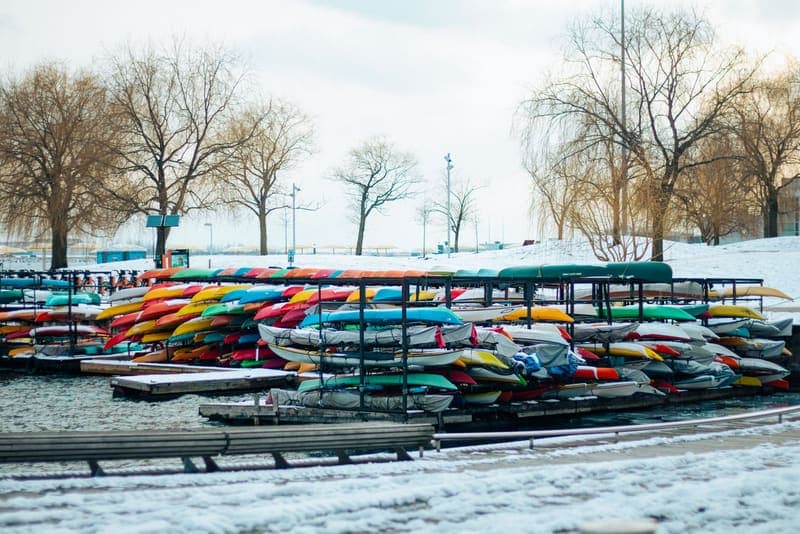
On the ground is the worst place for a kayak. It holds water underneath, it is where animals find it, and on grass it stays damp.
A rack solves it, and the orientation matters as much as the height. On edge or deck-down spreads the load along the strongest part of the structure; hull-down on two bars concentrates it exactly where the creep happens. Suspenz publishes cradles designed for that, and our full comparison of storage racks is on the kayak storage rack roundup.
If the boat is going up rather than out, the ceiling version of the same argument is on the kayak hoist roundup — and outdoors, under a deck or a carport, the same straps and the same re-positioning rules apply.
A cover, and the mistake everyone makes with one
A cover is the cheapest UV protection there is. Laid straight onto a bare hull in the sun, it is also a heat trap and a damp trap: the cover gets hot, the hull under it gets hotter, and condensation has nowhere to go.
The fix is airflow. Cover the boat so the fabric is held off the hull — over a rack, over a couple of pool noodles, over anything that creates a gap — and make sure water runs off rather than pooling. Our cover roundup goes into sizing and fabric, including the difference between a full cover and a cockpit cover.
Two details that decide whether a cover survives the season: it has to be tied down against wind, and it has to be lifted occasionally to let the boat dry. A cover that flogs against a hull all winter sands it.
UV protectant is a habit, not a fix
A marine UV protectant slows the fade. 303 publishes its Marine Aerospace Protectant for vinyl, plastic, rubber and PVC, states it dries to a matte finish with no oily residue, and tells you to apply it to a clean dry surface out of direct sun.
Two honest caveats. First, it is a coating that wears off; nobody publishes a service interval, so treat it as something you do at the start and end of the season rather than a one-time fix. Second, it does not undo damage. On a hull that is already chalky it improves the look more than it restores the plastic.
The matte finish matters on a kayak specifically: a glossy protectant on the deck of a sit-on-top is a slip hazard where you put your feet.
Choosing the spot
Where the boat sits outdoors matters more than anything you buy for it.
Shade beats everything. The north side of a building, under a deck, under a carport, beneath a tree that does not drop sap — any of these does more for the hull than a cover in full sun.
Off the ground, always. Ground contact means damp, animals and, in winter, a hull frozen to whatever it is resting on.
Out of the wind line. A kayak is a wing. A boat that is not tied down will move in a storm, and the damage is rarely to the boat alone.
Away from the drip line of a roof. Constant dripping finds hatches and keeps one patch of hull permanently wet.
Visible, if theft is a concern. A kayak stored beside a road is a kayak someone can carry away. A cable lock through a scupper or a grab handle is not serious security, but it defeats the opportunist.
Straps, cradles and what the hull rests on
Whatever the boat sits on, the rule is the same as indoors: spread the load, and do not leave it in one place for months.
Wide cradles or a sling beat narrow bars. Foam or carpet between the hull and any hard surface prevents the pressure points that become flat spots. And if the boat is strapped down for wind, check the straps seasonally — webbing tightens as it dries and shrinks, and a strap that was snug in September can be compressing a hull by January.
The full argument about how storage position deforms a hull, with the racks that avoid it, is on the kayak storage rack roundup.
Water, and the plug
Store the boat so water runs out, not in.
On a sit-on-top that means deck-down or on edge, with the drain plugout so any water that gets in can leave. On a sit-in, cockpit down or cockpit covered. A boat stored cockpit-up under an open sky is a bathtub with a fifty-gallon capacity, and in winter that water freezes.
Keep the plug somewhere you will find it. A drain plug is the cheapest part on a kayak and the one most likely to be missing on a used boat.
Animals, and the compartment you forgot
A kayak stored outdoors is a dry, sheltered tube, which is exactly what a mouse is looking for in October.
Block the cockpit of a sit-in with a cockpit cover, and close or block hatches on a sit-on-top — while still allowing some air movement, because a completely sealed damp compartment grows mold instead. Wasps build in cockpits and under seats; check before the first paddle rather than discovering it half a mile offshore.
The other resident nobody expects is water-borne: a boat stored where it collects leaves ends up with a wet mat of organic material against the hull, which stains and holds damp. Tip the boat so debris runs off rather than collecting.
Cover care, and when a tarp is worse than nothing
A cheap poly tarp is the default outdoor cover and it is the one that causes the problems people blame on outdoor storage.
A tarp laid on a hull traps condensation. A tarp left loose flogs in wind and sands the hull it is protecting. And a tarp with pooled water on it is a considerable weight sitting on the deck of your boat.
If a tarp is what you have, hold it off the hull, tension it so it cannot flap, and pitch it so water runs off. A purpose-made cover — sized, with a hem and tie-downs — solves those three problems by design, and the sizing and fabric details are on the kayak cover roundup.
Wash a cover occasionally too. Grit trapped between a cover and a hull is an abrasive held against the boat by every gust.
Winter, specifically
Cold does not hurt polyethylene much. Water does, and so does weight.
- Do not let snow load sit on a hull. A foot of wet snow on an unsupported span is real weight in exactly the wrong place.
- Slacken the straps. Straps that are tight in October are tighter in January when the fabric shrinks and the hull contracts.
- Leave hatches cracked or covers off. A sealed, damp compartment all winter grows things.
- Move the contact points once. Mid-winter, shift the boat a few inches on its cradles. It costs a minute and prevents the set.
The spring check
A boat that has been outside all winter deserves ten minutes before it goes back on the water, and the checks are the same ones you would make buying a used kayak.
- Look for light through the hull at the bow, stern and around every fitting.
- Lift the bow and listen for water sloshing inside.
- Sight along the hull for a flat spot or a twist that was not there in the autumn.
- Flex the deck fittings and handles. UV kills these before it kills the hull.
- Check the bungees. Perished deck cord is the most reliable sign that a boat has had a hard winter.
The full inspection, and which faults are cosmetic rather than structural, is on what to fix on a used kayak.
Paddles, seats and the soft gear
The hull tolerates outdoor storage far better than the things that go with it.
Bring the paddle, the life jacket and the seat indoors. Foam in a PFD degrades in UV, webbing fades and weakens, and a seat left strapped in all winter holds water against the deck. None of that takes much space in a garage or a closet, and all of it costs more to replace than the effort of carrying it inside.
What this costs, and what it saves
A rack, a cover and a bottle of protectant together cost a fraction of what a kayak costs, and considerably less than the discount you take on a sun-ruined hull when you sell it.
The order to buy in, if you are staging it: rack first, because getting the boat off the ground and onto its side fixes three of the four problems at once. Cover second. Protectant third, because it is the one that only slows things down rather than preventing them.
Inflatables and composites are different
Everything above assumes a polyethylene hull, which is what most cheap used kayaks are. Two other materials behave differently outdoors.
Composite boats — fiberglass, Kevlar, carbon — do not creep the way polyethylene does, so hull support matters slightly less. Their gelcoat is still UV-sensitive, and water sitting in a scratch through the gelcoat is a worse problem than on plastic.
Inflatables should not be stored inflated outdoors at all. Heat raises internal pressure, sun degrades the fabric coating, and a partially inflated boat holds water in folds. Dry it completely, deflate it, and store it indoors — which is the one case where outdoor storage is not a reasonable compromise.
The free version
If you are not buying anything today, you can still do most of this:
- Put the boat on its edge against a wall, on foam or carpet, not on bare concrete.
- Put it in the shade — north side of a building beats a tarp in full sun.
- Take the drain plug out and store it upside down or angled so water runs off.
- Tie it down. A kayak is a wing, and wind moves them.
- Block the cockpit or the hatches against animals.
That is free, and it is most of the benefit. The gear above makes it tidier, more durable and easier to keep doing.
In full
Every pick, in detail
Specs below are the manufacturer's published figures, cited per product. Where a maker does not publish a number, the row says so rather than guessing at it.
#1 · A wall with studs
Suspenz EZ Rack
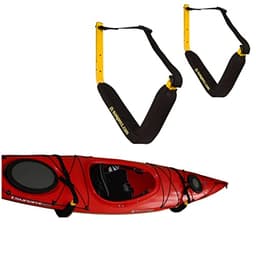
125 lb published, on 20-inch padded arms. The default wall rack.
Published specs
| Capacity | 125 lb |
|---|---|
| Arm extension | 20" from the wall |
| Rack height | 21" |
| Frame | Powder-coated rectangular steel tubing |
| Arms | 600D nylon-covered, foam-padded |
| Included | 2 arms, 2 integrated safety straps, wall hardware |
| Mounting | Wall studs; a TapCon screw set for concrete is sold separately |
| Finish options | Safety yellow or marine-grade black |
Our score, broken out
- Capacity9.0
- Hull protection9.0
- Install7.0
- Value8.0
What it gets right
- 125 lb of published capacity is comfortably more than any polyethylene recreational kayak weighs, so the rating is not the thing you are working around.
- The 20-inch arms hold the hull clear of the wall, which is what stops a stored boat developing a flat spot against drywall over a winter.
- Padded arms and the straps are in the box. A bare steel bracket plus a foam pipe insulation improvisation is the alternative, and it marks hulls.
What it gets wrong
- It wants wall studs, and Suspenz sells the concrete fixing set separately — so a masonry garage is an extra purchase before you can hang anything.
- The quick-release wall bracket and the free-standing hardware are both separate items, so the modularity that makes the system flexible also means the listing price is rarely the finished price.
Who should skip it
Skip it if you rent and cannot drill a wall. That is what a ceiling sling is for, and it costs a fraction of this.
#2 · A boat that lives outside
Classic Accessories Stellex Kayak Cover
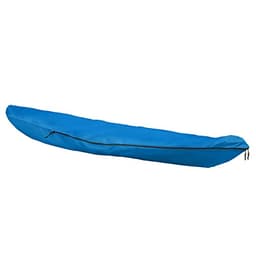
Full-length polyester cover, two sizes, two-year warranty. Rig it off the hull.
Published specs
| Sizes | 144" (fits up to 12 ft); 192" (fits up to 16 ft) |
|---|---|
| Fabric | Polyester Stellex fabric |
| Resistance | UV protection, mildew resistance, shrink resistance |
| Closure | Dual zipper opening with a locking feature (lock not included) |
| Handles | Positioned for installation and carrying |
| Cut | Full-cut, with room for paddles and life vests inside |
| Included | Storage bag |
| Warranty | Two-year limited |
| Fabric weight / denier | Manufacturer does not publish this |
Our score, broken out
- Coverage9.0
- Fabric7.0
- Fit8.5
- Value7.5
What it gets right
- It is a full enclosure with a zipper rather than a drawstring shroud, which is what actually keeps leaves, water and animals out of a boat parked outdoors for a season.
- Two published lengths cover nearly every recreational and fishing hull, and the full cut means the paddle and a vest can live inside it too.
- A two-year warranty on a cover is unusual; most in this category are sold with none.
What it gets wrong
- Classic Accessories does not publish the fabric weight or denier, so you cannot compare its durability on paper against a cover that does.
- A cover laid directly on a hull traps condensation and heat against the plastic. This one still has to be rigged over a line or frame so air moves underneath — the cover does not solve that on its own.
Who should skip it
Skip it if the boat is a sit-in stored under a roof. All you need there is a cockpit cover to keep the weather and the mice out of the hole, at a fraction of the price.
#3 · Slowing UV damage
303 Marine Aerospace Protectant
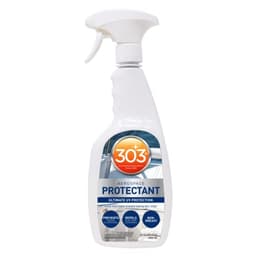
The UV protectant paddlers actually use on polyethylene, in a 32 oz bottle that will outlast several seasons.
Published specs
| Size | 32 oz |
|---|---|
| Protects | Against UV; repels dust, dirt and staining |
| Finish | Dries to a smooth matte finish, no oily residue |
| Surfaces | Vinyl, plastic, synthetic and natural rubber, PVC |
| Use | Apply to a clean dry surface, out of direct sun |
Our score, broken out
- Protection7.5
- Ease9.0
- Coverage9.0
- Value8.5
What it gets right
- UV is what actually kills a polyethylene hull left outside — color goes first, then the plastic goes chalky and brittle.
- Matte rather than greasy, so the deck you sit on does not become a slide.
- One 32 oz bottle treats a kayak many times over, so the per-season cost is trivial.
What it gets wrong
- It is a coating, not a cure. Applied over a hull that is already chalky it improves appearance more than it restores anything.
- It has to be reapplied. Manufacturers do not publish a service interval, so it is a habit rather than a fix.
- It is no substitute for shade or a cover. Storing the boat out of direct sun does far more.
Who should skip it
Skip it if the boat lives indoors or under a cover. The cover is doing the job already.
FAQ
Questions people actually ask
Can you store a kayak outside?
Yes, if you manage sun, water and support. UV is the real enemy: sunlight fades polyethylene, then makes it chalky, then costs it impact strength.
Get the boat off the ground, store it on edge or deck-down so the load is spread, keep water out of the cockpit, and shade or cover it. Done that way, outdoor storage is fine for years.
Should I cover a kayak stored outside?
Yes, but not by laying fabric straight onto a bare hull in the sun. That traps heat and condensation against the plastic.
Hold the cover off the hull so air moves — over a rack, or over something that creates a gap — make sure water runs off rather than pooling, and tie it down so it cannot flog against the hull in wind.
Does a kayak need UV protectant?
It helps, and it is not a cure. A marine protectant like 303's slows fading on plastic and rubber, and 303 publishes that it dries matte with no oily residue — which matters on a deck you stand on.
It wears off and needs reapplying, and no maker publishes a service interval. Shade and a cover do more than any spray.
How should a kayak be stored over winter?
On its edge or deck-down on wide supports, off the ground, with the drain plug out and water able to run off. Cold itself does little harm to polyethylene; trapped water that freezes does.
Slacken the straps, keep snow load off the hull, leave compartments able to breathe, and shift the boat a few inches on its supports once mid-season so it does not take a set.
We have not paddled with any of this gear. Everything above comes from published specifications, cited manuals and live retailer prices. Here is exactly how we pick.
Sources
Read next
Related on Drift & Dime
Racks & Transport
The best kayak storage racksWall racks and slings compared on published capacity and hull support.
Racks & Transport
The best kayak covers for outdoor storageFull covers and cockpit covers, and how to rig one so it helps rather than hurts.
Racks & Transport
The best kayak hoistsCeiling hoists on published capacity, pull ratio and ceiling height.
Outfitting
What to fix on a used kayakWhat matters on a second-hand hull, what is cosmetic, and what to walk away from.