Fishing Rigging
Is a fish finder worth it on a kayak?
Only if you fish water deeper than about 10 feet, or water you do not already know. If that is you, the Garmin STRIKER 4 plus a 12V 9Ah battery is the whole answer. If it is not, spend the money on an anchor trolley and keep the deck clear.
Disclosure: we earn a commission if you buy through the links on this page, at no extra cost to you. It does not change which products we pick or how we rank them. How this site is funded.
The short answer
Quick picks
Ranked for the person outfitting a used boat: what it costs, what it does, and who should skip it. 4 picks.
| # | Product | Best for | Our score | Price |
|---|---|---|---|---|
| 1 |  Garmin STRIKER 43.5-inch screen, CHIRP and real GPS waypoints. Battery not included. | A permanent install | 7.4 | $141.15View on Amazon |
| 2 |  ExpertPower EXP1290A 12V 9Ah sealed AGM in a case small enough to live in a hatch. The size a kayak fish finder was designed around. | The default fish finder battery | 8.0 | $23.50View on Amazon |
| 3 |  Attwood Group 24 Vented Battery BoxA vented, acid-resistant box with a 350 lb-rated strap that meets the Coast Guard hold-down rule. Oversized for a 9Ah cell, and still the right idea. | Containing the battery properly | 8.0 | $8.79View on Amazon |
| 4 | 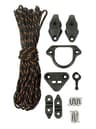 YakAttack LeverLoc Anchor TrolleyFlip-lock line clamp, stealth pulleys and 35 ft of 550 cord. | Moving the pull point | 8.3 | $37.95View on Amazon |
The short answer
If you fish water deeper than about 10 feet, or water you do not know, a fish finder is worth it — and the Garmin STRIKER 4 with a 12V 9Ah battery is the setup to buy. It reads depth and structure, which is the information you genuinely cannot get any other way from a seat 8 inches above the water.
If you fish a familiar pond, a shallow flat or a small river, skip it. In water you can see the bottom of, sonar tells you what your eyes already know, and the deck space, the battery and the wiring are real costs for no return. Buy an anchor trolley instead — it will catch you more fish than a screen will.
And price the whole thing, not the head unit. A finder is a display, a transducer, a battery, a box and a mount. The battery is not optional and it is the cost nobody quotes.
What a finder actually tells you
Managing this expectation is most of the decision, because the name of the product oversells what it does.
A fish finder is excellent at depth. It gives you a continuous, accurate number, and on unfamiliar water that single figure is worth the price of admission — it tells you where the drop-off is, where the channel runs, and whether the flat you are drifting over is 4 feet or 14.
It is good at structure and bottom hardness. Weed beds, timber, rock-to-mud transitions, the edge of a hole. This is where fish live, and finding it is the real use of sonar.
It is mediocre at finding fish, which is the thing people buy it for. A narrow cone under a moving kayak sees a thin column of water. Arches on a screen are returns you have already paddled past by the time you read them, and on a kayak you cannot circle back on a mark the way a bass boat can.
So the honest framing: it is a depth and structure instrument that occasionally shows you a fish. Bought on that basis it is a good purchase. Bought as a fish-locating device it disappoints almost everybody.
How we judged the decision
Three criteria, published on how we pick:
- Does your water hide information? Depth and structure you cannot see is the only thing sonar sells.
- Installed cost, not sticker cost. Head unit plus transducer plus battery plus box plus mount.
- What the same money buys instead. Every dollar on a kayak competes with an anchor trolley, a better seat and a better paddle.
Buy one if this is you
- You fish water over about 10 feet deep. Below that, depth becomes guesswork and the instrument earns its place immediately.
- You fish somewhere new. On an unfamiliar lake a finder compresses a season of learning into an afternoon of paddling around reading the bottom.
- You fish large open water. Reservoirs, big lakes, coastal bays — places with no visible reference for what is underneath you.
- You target structure-oriented fish. Walleye on a break, crappie on timber, bass on a weed edge. Finding the edge is the whole game.
- You fish through ice-out and winter. Fish stack up deep and you are not going to find them by casting at the shoreline.
Skip it if this is you
- You fish one pond you know well. You already have the map in your head. Sonar adds nothing to it.
- You fish shallow or clear water. A flat you can see the bottom of does not need an instrument to tell you the depth.
- You fish small rivers and creeks. Too shallow, too fast, and a transducer hanging under a hull in current is a snag waiting to happen.
- You are rigging a used boat on a budget. The finder is the single most expensive accessory in kayak fishing and the last one that should be bought. The order to buy things in is on the accessories checklist.
- You want to keep the deck clear. A display, a battery box and the cable between them occupy space you may prefer to give to tackle.
The cost nobody quotes
A fish finder is not one purchase, and this is where the decision usually turns.
| Part | Needed? | What it does |
|---|---|---|
| Head unit and transducer | Yes | The display and the sonar itself, normally sold together |
| 12V battery | Yes | No kayak has a power source. 9Ah is the standard answer |
| Battery box | Effectively yes | Keeps a lead-acid battery dry, upright and insulated |
| Mount or arm | Usually | Holds the display where you can read it |
| Transducer mounting | Usually | Inside the hull, through a scupper, or on an arm |
The battery line is the one that surprises people. A head unit is quoted on its own, and then you discover a kayak has no 12V supply, and the power side — battery plus box plus a fuse and terminals — adds a real fraction of the unit price again. We work through the 9Ah arithmetic and what it actually runs on the fish finder battery page.
The castable alternative, honestly
There is a middle option: a castable sonar ball that pairs to your phone, with no battery, no wiring and no transducer to mount. Garmin’s STRIKER Cast is the obvious one and we have reviewed it on its own page.
Where it genuinely wins: zero installation. Nothing is drilled, nothing is wired, nothing has to be un-rigged before you sell the boat. On a used hull you are not sure you are keeping, that matters.
Where it does not: your phone becomes the screen, which means a phone out on deck in reach of spray and a flat phone meaning dead sonar. The published depth capability is also a fraction of a fixed unit’s, which is fine for a lake and irrelevant to the person this page is for — because if you are shallow enough for that limit not to matter, you are probably shallow enough not to need sonar.
Availability on castable units moves around; check before you plan a rig around one. We keep the comparison against the fixed units on the budget fish finder roundup.
What the same money buys instead
This is the part a fish finder roundup cannot tell you, and it is the honest answer for most people reading this page.
An anchor trolley. It lets you hold position on a spot and set the boat at the angle you want to the wind. On a kayak, controlling where you are and which way you point is worth more than knowing what is under you, and it costs a fraction as much.
A better seat. The limit on a kayak fishing day is almost never information. It is your back. A seat that lets you fish five hours instead of three is the highest-return purchase in the category.
A proper paddle. Lighter and correctly sized, so you cover more water with less effort and reach the spots you currently do not bother with.
Nothing, for one season. Fish the water, learn it, and see whether the questions you keep having are depth questions. If they are, buy the finder next spring knowing exactly why.
What it does to the way you fish
A cost that never appears in a review, and it is worth thinking about before you spend: a screen changes where you look.
For the first few trips with a finder, most people watch it. That is time not spent watching the water, the birds, the wind line and the bait — which on a kayak, at water level, is genuinely good information that an angler sitting six feet up on a powerboat does not get as well as you do.
The people who get the most out of sonar on a kayak use it in two short bursts: a lap of the spot on arrival to read the bottom, and a glance at the depth number when something changes. The rest of the time it is ignored. If you cannot imagine using it that way, the money is better spent elsewhere.
It is also a small screen in bright glare, which is its own frustration and is mostly a mounting problem rather than a unit problem. We go through the display figures and what to do about them on the budget fish finder roundup.
Buying one used
Fish finders turn up second-hand constantly, often from people who bought one for exactly the reasons this page says not to. On a used-boat budget that is worth a look, with three checks.
The transducer must be present and undamaged. It is the half of the system that does the actual work, it is expensive to replace on its own, and a cracked or waterlogged one is scrap. Look closely at the cable where it leaves the body, which is where they fail.
Power it up before money changes hands. Any 12V source will do. You are looking for a display with no dead rows of pixels and a unit that boots properly rather than flickering.
Expect to buy the battery new. A sealed lead-acid battery that has sat discharged over a winter is finished, whatever the seller believes, and it is the cheapest part of the system to replace.
Where it all goes on the boat
Weight and trim matter on a kayak in a way they do not on a boat with an engine.
A 9Ah sealed lead-acid battery in a box is a meaningful lump, and the right place for it is low and close to the center of the boat — behind the seat in a tankwell, or in the footwell. High up or far back and you will feel it in the way the hull sits and turns.
Run the cable where it cannot be stepped on, snagged by a strap or caught by a paddle, and leave enough slack to lift the display without unplugging it. The install order, the fuse and the terminal hardware are on the battery page.
Who each of these is for
If the answer is yes: the Garmin STRIKER 4. Garmin publishes its depth range, frequencies and beamwidths, which is the level of detail that lets you know what the cone is covering. The full write-up is on the STRIKER 4 review.
The part people forget: the ExpertPower 12V 9Ah battery. No kayak has power. This is the standard answer and it is not optional.
Keeping that battery alive: the Attwood battery box. Dry, upright and insulated, for a few dollars.
If the answer is no: the YakAttack LeverLoc anchor trolley. Spend the money here. It changes how you fish; a screen mostly changes what you look at.
What we would buy
For most people outfitting a used fishing kayak: the trolley, this season. Fish the water you have, find out whether your unanswered questions are about depth, and buy the finder only if they are.
For the person already fishing deep or unfamiliar water: the STRIKER 4, a 9Ah battery and a box, bought together as one purchase so the real price is visible from the start. That is the version of this decision nobody regrets.
In full
Every pick, in detail
Specs below are the manufacturer's published figures, cited per product. Where a maker does not publish a number, the row says so rather than guessing at it.
#1 · A permanent install
Garmin STRIKER 4
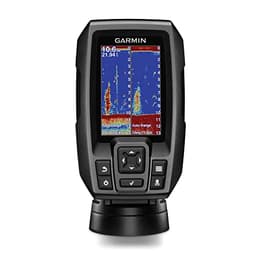
3.5-inch screen, CHIRP and real GPS waypoints. Battery not included.
Published specs
| Display | 3.5" color |
|---|---|
| Sonar | Dual-beam CHIRP, 77/200 kHz |
| Max depth | 1,600 ft freshwater; 750 ft saltwater |
| GPS | High-sensitivity internal receiver; waypoint marking and speed |
| Dimensions | 3.6" W × 5.9" H × 1.6" D |
| In the box | Unit, dual-beam transducer, transom and trolling-motor mounts, tilt/swivel mount, power cable |
| Battery | Not included |
Our score, broken out
- Sonar8.5
- Screen6.5
- Install cost6.0
- Value8.5
What it gets right
- Garmin publishes frequencies, depth capability and dimensions. The sub-hundred-dollar no-name finders publish a screen size and an adjective, and you cannot compare an adjective.
- GPS waypoints matter more from a kayak than from a powerboat, because you cannot hold position — marking the spot is how you find it again after the wind has moved you a hundred yards.
- Transom and trolling-motor mounts plus the tilt/swivel bracket are all in the box, so the mounting problem is partly solved before you start improvising.
What it gets wrong
- Nothing about it is kayak-specific. There is no battery, no kayak-shaped mount and no scupper or in-hull transducer arm, and between them those three are a large share of what the finished installation actually costs.
- Three and a half inches is a small screen, and you are reading it in daylight glare at arm's length while the boat moves.
Who should skip it
Skip it if you are not prepared to buy, charge and carry a sealed lead-acid or lithium battery every trip. The head unit without a power plan is an ornament.
#2 · The default fish finder battery
ExpertPower EXP1290
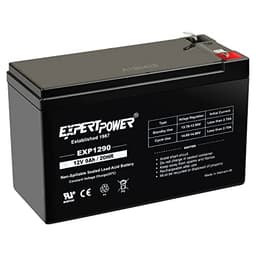
A 12V 9Ah sealed AGM in a case small enough to live in a hatch. The size a kayak fish finder was designed around.
Published specs
| Rating | 12V 9Ah |
|---|---|
| Type | Sealed lead acid, AGM, maintenance free, spill proof |
| Terminals | F2 |
| Dimensions | 5.94" × 2.56" × 3.7" |
| Warranty | 1-year limited |
| Case | Rugged ABS |
Our score, broken out
- Capacity8.0
- Size and weight6.5
- Published specs8.5
- Value9.0
What it gets right
- 9Ah is the right capacity for the job. A small fish finder draws very little, and this runs a full day with margin rather than a full day exactly.
- Published dimensions to the hundredth of an inch, which is what you need when the space is a dry box in a hatch.
- Sealed and spill-proof, so it can lie on its side in a hull that is never level.
What it gets wrong
- It is lead. Roughly a bag of sugar's worth of weight in the boat, in the worst place if you put it high.
- SLA hates being run flat and left. Charge it after every trip or it will not see a second season.
- F2 terminals are bare spades. Fuse the positive lead at the battery and box the whole thing.
Who should skip it
Skip it if weight is your binding constraint. Lithium is a third of the weight — and several times the price for a battery this small.
#3 · Containing the battery properly
Attwood Group 24 Vented Battery Box
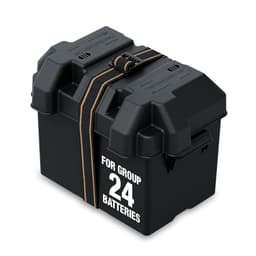
A vented, acid-resistant box with a 350 lb-rated strap that meets the Coast Guard hold-down rule. Oversized for a 9Ah cell, and still the right idea.
Published specs
| Interior | 10.6" × 7" × 10.125" |
|---|---|
| Fits | Group 24 batteries up to 10.125 in tall |
| Material | Polypropylene, impact tested from -20°F to +120°F |
| Venting | Integrated ventilation for battery gases |
| Strap | 40 in, rated 350 lb of force |
| Compliance | Meets USCG 183.420 for OEM-installed battery hold-down systems |
Our score, broken out
- Capacity9.0
- Size and weight5.0
- Published specs9.0
- Value9.0
What it gets right
- A box is not optional on a boat. A loose battery slides, corrodes at the terminals and can short — this is the cheapest part of the whole install and the one that prevents the dangerous failure.
- Vented, which is the correct choice for a lead-acid battery that off-gasses while charging.
- The published 350 lb strap rating and the USCG reference are real numbers in a category full of vague ones.
What it gets wrong
- It is a Group 24 box and a 9Ah fish finder battery is far smaller, so the cell rattles unless you pack it out with foam.
- It takes real deck or hatch space — the interior alone is over 10 inches long.
- Polypropylene is tough but not soft. Strap it down rather than letting it slide against a hull.
Who should skip it
Skip it for a compact dry box instead if space is tight — but do not skip containing the battery altogether.
#4 · Moving the pull point
YakAttack LeverLoc Anchor Trolley
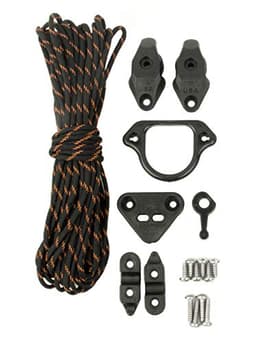
Flip-lock line clamp, stealth pulleys and 35 ft of 550 cord.
Published specs
| Lock | LeverLoc line clamp — flip to lock and release |
|---|---|
| Anchor points | PadHook — a combined pad eye and hook that keeps the line off the gunwale |
| Pulleys | YakAttack Stealth Pulleys |
| Line | 35 ft of USA-made 550 paracord with a reflective tracer |
| Ring | Easy-knot trolley ring |
| Hardware | All installation hardware included |
| HD version | Adds two extra PadHooks and backing plates for the pulleys and the LeverLoc |
Our score, broken out
- Safety9.5
- Hardware8.5
- Install6.5
- Value8.0
What it gets right
- The trolley, not the anchor, is the safety device. It moves the pull point to the bow or the stern so a current cannot swing you broadside, which is the mechanism behind most kayak anchoring accidents.
- The LeverLoc locks the line with a flip rather than a cleat you have to find by feel while the boat is already moving. That is a genuine difference in a real situation, not a convenience feature.
- The HD version ships backing plates, and soft polyethylene under load is exactly where a backing plate earns its money.
What it gets wrong
- It is a drilled installation along one whole side of the hull — four to six new holes — and the standard kit ships self-threading screws rather than the HD's backing plates.
- 550 paracord stretches. That is fine and even desirable in a trolley line, but do not carry it over to the anchor rode, where stretch costs you holding.
Who should skip it
Skip it if you anchor twice a season on flat water with no current. A short rode off a bow toggle does that job with no holes at all, and holes in a used boat are the thing you are trying not to add.
FAQ
Questions people actually ask
Is a fish finder worth it on a kayak?
It depends entirely on your water. If you fish deeper than about 10 feet, or water you do not already know, yes — depth and structure are information you cannot get from a seat 8 inches above the surface, and that is what sonar genuinely sells.
If you fish a familiar pond, a shallow flat or a small river, no. Sonar will tell you what your eyes already know, and the deck space, battery and wiring are real costs for no return. An anchor trolley is the better purchase at a fraction of the price.
What does a fish finder actually show you on a kayak?
Depth, reliably and continuously — which is the most useful thing it does. Then structure and bottom hardness: weed beds, timber, rock-to-mud transitions, the edge of a hole.
It is mediocre at the thing people buy it for. A narrow cone under a moving kayak sees a thin column of water, and by the time an arch appears on screen you have paddled past it — and unlike a powered boat you cannot easily circle back on the mark.
How much does a kayak fish finder cost once it is installed?
More than the head unit, and the gap surprises people. A kayak has no 12V supply, so the power side — a 9Ah battery, a box to keep it dry and upright, a fuse and terminals — adds a real fraction of the unit price again.
Budget for five parts rather than one: head unit and transducer, battery, battery box, a mount for the display, and something to mount the transducer to. Buying them together is the only way to see the real price before committing.
Should I buy a castable fish finder instead?
It is a genuine middle option, and its advantage is that nothing is installed — no battery, no wiring, no transducer to mount, and nothing to un-rig before you sell the boat.
The trade is that your phone becomes the screen, so a phone is out on deck in reach of spray and a flat phone means dead sonar. Published depth capability is also much shallower than a fixed unit's. Check availability before planning a rig around one.
What should I buy instead of a fish finder for kayak fishing?
An anchor trolley, first. Being able to hold a spot and set the boat's angle to the wind matters more on a kayak than knowing what is underneath you, and it costs a fraction as much.
After that, a better seat and a properly sized paddle. The limit on a kayak fishing day is almost never information — it is your back and how much water you can cover. Both of those buy more fishing time than a screen does.
We have not paddled with any of this gear. Everything above comes from published specifications, cited manuals and live retailer prices. Here is exactly how we pick.
Sources
Read next
Related on Drift & Dime
Fishing Rigging
The best budget kayak fish findersFinders compared on published sonar and the true cost of installing one.
Fishing Rigging
The best battery for a kayak fish finder12V 9Ah sealed batteries on published size and weight, plus the box and fuse.
Fishing Rigging
Garmin STRIKER 4 reviewThe classic first kayak fish finder, and the install it actually requires.
Fishing Rigging
The kayak anchor trolley guideWhy side anchoring rolls a kayak, and what a trolley costs in holes.
Fishing Rigging
The kayak fishing accessories checklistWhat to buy to fish from a kayak, in the order that wastes least money.