Fishing Rigging
Garmin STRIKER 4 review
The default first fish finder on a kayak, and the one whose real price is not the price on the box. Here is what it does and what it still needs.
Disclosure: we earn a commission if you buy through the links on this page, at no extra cost to you. It does not change which products we pick or how we rank them. How this site is funded.

The short answer
Quick picks
Ranked for the person outfitting a used boat: what it costs, what it does, and who should skip it. 1 picks.
| # | Product | Best for | Our score | Price |
|---|---|---|---|---|
| 1 |  Garmin STRIKER 43.5-inch screen, CHIRP and real GPS waypoints. Battery not included. Garmin STRIKER 43.5-inch screen, CHIRP and real GPS waypoints. Battery not included. | A permanent install | 7.4 | $139.99View on Amazon |
What it is
The STRIKER 4 is Garmin’s entry fish finder: a 3.5-inch color display with a keyed button interface, dual-beam CHIRP sonar at 77 and 200 kHz, and a high-sensitivity internal GPS receiver for marking waypoints. Garmin publishes a maximum depth of 1,600 feet in fresh water and 750 feet in salt, a display measuring 1.9 by 2.9 inches, an IPX7 water rating, and a built-in flasher view.
On a kayak it has been the default first finder for years, and the reasons are the ones that do not show up in a spec comparison: it is small enough to mount on a deck, the buttons work with wet hands, and it does not need a smartphone to function.
We rank it against the alternatives on the budget kayak fish finder roundup. This page is the closer look at the one unit.
The sonar, in plain terms
CHIRP is the part worth understanding, because it is the main reason this unit reads better than the cheap finders below it.
A traditional sonar pings one frequency. CHIRP sweeps a continuous range of frequencies, which Garmin states provides a wider range of information and creates crisper fish arches with better target separation. In kayak terms: two fish holding a foot apart are more likely to appear as two marks rather than one blob, and the bottom reads as a distinct line rather than a fuzzy band.
The dual beam matters for a different reason. The 200 kHz beam is narrower and sharper for detail under the boat; 77 kHz is wider and covers more water. On a kayak drifting slowly over structure, that width is genuinely useful — you are not moving fast enough to cover ground any other way.
The published depth limits — 1,600 feet fresh, 750 salt — are far beyond anything a kayak angler will fish. They are not a selling point so much as a sign that depth is not the constraint here.
The screen is small, and that is the trade
Garmin publishes 3.5 inches diagonal and 1.9 by 2.9 inches of actual display area. That is small. In bright sun, at arm’s length, with polarized sunglasses on, it is at the limit of readable.
On a kayak that is a more defensible trade than it would be on a boat. The screen sits close to you rather than across a console, there is no room for a seven-inch display anyway, and the smaller unit draws less power from a battery you are also carrying. Garmin sells the same platform in 5 and 7 inch sizes for people who want more.
Two practical notes. The keyed button interface is the right choice for a wet environment — touchscreens and spray do not mix — and the IPX7 rating means the unit tolerates immersion, which on a kayak is not a hypothetical.
GPS and waypoints: the underrated half
This is the feature people forget when comparing the STRIKER 4 with cheaper finders, and it is arguably worth more than the sonar on a kayak.
Garmin publishes a high-sensitivity internal GPS receiver with waypoint marking and speed. You can mark a brush pile, a stump, a dock or a drop and come back to it next month. On a boat with an engine that is convenient; on a kayak, where every trip covers a small area slowly, a library of marked spots is the difference between fishing and searching.
The speed readout has a second use nobody mentions: it tells you your drift rate, which is exactly the number you want when deciding whether to deploy a drift sock — the sizing for which is on the drift sock roundup.
What it is not is chartplotting. There is no base map. You are marking your own points on a blank screen, not navigating a chart.
What the box does not include
This is the part that matters most on a kayak and the part the price tag hides. Garmin publishes plainly that the battery is not included, and the rest follows from that.
- A 12V battery. The standard answer is a 12V 9Ah sealed lead acid, which we cover in detail on the fish finder battery guide.
- A fuse, at the battery. Not optional. A shorted battery in a plastic boat you are sitting in is the one genuinely dangerous failure in this whole category.
- A box for the battery. A bare cell loose in a hull slides, corrodes and leaks.
- A transducer mount. The transducer is in the box; a way to attach it to a kayak is not. Options run from a scupper mount to an arm to marine goop inside the hull.
- Somewhere to put the display. A track mount or a RAM-style arm, which on a boat with no factory track means holes.
Add those up and the real cost of a STRIKER 4 install is meaningfully more than the unit. That is not a criticism of the product — it is the same for every fixed finder — but it is the number to budget, and it is why the castable alternative exists.
Mounting it on a used kayak
Three decisions, in the order they bite.
The transducer. Through-hull shooting — the transducer bedded inside the hull in a pad of marine sealant — works on a single-layer polyethylene kayak and requires no holes at all. It costs a little sensitivity. A scupper-hole mount is tidier for sit-on-tops with a suitable scupper. An arm over the side is the most sensitive and the most vulnerable.
The cable run. Under the gunwale line, not across the footwell, and never pinched under a hatch lip. Every crossing point is a chafe point.
Holes. The standing position on this site is that holes in a second-hand hull are a decision, not a detail. The no-drill options for a used fishing kayak are on rigging a used fishing kayak, and if you do drill, back and seal every fitting.
Settings that matter on a small boat
Three adjustments do most of the work, and all three are on the unit rather than in an app.
The flasher view. Garmin publishes a built-in flasher, described as ideal for ice fishing or vertical jigging. On a kayak holding position over structure, the flasher is arguably the more useful display: it shows what is under you right now rather than a scrolling history of where you have been.
Frequency choice. 200 kHz for detail directly beneath, 77 kHz for a wider cone. Drifting slowly over a flat, the wider beam covers more water per pass, which suits how a kayak actually moves.
Screen brightness. A 3.5-inch display in direct sun is at the limit of readable, and brightness is the setting that decides whether it works — at a real cost in battery draw over a day.
What it draws, and what that means for the battery
Garmin publishes a current draw figure at 12 volts for this unit, and it is small — which is exactly why a 12V 9Ah sealed battery became the standard pairing for kayak installs rather than something larger.
The practical version: a small finder on a 9Ah cell runs a full day with margin. What shortens that is screen brightness and cold weather, not the sonar itself. And the failure that actually strands people is not capacity but neglect — sealed lead-acid batteries die from being stored flat, which is the argument on the fish finder battery guide.
Who should not buy it
Three honest cases.
You do not want to rig the boat. If the battery, the fuse, the box and the transducer mount sound like a project rather than a weekend, the castable unit skips all of it — that comparison is the next page.
You mostly fish very shallow water. Sonar in three feet of water tells you very little, and a pair of polarized sunglasses tells you more.
You want a chart. There is no base map here. If navigation rather than fish-finding is the goal, this is the wrong product family.
The verdict
The STRIKER 4 remains the sensible first fixed finder for a kayak, because the things it does well are the things that matter in a small boat: real CHIRP sonar, real GPS waypoints, buttons that work wet, and a footprint that fits a deck.
The screen is genuinely small, and the honest price is the unit plus a battery, a box, a fuse and two mounts. Budget for that and it is a good buy. Budget only for the box price and you will be disappointed twice — once at checkout and once at the ramp.
In full
Every pick, in detail
Specs below are the manufacturer's published figures, cited per product. Where a maker does not publish a number, the row says so rather than guessing at it.
#1 · A permanent install
Garmin STRIKER 4
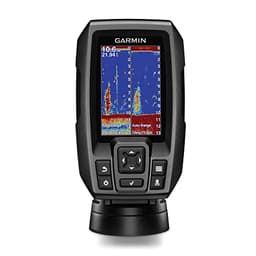
3.5-inch screen, CHIRP and real GPS waypoints. Battery not included.
Published specs
| Display | 3.5" color |
|---|---|
| Sonar | Dual-beam CHIRP, 77/200 kHz |
| Max depth | 1,600 ft freshwater; 750 ft saltwater |
| GPS | High-sensitivity internal receiver; waypoint marking and speed |
| Dimensions | 3.6" W × 5.9" H × 1.6" D |
| In the box | Unit, dual-beam transducer, transom and trolling-motor mounts, tilt/swivel mount, power cable |
| Battery | Not included |
Our score, broken out
- Sonar8.5
- Screen6.5
- Install cost6.0
- Value8.5
What it gets right
- Garmin publishes frequencies, depth capability and dimensions. The sub-hundred-dollar no-name finders publish a screen size and an adjective, and you cannot compare an adjective.
- GPS waypoints matter more from a kayak than from a powerboat, because you cannot hold position — marking the spot is how you find it again after the wind has moved you a hundred yards.
- Transom and trolling-motor mounts plus the tilt/swivel bracket are all in the box, so the mounting problem is partly solved before you start improvising.
What it gets wrong
- Nothing about it is kayak-specific. There is no battery, no kayak-shaped mount and no scupper or in-hull transducer arm, and between them those three are a large share of what the finished installation actually costs.
- Three and a half inches is a small screen, and you are reading it in daylight glare at arm's length while the boat moves.
Who should skip it
Skip it if you are not prepared to buy, charge and carry a sealed lead-acid or lithium battery every trip. The head unit without a power plan is an ornament.
FAQ
Questions people actually ask
Is the Garmin STRIKER 4 good for a kayak?
Yes, and it has been the default first fixed finder on kayaks for years. Garmin publishes dual-beam CHIRP sonar at 77/200 kHz, a high-sensitivity internal GPS for waypoints, an IPX7 rating and a keyed button interface that works with wet hands.
The 3.5-inch screen — 1.9 by 2.9 inches of actual display — is small, which is a more defensible trade on a kayak than on a boat because the unit sits close to you and draws less power.
Does the Garmin STRIKER 4 come with a battery?
No. Garmin publishes that the battery is not included, and on a kayak that is the start of a list: a 12V 9Ah sealed battery, a fuse at the battery, a box to contain it, a transducer mount and something to mount the display on.
The real cost of the install is meaningfully more than the unit price. That is true of every fixed fish finder, not just this one.
How deep does the STRIKER 4 read?
Garmin publishes a maximum depth of 1,600 feet in fresh water and 750 feet in salt water — far beyond anything a kayak angler fishes.
Depth is not the constraint with this unit. Screen size and the install are.
Does the STRIKER 4 have maps?
No base map. It has a high-sensitivity GPS receiver that marks and navigates back to waypoints, plus a speed readout, but it is not a chartplotter.
On a kayak the waypoint function is arguably worth more than the sonar: you mark a brush pile or a drop and return to it months later, which on a boat that covers water slowly is the difference between fishing and searching.
We have not paddled with any of this gear. Everything above comes from published specifications, cited manuals and live retailer prices. Here is exactly how we pick.
Sources
Read next
Related on Drift & Dime
Fishing Rigging
The best budget kayak fish findersFinders compared on published sonar and the true cost of installing one.
Fishing Rigging
Garmin STRIKER Cast reviewCastable sonar for a kayak: no install at all, and what that costs you.
Fishing Rigging
The best battery for a kayak fish finder12V 9Ah sealed batteries on published size and weight, plus the box and fuse.
Fishing Rigging
Rigging a used fishing kayakSealing inherited holes, reusing bolt patterns, and no-drill rigging.