Fishing Rigging
Garmin STRIKER Cast review
A sonar ball on a line that streams to your phone. It skips the battery, the fuse, the transducer mount and every hole in the boat — and gives up real things in exchange.
Disclosure: we earn a commission if you buy through the links on this page, at no extra cost to you. It does not change which products we pick or how we rank them. How this site is funded.

The short answer
Quick picks
Ranked for the person outfitting a used boat: what it costs, what it does, and who should skip it. 1 picks.
| # | Product | Best for | Our score | Price |
|---|---|---|---|---|
| 1 |  Garmin STRIKER CastCastable sonar on your phone. No holes, no bracket, no battery box. Garmin STRIKER CastCastable sonar on your phone. No holes, no bracket, no battery box. | No installation at all | 7.6 | $149.99View on Amazon |
What it is
The STRIKER Cast is a castable sonar: a small buoyant sonar unit you tie to a line, cast or drop over the side, and pair with a phone. Garmin publishes a weight of 75 grams, an IPX7 rating with the unit stated to float, a 2.4 GHz wireless link with a range of 60 meters, sonar at 260 and 455 kHz, and a depth range from under 0.6 meters to 45 meters.
Battery is built in: Garmin publishes a lithium-ion cell good for about 10 hours of typical use and roughly an hour and a half to charge. The listing also states that it powers on when floating in water and turns off when removed, which is the sort of detail that stops a device dying in a hatch.
The display is your phone. There is no screen in the box, and that is the whole design.
Why it exists for kayakers specifically
Every fixed fish finder on a kayak drags four other purchases behind it: a 12V battery, a fuse, a box, and a transducer mount — plus usually a mount for the display and the holes that go with it. We lay that out on the STRIKER 4 review and again on the fish finder battery guide.
The castable unit removes all of it. Nothing is wired, nothing is drilled, nothing is bolted to a hull you may want to resell. For a second-hand kayak that you are not ready to modify — the exact situation this site is written for — that is a genuinely different proposition rather than a lesser one.
It also travels. It fits in a pocket, works from a dock, a bank or a rented boat, and does not care which kayak you are sitting in this week.
The published numbers, and what they mean on the water
Range: 60 meters, about 200 feet. That is the distance between the sonar and your phone, and it is generous for kayak use where the unit is usually a rod length away or tied to the boat.
Depth: from under 2 feet to 150 feet. The shallow end matters more than the deep end for most kayak anglers. Garmin also states the unit performs in both shallow and deep water, and the published lower bound is one of the few places a maker in this category publishes a shallow limit at all.
Frequencies: 260 and 455 kHz, with published beam widths of 22 by 63 degrees at 260 kHz and 9 by 14 degrees at 455 kHz. The wide beam covers water; the narrow one resolves detail.
Battery: 10+ hours, about 1.5 hours to charge. That is a full day with margin, and the charge time means it is ready the evening before rather than overnight.
Tether: 5 meters, which is what it ships with for tying off.
What you give up
Four things, stated plainly, because this is where castable sonar gets oversold.
Continuous sonar while you move. A hull-mounted transducer paints a continuous picture as you drift over structure. A castable unit gives you a picture of where it currently is. You can tow it, but it is not the same as a fixed transducer under the boat.
Your phone becomes the instrument. That means battery drain on the device you also navigate and call for help with, a screen that is hard to read in bright sun, and a piece of expensive non-waterproof electronics out in the weather. A waterproof case and a secure mount stop being optional.
No dedicated GPS waypoints on a screen you own. Garmin publishes Quickdraw contour mapping with the app, but the fixed STRIKER units have their own GPS receiver and mark waypoints without a phone in the loop.
One more thing to lose. It floats and it is tethered, which is exactly the design you want — and it is still a small object on a line near a moving boat.
Using it from a kayak
Three practical notes that are specific to a small boat.
Tie it to the boat, not just the rod. Casting a sonar unit on a rod works from a bank. From a kayak, the sensible arrangement is the unit tethered to a deck fitting and hanging beside or behind the hull, where it reads continuously while you fish.
Mount the phone properly. A phone in a lap is a phone in the water. If the phone is the screen, it needs a real mount and a waterproof case, and that is the one purchase this product does still require.
Keep the crate in mind. Everything about this unit suits the boat that is not permanently rigged — which is the same boat where a milk crate does the work of a fitted console. The layout is on the kayak crate setup.
The app, and what comes with it
The STRIKER Cast app is the whole interface, and two published features are worth knowing about.
Sonar modes. Garmin publishes traditional 2-D sonar and an ice-fishing flasher mode, both streaming wirelessly to the phone. The flasher view is the one that suits a stationary kayak over structure.
Quickdraw contours. Garmin publishes downloadable maps with up to one-foot contours from the Quickdraw Community. On a small local lake with no commercial chart, community contour data is occasionally the only depth map that exists.
What the app cannot fix is the phone it runs on. Screen brightness in sun, battery drain, and the fact that a phone is not waterproof are all real constraints, and they are the reason a case and a mount are part of the true cost of this unit.
Cold weather, battery and the phone problem
Two batteries are in play here, and only one of them is Garmin's.
The sonar unit publishes 10-plus hours and recharges in about an hour and a half over USB. That is not the constraint. Your phone, running a live sonar stream over Bluetooth with the screen bright, is — and in cold weather phone batteries fall off a cliff.
So the honest kit list for this product is the unit, a waterproof phone case, a secure mount, and a power bank for a full day in the cold. That is still far less than a fixed install, but it is not nothing, and it is worth knowing before you compare sticker prices with the STRIKER 4.
Losing it, and not losing it
It is a small object on a line beside a moving boat, so the failure mode is obvious.
Garmin publishes that the unit floats and ships with a 5-meter tether, and that it powers on when floating and off when removed from the water. Those three facts together cover most of the risk: it will not sink, it is attached, and it will not quietly flatten its battery in a dry hatch.
What is left is the knot. Tie it to a deck fitting rather than to a rod if you are fishing from the boat, and check the tether where it meets the unit at the start of each season — that is the part that chafes.
Cast versus fixed: how to choose
The honest split is not about which is better. It is about whether you are rigging the boat.
Buy the castable if the kayak is borrowed, rented, shared, or one you do not want to drill; if you fish from banks and docks as well as the boat; or if the four extra purchases behind a fixed finder are the reason you have not bought one yet.
Buy the fixed unit if the boat is yours and staying yours, if you want continuous sonar while drifting, if you want waypoints on a dedicated screen, or if you would rather not have your phone out in the weather all day.
Both live on the budget fish finder roundup, which ranks them against the rest of the category.
The verdict
For a used kayak that you are not ready to modify, the STRIKER Cast is the more sensible purchase of the two Garmin units, and the published numbers back it: 10-plus hours of battery, 200 feet of range, a depth range that starts under two feet, and a 75-gram unit that floats and switches itself on in the water.
It is not a cheaper fish finder. It is a different one, and what it really sells is the absence of an install. If that absence is the reason you would actually use it, it is the right buy. If you were always going to rig the boat properly, spend the money on the fixed unit and the battery that goes with it.
In full
Every pick, in detail
Specs below are the manufacturer's published figures, cited per product. Where a maker does not publish a number, the row says so rather than guessing at it.
#1 · No installation at all
Garmin STRIKER Cast
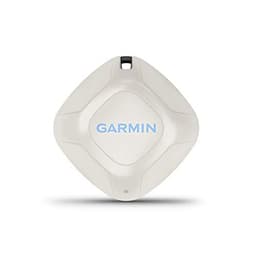
Castable sonar on your phone. No holes, no bracket, no battery box.
Published specs
| Weight | 75 g (2.64 oz) |
|---|---|
| Water rating | Floatable, IEC 60529 IPX7 |
| Wireless | 2.4 GHz; range 60 m (200 ft) |
| Sonar | 260/455 kHz |
| Depth | Less than 0.6 m to 45 m (less than 2 ft to 150 ft) |
| Beamwidth | 22° × 63° at 260 kHz; 9° × 14° at 455 kHz |
| Battery | Built-in lithium-ion; 10 hr typical, about 1.5 hr to charge |
| Tether | 5 m (16 ft) |
| Display | Your phone or tablet — no screen included |
Our score, broken out
- Sonar7.0
- Screen6.0
- Install cost9.5
- Value8.0
What it gets right
- Zero installation. No hole, no bracket, no battery box and nothing to un-rig before you sell the boat, which on a second-hand hull is most of the argument by itself.
- Garmin publishes beamwidths at both frequencies, which is a level of detail almost nothing else at this price gives you and the only way to know what the cone is actually covering.
- It floats and carries an IPX7 rating, so the obvious way to lose it — dropping it over the side — is the one thing it is designed to survive.
What it gets wrong
- Your phone is the screen. A flat phone is a dead sonar, and a phone out on deck in reach of spray is a more expensive problem than the sonar it is displaying.
- 150 feet of depth capability against the STRIKER 4's published 1,600 in freshwater. For a lake that is irrelevant; for anything deep it is the whole story.
- It is sold in versions with and without GPS at meaningfully different prices, and the listings do not always make it obvious which one is in the cart.
Who should skip it
Skip it if you want a display you can leave running all day at a glance. This one lives behind a phone screen lock, and unlocking a phone with wet hands in the sun is its own small misery.
FAQ
Questions people actually ask
Is the Garmin STRIKER Cast good for kayak fishing?
Yes, particularly on a boat you do not want to modify. It removes the battery, fuse, battery box, transducer mount and display mount that a fixed finder needs, which on a second-hand kayak is the whole barrier.
Garmin publishes 10+ hours of battery, a 60 m (200 ft) wireless range, sonar at 260/455 kHz and a depth range from under 2 ft to 150 ft. It weighs 75 g, floats, and powers on when it is in the water.
Does the STRIKER Cast need a phone?
Yes — your phone or tablet is the display, and there is no screen in the box. That means battery drain on the device you also use to navigate and call for help, and a screen that is harder to read in bright sun than a dedicated unit.
If the phone is the instrument, a waterproof case and a secure mount stop being optional accessories.
STRIKER Cast or STRIKER 4 for a kayak?
It depends on whether you are rigging the boat. The Cast suits a borrowed, shared or unmodified kayak, and anyone who also fishes from banks and docks.
The fixed STRIKER 4 suits a boat that is yours and staying yours: it gives continuous sonar while you drift, its own GPS waypoints on a screen you own, and no reliance on a phone — in exchange for a battery, a fuse, a box and two mounts.
How deep does the STRIKER Cast read?
Garmin publishes a depth range from less than 0.6 m to 45 m — under 2 feet to about 150 feet — and states it performs in both shallow and deep water.
The published shallow limit is the more useful figure for kayak anglers, and it is one of the few places a maker in this category publishes one at all.
We have not paddled with any of this gear. Everything above comes from published specifications, cited manuals and live retailer prices. Here is exactly how we pick.
Sources
Read next
Related on Drift & Dime
Fishing Rigging
The best budget kayak fish findersFinders compared on published sonar and the true cost of installing one.
Fishing Rigging
Garmin STRIKER 4 reviewThe classic first kayak fish finder, and the install it actually requires.
Fishing Rigging
Rigging a used fishing kayakSealing inherited holes, reusing bolt patterns, and no-drill rigging.
Fishing Rigging
The kayak crate setupBuilding a crate: rod tubes, tackle, strapping — and no holes in the hull.