Fishing Rigging
The best battery for a kayak fish finder
A small fish finder needs very little power and a great deal of containment. The battery is the cheap part; the box and the fuse are the parts that stop a bad day.
Disclosure: we earn a commission if you buy through the links on this page, at no extra cost to you. It does not change which products we pick or how we rank them. How this site is funded.
The short answer
Quick picks
Ranked for the person outfitting a used boat: what it costs, what it does, and who should skip it. 3 picks.
| # | Product | Best for | Our score | Price |
|---|---|---|---|---|
| 1 |  ExpertPower EXP1290A 12V 9Ah sealed AGM in a case small enough to live in a hatch. The size a kayak fish finder was designed around. ExpertPower EXP1290A 12V 9Ah sealed AGM in a case small enough to live in a hatch. The size a kayak fish finder was designed around. | The default fish finder battery | 8.0 | $23.50View on Amazon |
| 2 |  Mighty Max ML9-12The same 12V 9Ah AGM format with a UL certification and a stated any-orientation mounting claim. Mighty Max ML9-12The same 12V 9Ah AGM format with a UL certification and a stated any-orientation mounting claim. | The same job, UL certified | 7.9 | $24.98View on Amazon |
| 3 |  Attwood Group 24 Vented Battery BoxA vented, acid-resistant box with a 350 lb-rated strap that meets the Coast Guard hold-down rule. Oversized for a 9Ah cell, and still the right idea. Attwood Group 24 Vented Battery BoxA vented, acid-resistant box with a 350 lb-rated strap that meets the Coast Guard hold-down rule. Oversized for a 9Ah cell, and still the right idea. | Containing the battery properly | 8.0 | $10.99View on Amazon |
12V 9Ah is the answer, and here is why
Kayak fish finders are small, low-draw units. The power question is not “how much can I fit” but “what is the smallest thing that comfortably runs a screen for a day.” In practice that has settled on a 12-volt, 9 amp-hour sealed lead-acid battery, and both batteries here are exactly that.
The format matters more than the brand. A 12V 9Ah SLA is roughly six inches by two and a half by four, weighs a few pounds, fits a dry box, and costs about as much as a couple of soft plastics packs. It is sealed, so it can lie on its side in a hull that is never level.
If your finder came with a battery, keep it and read the rest of this page for the box and the fuse. If it did not — which is normal, and which our budget fish finder roundup flags — this is the part you are missing.
How we ranked these
Four criteria, weighted equally and published on how we pick:
- Capacity. Amp-hours against what a kayak finder actually draws.
- Size and weight. Published dimensions, because the constraint is a dry box in a hatch, not a battery tray.
- Published specs. What the maker states: certification, terminals, warranty.
- Value. Against the finder it powers.
The three things that are not the battery
Spend the battery money once and then spend a little more on the parts that keep it from becoming a problem.
A fuse, at the battery. Not at the unit. A shorted lead-acid battery in a plastic boat you are sitting in is the one genuinely dangerous outcome in this whole category, and an inline fuse on the positive lead within a few inches of the terminal is what stops it. Our fish finder roundup says the same thing, and it is worth repeating here.
A box. A bare battery loose in a hull slides, corrodes at the terminals and eventually leaks. Attwood's vented box publishes a 40-inch strap rated at 350 lb of force and states compliance with USCG 183.420 for OEM-installed hold-down systems — real numbers in a category full of vague ones. It is sized for a Group 24 battery, which is far bigger than a 9Ah cell, so pack the space out with foam.
A charger you will actually use. SLA batteries hate being run flat and left. Charge it after the trip, not before the next one.
How long 9Ah actually lasts
Long enough, and the arithmetic is worth doing once so you stop worrying about it.
Amp-hours are a rate multiplied by time: a 9Ah battery theoretically delivers 9 amps for an hour, or 1 amp for nine hours, or half an amp for eighteen. Small kayak fish finders are low-draw devices, which is why this size became the standard for them rather than something larger.
Two honest caveats. Manufacturers publish draw figures for their own units and we are not going to invent one for yours — check your finder's manual for the number, because a unit with a big backlit screen draws meaningfully more than a small monochrome one. And lead-acid capacity is not fully usable: running an SLA battery flat repeatedly shortens its life sharply, so plan around using roughly half of what is written on the case.
The practical version: for a day trip with a small finder, 9Ah is comfortable. For a multi-day trip with no charging, carry a second battery rather than a bigger one, because two small cells stow better in a kayak than one large one.
Two batteries beat one big one
If a day on the water is not enough, the instinct is to buy a larger battery. On a kayak that is usually the wrong move.
A larger lead cell is heavier and, more importantly, a different shape — and the constraint in a kayak is almost never capacity, it is the size of the dry box or hatch the battery has to live in. Two 9Ah cells stow in places one 18Ah cell will not, and a spare that lives in the car is a spare you can actually use.
It also means a dead battery ends a session rather than a trip, which matters more on a two-day trip than any amp-hour figure.
Charging, and the mistake that kills these
Sealed lead-acid batteries die from being stored discharged. Not from being used, not from age, but from sitting in a garage at 20 percent charge over a winter while sulfation hardens on the plates.
So the routine is: charge after the trip, not before the next one. Use a charger intended for sealed lead-acid batteries at this size — a car charger is generally far too aggressive for a 9Ah cell. If the boat is stored over winter, top the battery up once mid-season.
ExpertPower publishes a one-year limited warranty and Mighty Max publishes a full one-year warranty. Neither covers being left flat, and a battery treated well should outlast both warranties comfortably.
Which finder this battery is for
Everything on this page assumes a small fixed finder, and on a kayak that usually means the Garmin STRIKER 4 or one of its siblings. Garmin publishes plainly that the battery is not included with it, which is why this guide exists at all.
What that install actually involves, and the three other purchases behind the unit, is on the STRIKER 4 review.
The no-battery alternative
Before you buy any of this, it is worth knowing that there is a route that skips the whole install.
A castable sonar unit has its own internal rechargeable battery, pairs with a phone, and needs no wiring, no box, no fuse and no transducer mount. Garmin publishes a built-in lithium-ion battery good for about 10 hours of typical use for its castable unit, which is the figure our budget fish finder roundup compares against a traditional install.
The trade is real in both directions. A castable gives up screen size, continuous sonar while moving, and the ability to see structure as you pass over it. A traditional finder gives up simplicity and costs you a battery, a box, a fuse and usually a mount. If the battery chapter of this page is putting you off, that is a legitimate signal about which route suits you.
Weight, trim and where it all ends up
A 12V 9Ah lead battery weighs a few pounds; Attwood's box adds a couple more; the finder, cable and mount add a little on top. Call it a small bag of groceries in total, which on a kayak is not nothing.
Where it sits matters more than what it weighs. Low and central keeps the boat feeling like it did before; high in a crate or off to one side raises your center of gravity in a boat that may already have felt tippy. The same argument runs through the stabilizer roundup, where load placement is one of the free fixes people skip before buying hardware.
If you already run a crate, put the battery box in the crate and strap the crate properly rather than strapping the box separately. One secured object beats two loose ones, and the crate layout is on the kayak crate setup.
Wiring it, in the right order
The whole install is four connections and one rule.
- Fuse on the positive lead, at the battery. Within a few inches of the terminal. This is the rule, and everything else is detail.
- Positive from the fuse to the finder's red lead, using a connector you can undo without tools so the battery comes out for charging.
- Negative from the battery to the black lead, kept just as tidy.
- Everything inside the box, with the cable leaving through one point rather than under the lid where it gets pinched.
Seal any hull penetration you make for the cable properly, and treat it like any other fitting on a used boat — the method is in the deck rigging guide.
Lead or lithium?
The honest answer for this specific job is lead, and it is worth explaining why a site that likes good gear is saying so.
Lithium’s advantages are weight and cycle life. On a kayak carrying a 9Ah cell, the weight difference is a couple of pounds, and the cycle life is irrelevant to someone who charges it twenty times a season. For that you pay several times the price.
There is a second problem. The lithium cells at this size on the big marketplaces are mostly house brands with no manufacturer behind them — no spec page, no support, and nothing to check a claim against. We are not going to recommend an unsupported lithium cell for a sealed box in a boat, and the one reputable brand we looked for was not available, so this page stays with lead.
If you are running a bigger screen, live scope, or a trolling motor, the calculation changes completely and lithium earns its price. That is a different boat from the one this site is about.
Terminals, and the small parts that stall an install
Both batteries here publish F2 terminals, which are the wider spade connectors. F1 is the narrower version, and the two are not interchangeable without adapters.
Mighty Max publishes plainly that the listing is the battery only, with no wire harness or mounting accessories. That is honest and it is also the thing that stops an install at 9pm the night before a trip. Order the connectors, the inline fuse holder and the cable at the same time as the battery.
Where the battery goes
Low and central, strapped down, and forward of the seat if the hull gives you the choice.
Several pounds high up or off to one side is noticeable in a boat you are trying to stand in, and a battery that slides when you lean is a battery that eventually rests against a hull fitting. The tankwell works on most sit-on-tops; a crate works better because it holds the box square. If you are building the crate around the rest of the rig, the layout is on the kayak crate setup.
Wiring it without regret
Two rules cover most of it on a used boat.
Run the cable where it will not be stood on or pinched. Under the gunwale line, not across the footwell. Every place the cable crosses a hatch lip is a place it will chafe.
Do not drill for this if you can avoid it. A transducer arm and a battery can both be rigged without new holes on most boats, and the standing position on this site is that holes in a second-hand hull are a decision rather than a detail — the no-drill options are covered on rigging a used fishing kayak.
What we would buy
Either battery, honestly. The ExpertPower and the Mighty Max are the same 12V 9Ah AGM format at the same price. The Mighty Max publishes a UL certification and an any-orientation mounting claim; the ExpertPower is about a third of an inch shorter, which is the kind of detail that decides it when your dry box is shallow.
Then buy the box and the fuse. Together they cost less than the battery and they are the difference between a tidy install and a corroded, sliding hazard.
And skip lithium at this size, unless you are running much more than a small fish finder.
In full
Every pick, in detail
Specs below are the manufacturer's published figures, cited per product. Where a maker does not publish a number, the row says so rather than guessing at it.
#1 · The default fish finder battery
ExpertPower EXP1290
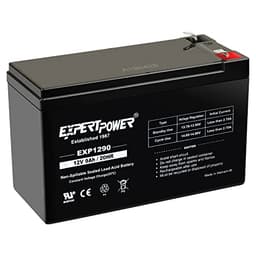
A 12V 9Ah sealed AGM in a case small enough to live in a hatch. The size a kayak fish finder was designed around.
Published specs
| Rating | 12V 9Ah |
|---|---|
| Type | Sealed lead acid, AGM, maintenance free, spill proof |
| Terminals | F2 |
| Dimensions | 5.94" × 2.56" × 3.7" |
| Warranty | 1-year limited |
| Case | Rugged ABS |
Our score, broken out
- Capacity8.0
- Size and weight6.5
- Published specs8.5
- Value9.0
What it gets right
- 9Ah is the right capacity for the job. A small fish finder draws very little, and this runs a full day with margin rather than a full day exactly.
- Published dimensions to the hundredth of an inch, which is what you need when the space is a dry box in a hatch.
- Sealed and spill-proof, so it can lie on its side in a hull that is never level.
What it gets wrong
- It is lead. Roughly a bag of sugar's worth of weight in the boat, in the worst place if you put it high.
- SLA hates being run flat and left. Charge it after every trip or it will not see a second season.
- F2 terminals are bare spades. Fuse the positive lead at the battery and box the whole thing.
Who should skip it
Skip it if weight is your binding constraint. Lithium is a third of the weight — and several times the price for a battery this small.
#2 · The same job, UL certified
Mighty Max ML9-12
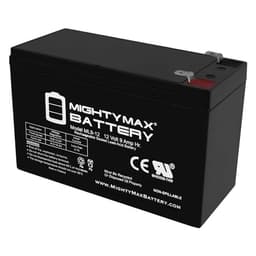
The same 12V 9Ah AGM format with a UL certification and a stated any-orientation mounting claim.
Published specs
| Rating | 12V 9Ah |
|---|---|
| Type | Sealed lead acid, AGM, maintenance free |
| Certification | UL certified |
| Dimensions | 5.94" × 2.56" × 4.02" |
| Terminals | F2 |
| Mounting | Can be mounted in any position |
| Warranty | Full one year |
Our score, broken out
- Capacity8.0
- Size and weight6.0
- Published specs8.5
- Value9.0
What it gets right
- A UL certification on a sealed battery you are putting in a boat is worth having, and it is not universal at this price.
- Explicitly rated for mounting in any position, which is the honest version of what a kayak hull does to anything inside it.
- Published as battery only, with no harness — an annoyance, but it stops you assuming wiring is included.
What it gets wrong
- No wire harness, no mounting hardware, no box. Budget all three.
- It is about a third of an inch taller than the ExpertPower, which can matter in a shallow hatch.
- Same lead-acid discipline required: charge it after every trip, never store it flat.
Who should skip it
Skip it if your dry box is shallow — check the 4.02-inch height against your box before ordering.
#3 · Containing the battery properly
Attwood Group 24 Vented Battery Box
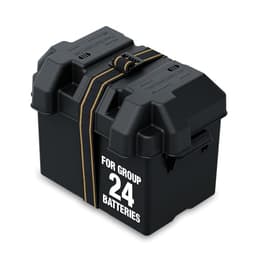
A vented, acid-resistant box with a 350 lb-rated strap that meets the Coast Guard hold-down rule. Oversized for a 9Ah cell, and still the right idea.
Published specs
| Interior | 10.6" × 7" × 10.125" |
|---|---|
| Fits | Group 24 batteries up to 10.125 in tall |
| Material | Polypropylene, impact tested from -20°F to +120°F |
| Venting | Integrated ventilation for battery gases |
| Strap | 40 in, rated 350 lb of force |
| Compliance | Meets USCG 183.420 for OEM-installed battery hold-down systems |
Our score, broken out
- Capacity9.0
- Size and weight5.0
- Published specs9.0
- Value9.0
What it gets right
- A box is not optional on a boat. A loose battery slides, corrodes at the terminals and can short — this is the cheapest part of the whole install and the one that prevents the dangerous failure.
- Vented, which is the correct choice for a lead-acid battery that off-gasses while charging.
- The published 350 lb strap rating and the USCG reference are real numbers in a category full of vague ones.
What it gets wrong
- It is a Group 24 box and a 9Ah fish finder battery is far smaller, so the cell rattles unless you pack it out with foam.
- It takes real deck or hatch space — the interior alone is over 10 inches long.
- Polypropylene is tough but not soft. Strap it down rather than letting it slide against a hull.
Who should skip it
Skip it for a compact dry box instead if space is tight — but do not skip containing the battery altogether.
FAQ
Questions people actually ask
What size battery do I need for a kayak fish finder?
A 12-volt 9Ah sealed lead-acid battery is the standard answer, and it is what both picks on this page are. Small kayak fish finders draw very little, so 9Ah runs a full day with margin.
The format is about six inches long and a few pounds, which fits a dry box in a hatch or a crate. Bigger is not better here — it is just heavier and harder to stow.
Do I need a battery box for a kayak fish finder?
Yes, or an equivalent sealed dry box. A bare battery loose in a hull slides, corrodes at the terminals and can short.
Attwood's vented box publishes a 40-inch hold-down strap rated at 350 lb and states compliance with USCG 183.420. Note it is sized for a Group 24 battery, so a 9Ah cell needs foam packing to stop it rattling.
Should I use a lithium battery for a kayak fish finder?
For a small finder, usually not. Lithium's advantages are weight and cycle life, and at 9Ah that means saving a couple of pounds and a cycle count you will never reach — for several times the price.
There is also a sourcing problem: most lithium cells this size are marketplace house brands with no published specs to check. For a bigger screen, live sonar or a trolling motor, lithium does earn its cost.
Where should the battery go in a kayak?
Low, central and strapped down — ideally forward of the seat if the hull allows it. Several pounds high or off to one side is noticeable in a boat you are trying to stand in.
Fuse the positive lead at the battery rather than at the unit, and route the cable under the gunwale line rather than across the footwell where it gets stood on.
We have not paddled with any of this gear. Everything above comes from published specifications, cited manuals and live retailer prices. Here is exactly how we pick.
Sources
Read next
Related on Drift & Dime
Fishing Rigging
The best budget kayak fish findersFinders compared on published sonar and the true cost of installing one.
Fishing Rigging
Rigging a used fishing kayakSealing inherited holes, reusing bolt patterns, and no-drill rigging.
Fishing Rigging
The kayak crate setupBuilding a crate: rod tubes, tackle, strapping — and no holes in the hull.
Outfitting
The best kayak gear tracks and accessory railsTracks and rails compared on the hardware standard they accept, not the marketing.