Outfitting
The best budget kayak dry bags
Read the rating, not the adjective. IPX6 is jets of water, not immersion — and the part that fails first is the base, not the seal.
Disclosure: we earn a commission if you buy through the links on this page, at no extra cost to you. It does not change which products we pick or how we rank them. How this site is funded.
The short answer
Quick picks
Ranked for the person outfitting a used boat: what it costs, what it does, and who should skip it. 2 picks.
| # | Product | Best for | Our score | Price |
|---|---|---|---|---|
| 1 |  Earth Pak Waterproof Dry Bag500D PVC, IPX6 published, and a phone case usually in the box. Earth Pak Waterproof Dry Bag500D PVC, IPX6 published, and a phone case usually in the box. | First dry bag | 8.2 | $23.99View on Amazon |
| 2 | SealLine Baja Dry Bag19 oz vinyl sides, 30 oz bottom. Built to be dragged. | Abuse | 8.1 | Check price on Amazon |
What “waterproof” actually claims
This is the category where marketing language does the most damage, so start with the rating.
Earth Pak publishes IPX6 for its roll-top bags. In the IP standard, 6 in the water position means protection against powerful water jets from any direction. That is rain, spray, and a wave over the deck. It is not an immersion rating — immersion is IPX7 and above, and it is a materially different test.
A roll-top bag keeps water out when it is rolled at least three times and clipped. It is not a submarine hatch, and it is not designed to be. If your phone absolutely has to survive a capsize and a swim, that is a different product category with a different budget.
SealLine does not publish an IP rating for the Baja at all, publishing construction weights instead. Neither approach is dishonest; they just make the two hard to compare, which is worth knowing before you go looking for a number that is not there.
The base fails first, not the seam
Think about how a dry bag actually dies. Not submerged — dragged. Across a concrete ramp, over gravel, along the deck, into a hatch and out again.
That is why SealLine’s published construction is the most useful spec on this page: 19 oz vinyl sides on a 30 oz bottom. Heavier material exactly where the abrasion happens. Earth Pak publishes 500D PVC throughout, which is a reasonable single-material answer to the same problem.
When you are comparing two bags at similar money, look for whether the maker has thought about the base separately. It tells you something about the rest of the design.
Sizing: buy two, not one big one
A zip bag of soft plastics inside a dry bag is also the honest answer for the tackle that does not rust, which is most of it — see the tackle box roundup for which trays actually need a seal.
Published size ladders here go from 5 L to 55 L. The instinct is to buy one large bag; the better answer for a kayak is usually two small ones.
A 5 to 10 liter bag for the things that must stay dry: phone, keys, wallet, a headlamp. Small enough to live between your knees or clipped to a deck line where you can reach it.
A 20 to 30 liter bag for the dry layer, a towel and lunch. This one goes in a hatch or under the bungees and you do not open it on the water.
One 40-liter bag holding everything means opening the whole thing to get your phone, on the water, which is when things go in the lake. It also will not fit through a round hatch, which is a very common and very annoying discovery.
The rolling technique that people get wrong
A roll-top only seals if it is rolled properly, and most leaks are user error rather than product failure.
- Do not overfill. Leave enough slack at the top for at least three full rolls. A bag filled to the brim cannot be sealed at all.
- Press the air out before rolling. Trapped air makes the bag rigid, awkward to stow, and it forces the roll open under pressure.
- Roll three times minimum, folding the top edge over on itself evenly. Two rolls is not a seal.
- Clip the buckle across, which holds the roll and gives you a carry handle.
Counterintuitively, leaving a little air in the bag is good: it makes the bag float rather than sink if it goes over the side.
What to clip it to
A dry bag that floats away is a dry bag that worked perfectly and is gone. Clip the small one to a deck line or padeye — something structural, not a bungee.
The large one should be inside a hatch or firmly under bungees. If the boat has no hatch, a milk crate behind the seat is a good home for it, and it stops the bag rolling around the deck.
Two things dry bags are not
They are not flotation. An air-filled dry bag adds some buoyancy, but it is not a substitute for proper float bags in a sit-in kayak with no bulkheads, and it is certainly not a substitute for a PFD.
They are not a dry hatch. Many sit-on-tops have hatch covers that are splash-resistant at best, and water gets in around the seal over a day. The dry bag inside the hatch is what actually keeps things dry — use both.
In full
Every pick, in detail
Specs below are the manufacturer's published figures, cited per product. Where a maker does not publish a number, the row says so rather than guessing at it.
#1 · First dry bag
Earth Pak Waterproof Dry Bag
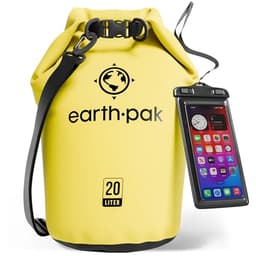
500D PVC, IPX6 published, and a phone case usually in the box.
Published specs
| Sizes | 10 L to 40 L (some listings to 55 L) |
|---|---|
| Material | 500D PVC |
| Closure | Roll-top |
| Rating | IPX6 |
Our score, broken out
- Waterproofing7.5
- Durability8.0
- Carry8.0
- Value9.5
What it gets right
- Publishes an IPX6 rating, which is more than most budget bags will commit to in writing.
- Usually bundled with a waterproof phone case, which is the thing you actually need dry.
What it gets wrong
- IPX6 is a splash and jet rating, not a submersion rating. A roll-top keeps water out when it is rolled properly and closed, not when it is upside down in a swamped cockpit.
- PVC is heavier than coated nylon for the same volume.
Who should skip it
Skip it if you need your phone to survive a capsize rather than a splash. Read the rating: IPX6 is jets of water, not immersion, and the difference is the whole point of the number.
#2 · Abuse
SealLine Baja Dry Bag
19 oz vinyl sides, 30 oz bottom. Built to be dragged.
Published specs
| Sizes | 5 L to 55 L |
|---|---|
| Body | 19 oz vinyl sides |
| Base | Heavy-duty 30 oz bottom |
| Closure | Dry Seal roll-top |
| Attachment | D-ring |
| IP rating | Manufacturer does not publish this |
Our score, broken out
- Waterproofing8.5
- Durability9.5
- Carry7.0
- Value7.0
What it gets right
- The heavier base is where dry bags fail first — they get dragged across a concrete ramp, not submerged.
- A published size ladder from 5 L to 55 L means you can buy the size you need rather than the size sold.
What it gets wrong
- Vinyl is stiff in cold weather and does not pack down small when empty.
- No published IP rating to compare against bags that quote one.
Who should skip it
Skip it if you want a bag that stuffs into a hatch when empty. Vinyl holds its shape, which is exactly what makes it tough and exactly what makes it bulky.
FAQ
Questions people actually ask
What does IPX6 mean on a dry bag?
Protection against powerful water jets from any direction — rain, spray and a wave over the deck. Earth Pak publishes IPX6 for its roll-top bags.
It is not an immersion rating. Immersion is IPX7 and above and is a materially different test. A roll-top bag seals when it is rolled three times and clipped; it is not a submarine hatch.
How do you roll a dry bag so it does not leak?
Leave enough slack for at least three full rolls, press the air out, fold the top edge over on itself three times evenly, and clip the buckle across.
Most dry bag leaks are user error: overfilling so the top cannot be rolled, or rolling only twice. Leaving a little air in is deliberate — it makes the bag float rather than sink if it goes over the side.
What size dry bag do I need for a kayak?
Two rather than one. A 5 to 10 liter bag for the phone, keys and wallet, small enough to keep within reach; and a 20 to 30 liter bag for a dry layer and lunch, stowed in a hatch or under bungees.
One 40 liter bag means opening everything to reach your phone on the water, and it will very likely not fit through a round hatch.
We have not paddled with any of this gear. Everything above comes from published specifications, cited manuals and live retailer prices. Here is exactly how we pick.
Sources
Read next
Related on Drift & Dime
Kits
The first season kayak kitLegal minimum plus what keeps you paddling — eight lines, priced.
Outfitting
The kayak bilge pump guideFlow rates compared, and why stowage decides whether a pump is any use.
Fishing Rigging
The kayak crate setupBuilding a crate: rod tubes, tackle, strapping — and no holes in the hull.
PFDs & Safety
The kayak safety kit checklistThe required items, the genuinely useful ones, and the padding to skip.