Fishing Rigging
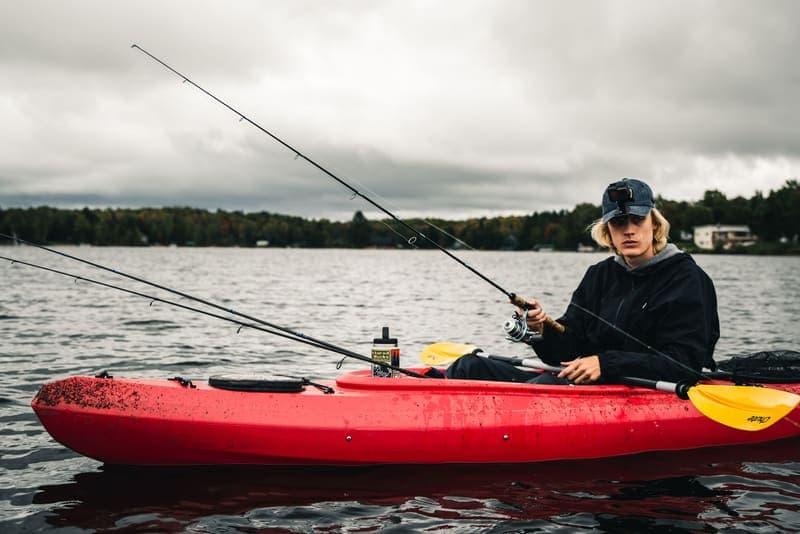
Can you fish from a sit-in kayak?
Yes, and on cold water it is the better boat. Three things change: there is no tankwell for a crate, so a deck bag replaces it; a clamp-on Scotty mount replaces the scupper and track rigging; and a bilge pump stops being optional.
Disclosure: we earn a commission if you buy through the links on this page, at no extra cost to you. It does not change which products we pick or how we rank them. How this site is funded.
The short answer
Quick picks
Ranked for the person outfitting a used boat: what it costs, what it does, and who should skip it. 5 picks.
| # | Product | Best for | Our score | Price |
|---|---|---|---|---|
| 1 |  Scotty 230 Powerlock1.95" interior, 360° rotation, locking ring. The default holder. | Most rods | 8.6 | $20.98View on Amazon |
| 2 | 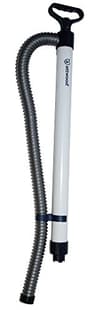 Attwood Hand Bilge PumpUp to 8 gpm, floating grip. The one that empties a swamped boat. | Getting water out | 8.2 | $39.99View on Amazon |
| 3 |  Earth Pak Waterproof Dry Bag500D PVC, IPX6 published, and a phone case usually in the box. | First dry bag | 8.2 | $23.75View on Amazon |
| 4 | 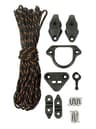 YakAttack LeverLoc Anchor TrolleyFlip-lock line clamp, stealth pulleys and 35 ft of 550 cord. | Moving the pull point | 8.3 | $37.95View on Amazon |
| 5 | Harmony Synthesis SprayskirtSized by cockpit dimensions, with an implosion bar in the deck. | Sizing by the numbers | 8.0 | Check price on Amazon |
The short answer
Yes, and nobody should talk you out of it. A sit-inside is drier, warmer, faster for the same effort and usually cheaper second-hand than the sit-on-top the whole kayak fishing internet assumes you own.
Three things genuinely change. There is no tankwell behind the seat, so the milk-crate setup everyone recommends does not apply — a deck bag under the rear bungees does that job. There are no scuppers and often no gear track, so rod holders mount differently: a clamp-on Scotty 230 with its side-deck bracket is the answer. And because a sit-inside holds water instead of draining it, a bilge pump moves from sensible to mandatory.
Buy the pump first. It is the cheapest item on this page and the only one that is about getting home rather than catching fish.
Why the standard advice assumes the wrong boat
Almost every kayak fishing guide written in the last decade assumes a sit-on-top: an open deck, a tankwell behind the seat, scupper holes through the hull and a factory gear track down each gunwale. That boat is the industry default and it is what the accessory market is designed around.
It is also not what most people buying a cheap used kayak end up with. Sit-insides are the commonest second-hand recreational boat in the country, they are frequently half the price of a comparable fishing sit-on-top, and there is nothing wrong with fishing from one.
What goes wrong is buying the standard kit list for a boat it does not fit. A crate with nowhere to sit, scupper-mount rod holders with no scuppers, and an anchor trolley fitted where it fouls the cockpit are all predictable and all avoidable.
What a sit-inside is actually better at
Worth saying before the compromises, because these are real advantages rather than consolation.
It is dry and warm. Your legs are inside the hull, out of the wind and out of the water. On a cold morning in spring or fall that is the difference between a three-hour session and a one-hour session, and it is the single biggest practical argument for the boat.
It is faster. Sit-insides are usually longer, narrower and lower than a fishing sit-on-top, so you cover water with less effort. If the fish are a mile from the launch, that matters.
You sit lower. A lower center of gravity means a narrower hull can still feel stable, and a lower seat is less affected by wind.
It stores and carries more easily. Lighter than a rigged fishing sit-on-top, usually by a lot, which shows up every time you lift it onto a car.
What it is genuinely worse at
Standing up is out. If you want to stand and cast, this is the wrong boat and no accessory changes that.
Re-entry after a swim is harder. A sit-on-top you climb back onto. A sit-inside you have to empty first, then get back into, and that is a skill worth practicing somewhere warm and shallow before you need it.
Deck space is limited. Everything lives in front of you, behind you under bungees, or inside a hatch. There is no open floor to put a box on.
It holds water. A sit-on-top drains through its scuppers. A sit-inside is a bathtub, and whatever gets in stays in until you pump it out.
How we picked this kit
Three criteria, published on how we pick:
- Does it work without a tankwell, scuppers or a track? The three things a sit-inside does not have.
- Does it fit a used hull without drilling? On a boat you paid two hundred dollars for, a clamp beats a hole.
- Does it earn its deck space? There is very little of it.
The crate problem, and what replaces it
A milk crate in a tankwell is the cheapest and best storage system in kayak fishing, and we recommend it properly on the kayak crate setup. You cannot use it. There is nowhere to put it.
What works instead, in order:
A deck bag under the rear bungees. This is the direct replacement. A dry bag or a purpose-made deck bag strapped under the stern deck rigging carries tackle, a dry layer and lunch, stays put, and keeps the weight low and behind you where it belongs. It is the one purchase that makes a sit-inside workable for fishing.
The hatches, for things you will not need. A bow or stern compartment is excellent storage and completely inaccessible on the water. Spare clothes yes, the tackle you are using no.
A small box between your knees. On most sit-insides there is usable floor in front of the seat for a 3600-size box, which is where the lures you are actually using should live. The footprint standard and why it matters is on the tackle box roundup.
Rod holders without a track or a scupper
This is the part people assume is impossible and it is the easiest thing on the page.
A Scotty 230 PowerLock is sold with the 241 side-deck mounting bracket, and that bracket screws to the flat area of the side deck just behind the cockpit rim. Almost every sit-inside has that flat area, and it is the correct place for a rod holder on this kind of boat: behind you, out of the paddle’s sweep, reachable without turning around far.
Two things to get right. Check what is behind the deck before drilling — on a sit-inside you can usually reach inside the cockpit to put a nut and backing washer on, which is a luxury the sealed sit-on-top deck does not give you. And bed the screws in sealant, because a hole in a sit-inside deck leads directly into the space your legs are in.
If you would rather not drill the hull at all, clamp-on gunwale brackets exist for exactly this, and the full menu of mount types is on the budget rod holder roundup.
Anchoring: the trolley still works
An anchor trolley is a loop of line running along the side of the boat that lets you move the anchor point fore and aft, and it is the single most useful fishing modification on any kayak. It works fine on a sit-inside.
What changes is where it goes. On a sit-on-top the trolley usually runs between two existing pad eyes well away from the paddler. On a sit-inside you want it low on the side deck, clear of the cockpit rim and clear of where your hands land on the paddle — and crucially, clear of a spray skirt if you use one.
The reason anchoring matters more on this boat than on a sit-on-top is the same reason it is more dangerous: anchoring from the side of any kayak in current is how boats get rolled, and a sit-inside you have swamped is harder to recover than a sit-on-top you have fallen off. Have a way to release the anchor instantly. The whole argument, with the rigging detail, is on the anchor trolley guide.
The pump is not optional
On a sit-on-top, a bilge pump is a sensible thing to own. On a sit-inside it is equipment.
The arithmetic is simple and unforgiving. Water in a sit-inside cockpit does not drain, it sloshes, and a few inches of it destabilizes the boat and makes it heavy and slow. A hand pump moves a published flow rate per stroke; a swamped recreational cockpit is a lot of strokes. That is why the pump and the spray skirt are the two items on this page that are really about getting home.
Keep the pump where you can reach it while sitting in the boat — under the bungees on the front deck, not in a hatch. A pump in a sealed compartment is a pump you cannot use. The flow-rate figures and the length trade-off are on the kayak bilge pump guide.
Should you fish with a spray skirt on?
Mostly no, and this is a genuine difference from touring use.
A skirt keeps water out, which on cold or choppy water is exactly what you want. But it also puts a layer between you and everything in the cockpit, makes reaching a box between your knees awkward, and adds a step to getting out of the boat in a hurry. For casual fishing on flat water it is more nuisance than benefit.
Where it flips: cold water, open water, or wind-driven chop coming over the deck. Then a skirt is the thing keeping the cockpit empty and your legs warm, and a half skirt — which covers the front of the cockpit and leaves your lap open — is a good compromise for fishing specifically.
Whichever you use, practice the release before you need it. The sizing and the nylon-versus-neoprene decision are on the spray skirt guide.
Landing a fish into a cockpit
Nobody writes about this and it is the thing that surprises people on day one.
On a sit-on-top you swing a fish onto an open deck and deal with it. On a sit-inside the only flat surface is your lap, and a thrashing fish with hooks in it over a cockpit full of your legs is a genuinely bad arrangement.
Three habits fix it. Unhook over the side where possible rather than lifting the fish aboard at all. Keep a pair of long pliers clipped somewhere reachable so you are not rummaging one-handed. And if you keep fish, decide where they are going before you catch one — a bag under the rear bungees, not loose in the cockpit.
What a sit-inside rig costs
The honest total, and it is the real argument for the boat.
A pump, a deck bag, one rod holder with its bracket and a trolley kit is a modest amount of money — and it is less than the crate-plus-track-plus-scupper-mount setup a sit-on-top invites, because there is no deck real estate to fill.
Add that to a used sit-inside that cost half what a used fishing sit-on-top costs, and the whole fishing-capable boat comes in under what many people spend on the hull alone. For the person this site is written for, that is the point.
Who each of these is for
Buy first: the Attwood hand bilge pump. A sit-inside holds water. This is the item that is about getting home.
The crate replacement: the Earth Pak dry bag. Strapped under the rear deck bungees, it is the storage system this boat can actually use.
The rod holder: the Scotty 230 PowerLock. Sold with the 241 side-deck bracket, which mounts on the flat deck every sit-inside has.
The upgrade that changes the fishing: the YakAttack LeverLoc anchor trolley. Fit it low on the side deck, clear of the cockpit rim.
Cold or choppy water: the Harmony Synthesis spray skirt. More nuisance than help on a warm flat day, and the thing keeping you going on a cold one.
What we would buy
Pump, deck bag, one rod holder. In that order, and nothing else until you have fished the boat three or four times.
The trolley is the first real upgrade after that, and it is worth more than a second rod holder. The skirt is a seasonal decision rather than a rigging one. And if you find yourself wanting to stand up and wanting a crate, that is not a kit problem — that is the boat telling you that the next hull should be a sit-on-top.
In full
Every pick, in detail
Specs below are the manufacturer's published figures, cited per product. Where a maker does not publish a number, the row says so rather than guessing at it.
#1 · Most rods
Scotty 230 Powerlock
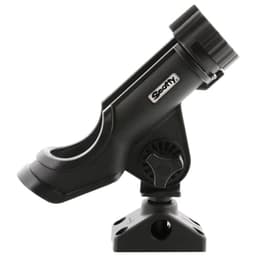
1.95" interior, 360° rotation, locking ring. The default holder.
Published specs
| Interior diameter | 1.95" |
|---|---|
| Mount dimensions | 4" × 2" × 2" |
| Bolt pattern | 1 5/16" × 3 3/16" |
| Rotation | 360° horizontal, adjustable up and down |
| Material | Fiber-reinforced engineering-grade nylon |
| Included | #241 side/deck mount |
Our score, broken out
- Mount8.0
- Adjustability9.5
- Build8.5
- Value8.5
What it gets right
- The front locking ring is the difference between a rod holder and a rod launcher. Open-style holders without one lose rods.
- Publishes its bolt pattern, so you can check it against your existing holes before you drill new ones.
- The mount is in the box. Scotty holders sold without a mount are a common and annoying surprise.
What it gets wrong
- Mounting means drilling the deck, and every hole is a potential leak.
- The open cradle collects grit; it needs rinsing.
Who should skip it
Skip it if your kayak has a factory gear track. A track-mounted holder gives you the same function with zero holes in the hull, and holes in a used boat are the thing you are trying to stop, not start.
#2 · Getting water out
Attwood Hand Bilge Pump
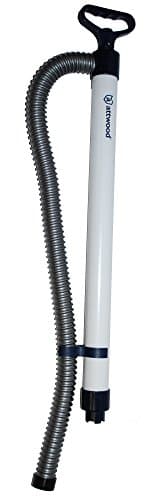
Up to 8 gpm, floating grip. The one that empties a swamped boat.
Published specs
| Flow | Up to 8 gallons per minute |
|---|---|
| Grip | Floating |
| Body | Plastic |
| Hose | Removable 32" discharge hose |
Our score, broken out
- Flow9.5
- Ergonomics8.0
- Stowage6.5
- Value8.5
What it gets right
- 8 gpm is an order of magnitude above the small kayak hand pumps, and volume is the entire point of a bilge pump.
- A floating grip means dropping it in the water is an inconvenience rather than a loss.
What it gets wrong
- The pump body plus a 32" hose is a lot of length for a small cockpit — check it stows where you can reach it while seated.
- Plastic construction; the shaft is the failure point if you lean on it.
Who should skip it
Skip it if it will live in a hatch. A bilge pump you cannot reach while sitting in a swamped boat is decoration. Deck-bungee it or do not buy it.
#3 · First dry bag
Earth Pak Waterproof Dry Bag

500D PVC, IPX6 published, and a phone case usually in the box.
Published specs
| Sizes | 10 L to 40 L (some listings to 55 L) |
|---|---|
| Material | 500D PVC |
| Closure | Roll-top |
| Rating | IPX6 |
Our score, broken out
- Waterproofing7.5
- Durability8.0
- Carry8.0
- Value9.5
What it gets right
- Publishes an IPX6 rating, which is more than most budget bags will commit to in writing.
- Usually bundled with a waterproof phone case, which is the thing you actually need dry.
What it gets wrong
- IPX6 is a splash and jet rating, not a submersion rating. A roll-top keeps water out when it is rolled properly and closed, not when it is upside down in a swamped cockpit.
- PVC is heavier than coated nylon for the same volume.
Who should skip it
Skip it if you need your phone to survive a capsize rather than a splash. Read the rating: IPX6 is jets of water, not immersion, and the difference is the whole point of the number.
#4 · Moving the pull point
YakAttack LeverLoc Anchor Trolley
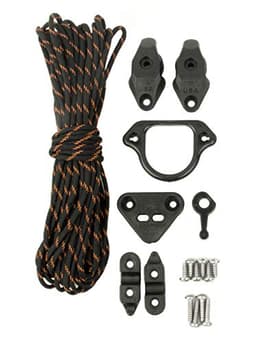
Flip-lock line clamp, stealth pulleys and 35 ft of 550 cord.
Published specs
| Lock | LeverLoc line clamp — flip to lock and release |
|---|---|
| Anchor points | PadHook — a combined pad eye and hook that keeps the line off the gunwale |
| Pulleys | YakAttack Stealth Pulleys |
| Line | 35 ft of USA-made 550 paracord with a reflective tracer |
| Ring | Easy-knot trolley ring |
| Hardware | All installation hardware included |
| HD version | Adds two extra PadHooks and backing plates for the pulleys and the LeverLoc |
Our score, broken out
- Safety9.5
- Hardware8.5
- Install6.5
- Value8.0
What it gets right
- The trolley, not the anchor, is the safety device. It moves the pull point to the bow or the stern so a current cannot swing you broadside, which is the mechanism behind most kayak anchoring accidents.
- The LeverLoc locks the line with a flip rather than a cleat you have to find by feel while the boat is already moving. That is a genuine difference in a real situation, not a convenience feature.
- The HD version ships backing plates, and soft polyethylene under load is exactly where a backing plate earns its money.
What it gets wrong
- It is a drilled installation along one whole side of the hull — four to six new holes — and the standard kit ships self-threading screws rather than the HD's backing plates.
- 550 paracord stretches. That is fine and even desirable in a trolley line, but do not carry it over to the anchor rode, where stretch costs you holding.
Who should skip it
Skip it if you anchor twice a season on flat water with no current. A short rode off a bow toggle does that job with no holes at all, and holes in a used boat are the thing you are trying not to add.
#5 · Sizing by the numbers
Harmony Synthesis Sprayskirt
Sized by cockpit dimensions, with an implosion bar in the deck.
Published specs
| High-wear deck | 1000-denier ballistic nylon reinforcement |
|---|---|
| Deck and tunnel | Three-ply waterproof and breathable fabric |
| Waist | Fully adjustable neoprene |
| Rand | PU-coated adjustable shock cord |
| Deck support | Implosion bar |
| Attachment | Four deck tie-off loops |
| Cockpit sizes | 32/18, 34/19, 36/19, 38/20, 41/23 |
| Seams | Double-stitched and sealed |
Our score, broken out
- Sealing8.0
- Fit range7.5
- Features8.5
- Value8.0
What it gets right
- The size codes are cockpit dimensions, so you take a tape to your coaming and match a number instead of decoding a proprietary chart. On a used boat with no model badge left, that is the difference between ordering and guessing.
- The implosion bar is the part that stops the deck folding inward under a wave, which is the failure that dumps a cockpit full of water in one go.
- An adjustable shock cord rand tolerates a coaming that is not exactly nominal — and second-hand coamings, after a decade of being levered at, rarely are.
What it gets wrong
- A neoprene waist on a breathable deck is a compromise in both directions: warmer at the waist than a nylon tunnel, less watertight at the deck than full neoprene.
- Five published sizes only. If your cockpit measures between two of them there is no in-between option, and a skirt that is close is a skirt that pops.
Who should skip it
Skip it if your cockpit falls between the published sizes. A sprayskirt that nearly fits releases under load, which is worse than not having one because you have stopped expecting to get wet.
FAQ
Questions people actually ask
Can you fish from a sit-in kayak?
Yes, and on cold water it is the better boat — your legs are inside the hull, out of the wind and the spray, and a sit-inside is usually longer and faster for the same effort.
Three things change. There is no tankwell, so a deck bag under the rear bungees replaces the milk crate. There are no scuppers and often no gear track, so a clamp-on or side-deck mounted rod holder replaces scupper and track mounts. And because the cockpit holds water rather than draining it, a bilge pump stops being optional.
Where do you put tackle in a sit-in kayak?
In three places. A deck bag or dry bag strapped under the stern deck bungees carries the bulk and keeps the weight low and behind you — this is the direct replacement for a crate.
A 3600-size box fits on the cockpit floor in front of the seat on most sit-insides, which is where the lures you are actually using should live. The bow and stern hatches are excellent for spare clothes and useless for anything you need on the water, because you cannot reach into them while afloat.
How do you mount a rod holder on a sit-in kayak?
On the flat side deck just behind the cockpit rim. A Scotty 230 PowerLock is sold with the 241 side-deck bracket, which screws to exactly that area, and it puts the rod behind you and clear of the paddle's sweep.
Two cautions. A sit-inside lets you reach inside the cockpit to fit a nut and backing washer, which is a real advantage over a sealed sit-on-top deck — use it. And bed the screws in sealant, because a hole in this deck leads straight into the space your legs are in. Clamp-on gunwale brackets avoid drilling altogether.
Do you need a bilge pump to fish from a sit-in kayak?
Yes. This is the one piece of kit that is genuinely different from a sit-on-top. A sit-on-top drains through its scuppers; a sit-inside cockpit holds whatever gets in, and a few inches of sloshing water makes the boat heavy, slow and unstable.
Keep the pump under the front deck bungees where you can reach it while seated, not in a hatch. A pump inside a sealed compartment is a pump you cannot use in the only situation that calls for it.
Should you wear a spray skirt while fishing?
Usually not on warm flat water. A skirt puts a layer between you and everything in the cockpit, makes reaching a tackle box awkward, and adds a step to getting out quickly.
On cold water, open water or wind-driven chop it flips, and the skirt is what keeps the cockpit empty and your legs warm. A half skirt that covers the front of the cockpit and leaves your lap open is the sensible compromise for fishing. Practice the release before you need it either way.
We have not paddled with any of this gear. Everything above comes from published specifications, cited manuals and live retailer prices. Here is exactly how we pick.
Sources
Read next
Related on Drift & Dime
Fishing Rigging
The kayak crate setupBuilding a crate: rod tubes, tackle, strapping — and no holes in the hull.
Fishing Rigging
The best budget kayak rod holdersHolders compared on locking ring, published bolt pattern and mounting.
Outfitting
The kayak bilge pump guideFlow rates compared, and why stowage decides whether a pump is any use.
Outfitting
The kayak spray skirt guideSizing a skirt for a boat with no badge, and what nylon gives up to neoprene.
Fishing Rigging
Rigging a used fishing kayakSealing inherited holes, reusing bolt patterns, and no-drill rigging.