Outfitting
What to do with your phone on a kayak
Buy the Pelican Marine pouch: IP68, published to 1 m for 30 minutes, and it floats, which is the only spec that matters when a phone goes over the side. If you need to read the screen while paddling, add a track-mounted holder and tether it.
Disclosure: we earn a commission if you buy through the links on this page, at no extra cost to you. It does not change which products we pick or how we rank them. How this site is funded.

The short answer
Quick picks
Ranked for the person outfitting a used boat: what it costs, what it does, and who should skip it. 5 picks.
| # | Product | Best for | Our score | Price |
|---|---|---|---|---|
| 1 |  Pelican Marine Waterproof PouchIP68, 1 m for 30 minutes, air cushions so it will not sink. | A pouch that floats | 8.3 | $19.99View on Amazon |
| 2 |  JOTO Waterproof Phone PouchIPX8, two in a pack, under ten dollars. Start here. | The cheapest thing that works | 7.9 | $8.99View on Amazon |
| 3 |  Rynapac Large Waterproof PouchIPX8 and up to 10", which is the size most pouches miss. | A phone bigger than 7 inches | 7.6 | $18.99View on Amazon |
| 4 |  YakAttack RotoGrip Phone HolderTrack-mounted, with the harness and tether in the box. | A phone you can read while paddling | 7.4 | $51.95View on Amazon |
| 5 |  Rogue Fishing The ProtectorA leash for the phone. The cheapest insurance on the boat. | Not losing the phone at all | 7.5 | $21.99View on Amazon |
The short answer
Buy the Pelican Marine pouch. It publishes IP68 and a real test — 3.3 ft for 30 minutes — and it has air cushions in it, so a dropped phone floats instead of going to the bottom. That one property is worth the price difference over a basic pouch by itself.
If money is the point, the JOTO two-pack does the waterproofing for under ten dollars. It publishes IPX8, which is the immersion rating rather than the splash one. It makes no floating claim, so clip the lanyard to something that does not sink.
If you need to see the screen while you paddle — a chart, a track log, a fish finder app — a pouch on a lanyard will not do it. That is the YakAttack RotoGrip: a track-mounted holder with the harness and tether in the box.
Three different problems, and people buy for the wrong one
Almost every bad phone decision on a kayak comes from treating this as one problem. It is three, and the right kit depends on which one you actually have.
- Water. Spray, a wave over the deck, a swim. Solved by a pouch or a waterproof case, and only by those.
- Loss. The phone leaves your hand and goes over the side. Solved by a tether or by buoyancy — not by waterproofing, which just means you own a dry phone at the bottom of a lake.
- Visibility. You need to read it while moving. Solved by a mount, which is the one answer that makes the first two problems worse rather than better.
A pouch answers water and nothing else. A tether answers loss and nothing else. They are cheap enough that most people on a used boat should own both, and that combination costs less than the mount.
How we judged these
Four criteria, published on how we pick:
- Published water protection. An actual IP rating, and ideally a depth and a duration rather than a bare code.
- Retention. Does it float, does it tether, or does it do neither?
- Usability. Whether the phone still works — touchscreen, camera, and getting it out when wet.
- Value against the phone it protects. The whole category is cheap next to the thing in it, which is worth remembering before economizing.
IP ratings, decoded properly
This is where the category hides, and it is not complicated once you know what the second digit means.
The number after the IP or IPX is the water digit. 6 means protection against powerful jets — rain, spray, a wave over the deck — and it is not an immersion rating. 7 and 8 are immersion ratings, and 8 means deeper or longer than 7 under conditions the maker specifies.
That distinction is the whole purchase. A dry bag rated IPX6 keeps a phone dry in the rain and will not survive the boat going over, which is why we say the same thing on the dry bag roundup. The pouches on this page publish IPX8 and IP68, which is the right side of that line.
Pelican goes further than the code and publishes the test: 3.3 ft of water for 30 minutes. That is the most useful spec in this entire category, because it tells you what the rating was actually earned against.
The thing almost nobody checks: does it float?
A phone in a sealed pouch is a dense object in a thin plastic bag. Unless the pouch has air or foam built into it, the whole assembly sinks, and it sinks fast.
So the honest ranking of outcomes when a phone goes over the side is: floats and waterproof, best; tethered to you, nearly as good; waterproof and sinking, you have a working phone you will never see again; neither, you have lost it and it is broken.
Pelican publishes built-in air cushions and states the pouch will not stay submerged. The cheaper pouches here publish no buoyancy claim at all, which is not a flaw as long as you treat them accordingly — a lanyard round your neck, under the PFD, or clipped to a deck line.
Hi-vis yellow is the other reason the Pelican is the pick. A black pouch floating in dark water in low light is, functionally, gone.
Published figures, side by side
| Spec | Pelican Marine | JOTO | Rynapac Large |
|---|---|---|---|
| Rating | IP68 | IPX8 | IPX8 |
| Published test | 3.3 ft for 30 minutes | Not published beyond the code | Not published beyond the code |
| Floats | Yes — built-in air cushions | No claim published | No claim published |
| Phone size | Regular and XL sold | Up to 7" | Up to 10" |
| In the pack | One pouch | Two pouches | Two pouches |
| Lanyard | Detachable | Included | Adjustable, included |
Two rows decide it. The floating row is why the Pelican is first. The phone-size row is why the Rynapac exists at all: a large phone in a case exceeds the 7 inches the standard pouch publishes, and a pouch stretched to its limit is a pouch that leaks.
Measure your phone before you order
Seven inches sounds generous and is not. Measure the phone diagonally, in the case you actually use, because the case is part of what has to go in the bag.
A current large-format phone in a protective case is routinely over seven inches. If yours is, buy the 10-inch pouch and accept the slack. If yours is comfortably under, buy the smaller one — it seals better precisely because there is less of it to seal.
Either way, test the pouch before it matters. Close it empty, hold it under water in a sink, and squeeze. Any bubble means a bad seal and a pouch that goes in the bin, not on the boat.
The mount question
A mount is the only answer if the phone is doing a job that needs looking at: navigation on open water, a GPS track, or a sonar app paired to a castable unit.
Two honest caveats before buying one. First, a mount is not waterproof and does not pretend to be — it holds a phone out in the open, so either the weather is good or the phone is in its own waterproof case. Second, a phone on a ball mount with no tether is a phone in the water. YakAttack includes a harness and tether and tells you to use them, which is the correct instruction.
The published fit range is worth checking against your phone: 2.75 to 3.625 inches wide and 0.303 to 0.625 inches thick. A large phone in a thick case is outside that.
Where the mount goes, and the hole question
The RotoGrip arrives with a 1-inch Screwball track mount, which means it drops straight into a gear track without drilling anything — if the boat has a track.
Plenty of used hulls do not. Adding one is a small job and a cheap part, and we cover which track accepts what on the gear track roundup. If you would rather not drill a used boat at all, that page covers the no-drill routes too.
On placement: put it where you can read it without taking your eyes far off the water, and not where a paddle shaft sweeps. Most people end up just inboard of the left or right thigh rather than dead center, because dead center is exactly where a paddle drip lands. The same fitting that holds a phone usually holds a drink holder, so think about both before you commit to a spot.
The tether is the cheapest thing here
Phones are rarely drowned on a kayak. They are dropped — while being held, over the side, in about half a second.
A tether is a silicone sleeve around the phone, a ring, and a carabiner that clips to a PFD or a deck line. It works with a phone you already own in whatever case it is in, and it keeps working whether you also use a pouch, a mount, or neither. For the money it is the highest-value item on this page.
What it does not do is anything about water. A tethered phone that goes in still goes in; it just comes back. Pair it with the pouch rather than choosing between them.
The thing a phone is not
Worth stating plainly, because the whole category encourages the opposite belief: a phone is not a safety plan.
It is a reasonable emergency call from inshore water with coverage, and it is useless with a flat battery, in a dead spot, or in the water you just swam in. The required and recommended kit — a sound signal, a light after dark, a means of self-rescue — is not optional because you have a phone, and it is on the kayak safety kit checklist.
The practical version of that: put the phone in the PFD pocket, not in the hatch. A phone sealed in a dry bag inside a locked compartment is a phone you cannot reach in the one situation where you need it, which is in the water next to an upturned boat.
Battery, cold and sun
Three things that go wrong on the water and have nothing to do with water.
Cold kills charge. A phone that reads 60 percent at the launch can read 20 on a cold morning two hours later. If the phone is your navigation, start the day full and keep it against your body rather than out on deck.
Sun kills screens. A phone in direct sun on a bright deck is close to unreadable at the brightness a battery can sustain, which is the same problem fish finder screens have. A mount you can angle out of the glare is worth more than a brighter phone.
Heat shuts phones down. A sealed pouch on a black deck in summer is an oven, and a phone that overheats stops working until it cools. If it is hot, the phone wants shade, not the deck.
Who each of these is for
One pouch for everything: the Pelican Marine. IP68, published to 1 m for 30 minutes, floats, hi-vis. The pick.
Cheapest thing that genuinely works: the JOTO two-pack. IPX8, two in a pack so you have a spare, lanyard included. Assume it sinks.
A big phone: the Rynapac. Published to 10 inches, which is the size the standard pouch misses.
A screen you need to read while paddling: the YakAttack RotoGrip. Track-mounted, harness and tether in the box, published fit range.
Whatever else you buy: the Rogue Fishing tether. It solves the failure that actually happens.
What we would buy
A floating pouch and a tether. That is around forty dollars, it covers both of the failures that actually lose phones, and it needs nothing fitted to the boat — which on a used hull you have not finished rigging yet is the point.
Add the mount only when the phone has a job that needs reading. If it is just a camera and a phone, a pouch in a PFD pocket is the better answer and costs a quarter as much.
In full
Every pick, in detail
Specs below are the manufacturer's published figures, cited per product. Where a maker does not publish a number, the row says so rather than guessing at it.
#1 · A pouch that floats
Pelican Marine Waterproof Pouch
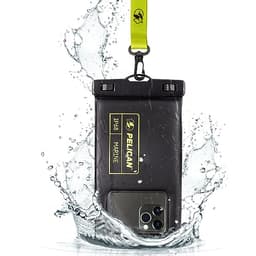
IP68, 1 m for 30 minutes, air cushions so it will not sink.
Published specs
| Rating | IP68 |
|---|---|
| Submersion | 3.3 ft (1 m) for 30 minutes |
| Buoyancy | Built-in air cushions; Pelican states it will not stay submerged |
| Touchscreen | Usable through the window |
| Lanyard | Detachable |
| Sizes | Regular and XL |
| Condition | Pelican states it must be sealed properly to be waterproof |
Our score, broken out
- Water protection9.0
- Usability7.5
- Retention8.5
- Value6.5
What it gets right
- It floats, and that is the whole reason to pay three times the price of a basic pouch. A phone that floats is a phone you can still retrieve.
- Pelican publishes a depth and a duration — 1 m for 30 minutes — instead of a bare IP code, so you know what the rating actually covers.
- Hi-vis yellow is a deliberate choice: a black pouch in dark water is gone.
What it gets wrong
- Three times the price of a two-pack of basic pouches, for one pouch.
- The air cushions make it bulkier than a flat sleeve, so it is a poor fit for a trouser pocket.
- Pelican's own caveat applies: sealed properly. A pouch is only as waterproof as the last person who closed it.
Who should skip it
Skip it if the phone lives clipped inside a dry bag anyway. Buoyancy you never use is the only thing you are paying extra for.
#2 · The cheapest thing that works
JOTO Waterproof Phone Pouch
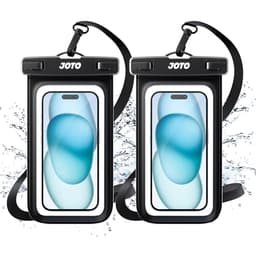
IPX8, two in a pack, under ten dollars. Start here.
Published specs
| Rating | IPX8 |
|---|---|
| Fits | Phones up to 7" |
| Contents | 2 pouches |
| Lanyard | Included |
| Buoyancy | Manufacturer does not publish a floating claim |
Our score, broken out
- Water protection7.5
- Usability7.0
- Retention5.0
- Value9.5
What it gets right
- Two in a pack at this price means a spare, which matters because the failure mode of a pouch is a torn seal you do not notice until it leaks.
- IPX8 is the rating that covers immersion rather than splashes, which is the one that matters when the boat goes over.
- The touchscreen works through the window, so the phone still takes photographs without coming out of the bag.
What it gets wrong
- No published buoyancy claim. Assume it sinks, and clip the lanyard to something.
- Up to 7 inches rules out the biggest current phones, and a pouch stretched over an oversize phone is a pouch that leaks.
- The lanyard is thin cord rather than webbing. It holds a phone, not a wet grab.
Who should skip it
Skip it if your phone is over 7 inches. A pouch that only just closes is the one that lets water in, and the larger version on this page costs barely more.
#3 · A phone bigger than 7 inches
Rynapac Large Waterproof Pouch
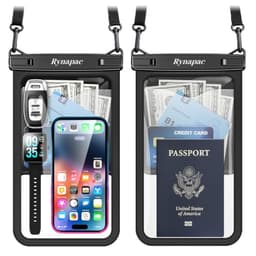
IPX8 and up to 10", which is the size most pouches miss.
Published specs
| Rating | IPX8 |
|---|---|
| Fits | Phones up to 10" |
| Contents | 2 pouches |
| Lanyard | Adjustable, included |
| Buoyancy | Manufacturer does not publish a floating claim on this version |
Our score, broken out
- Water protection7.5
- Usability7.0
- Retention6.0
- Value8.5
What it gets right
- Ten inches covers a large phone in a case, which is the combination that splits the seams on a standard pouch.
- Two in a pack, so one lives in the boat and one in the car.
- The lanyard adjusts, which means it can be worn short under a PFD rather than swinging loose.
What it gets wrong
- No published buoyancy claim on this version, so treat it as a sinker and tether it.
- A big pouch holds a big air pocket and flaps about on deck in wind if it is not clipped down.
- Oversize for a normal phone — the extra room is slack that creases over the screen.
Who should skip it
Skip it if your phone is a normal size. The smaller pouch seals better precisely because there is less of it.
#4 · A phone you can read while paddling
YakAttack RotoGrip Phone Holder
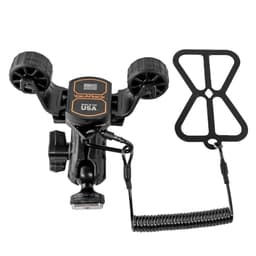
Track-mounted, with the harness and tether in the box.
Published specs
| Fits phones | 2.75–3.625" wide, 0.303–0.625" thick |
|---|---|
| Mount | 1" Screwball track mount with a 2.5" ball connector, included |
| Track compatibility | YakAttack GearTrac, MightyMounts and most factory kayak track systems |
| Tether | Harness and tether included |
| Adjustment | Rotates on the ball for viewing angle |
| Warranty | YakAttack Built for Life guarantee |
Our score, broken out
- Visibility9.0
- Water protection2.0
- Retention8.5
- Value6.0
What it gets right
- It is the only answer on this page that leaves the phone visible and both hands on the paddle, which is what a chart or a track log is for.
- The harness and tether are included rather than extra. YakAttack's own instruction is to use them, and a phone on a ball mount without a tether is a phone in the lake.
- The 1 inch Screwball fits the track systems this site already recommends, so it drops onto a deck that has a gear track without new holes.
What it gets wrong
- It is not waterproof and makes no claim to be. The phone is exposed on deck, so this is a fair-weather mount or a mount for a phone in its own waterproof case.
- The published width range stops at 3.625 inches, which a large phone in a thick case exceeds.
- It needs a track or a mounting point. On a bare used hull that is another purchase and possibly a drilled hole.
Who should skip it
Skip it if the boat has no gear track and you do not want to drill. A pouch on a lanyard costs a tenth as much and needs nothing fitted to the deck.
#5 · Not losing the phone at all
Rogue Fishing The Protector
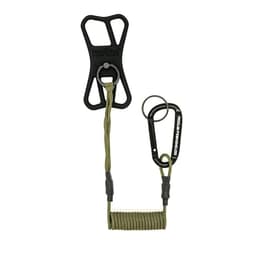
A leash for the phone. The cheapest insurance on the boat.
Published specs
| Fits phones | Up to 7" |
|---|---|
| Attachment | Silicone sleeve around the phone, tether ring and locking carabiner |
| Materials | Silicone sleeve, stainless steel backing plate, PVD-coated ring |
| Tether length | Manufacturer does not publish a figure for this version |
| Rated load | Manufacturer does not publish this |
| Guarantee | 1 year on the leash, 90 days on the silicone case |
Our score, broken out
- Retention9.0
- Water protection1.0
- Usability8.5
- Value7.5
What it gets right
- It solves the actual failure. Phones are not usually drowned on a kayak, they are dropped over the side while being held.
- The sleeve works with a phone you already have and whatever case it is in, rather than replacing either.
- It is the one item here that keeps working with a pouch, a mount, or neither.
What it gets wrong
- Rogue does not publish a rated load or a length for this version, so there is no figure to check it against.
- The silicone sleeve is a consumable — it is the part with the 90-day guarantee rather than the 1-year one, which tells you something.
- It keeps the phone attached to you. It does nothing at all about water.
Who should skip it
Skip it if the phone never leaves a sealed pouch clipped to a deck line. The tether is for a phone in your hand.
FAQ
Questions people actually ask
What should you do with your phone when kayaking?
Put it in a pouch that floats, and tether it. A Pelican Marine pouch publishes IP68 and a tested 3.3 ft for 30 minutes, and it has built-in air cushions so the phone does not sink if it goes over the side.
Keep it in the PFD pocket rather than a hatch. A phone sealed inside a locked compartment is unreachable in the one situation where you need it, which is in the water beside an upturned boat.
Do waterproof phone pouches actually work?
The ones with a real immersion rating do. The number to look for is the water digit: IPX6 means jets and spray and is not an immersion rating, while IPX7 and IPX8 are. Both pouches here publish IPX8 and the Pelican publishes IP68 plus the test behind it.
Two caveats. A pouch is only as waterproof as the last person who closed it, which Pelican states outright. And test it before you trust it — seal it empty, hold it under water and squeeze, and bin it if you see a bubble.
Will a waterproof phone pouch float?
Only if it is built to. A phone in a thin sealed bag is a dense object and sinks quickly.
Pelican publishes built-in air cushions and states the pouch will not stay submerged. The cheaper pouches on this page publish no buoyancy claim at all, so treat them as sinkers and keep the lanyard clipped to you or to a deck line.
How do you mount a phone on a kayak?
On a gear track, with a tether. The YakAttack RotoGrip comes with a 1 inch Screwball track mount that drops into YakAttack GearTrac, MightyMounts and most factory kayak tracks without drilling, and it includes a harness and tether.
If the hull has no track, adding one is a cheap part and a small job — or use a no-drill mounting route instead. Place it where you can read it without looking far off the water and clear of the paddle's sweep, which usually means just inboard of one thigh rather than dead center.
Is a phone enough for safety on a kayak?
No. It is a reasonable emergency call from water with coverage, and it is useless flat, out of range, or in the water you have just swum in.
It does not replace a sound signal, a light after dark, or a means of self-rescue. Carry those, keep the phone reachable in a PFD pocket, and start the day fully charged — cold weather drains a battery much faster than people expect.
We have not paddled with any of this gear. Everything above comes from published specifications, cited manuals and live retailer prices. Here is exactly how we pick.
Sources
- Pelican — Marine waterproof phone pouch published IP68 rating, 3.3 ft (1 m) for 30 minutes submersion, built-in air cushions and Regular/XL sizes, via its Marine waterproof collection page and stocking retailer listings
- JOTO — waterproof phone pouch published IPX8 rating, 7 inch phone limit, pack size and lanyard (via its retail listing; the brand has no manufacturer site)
- Rynapac — large waterproof phone pouch published IPX8 rating, 10 inch phone limit and adjustable lanyard (via its retail listing; the brand has no manufacturer site)
- YakAttack — RotoGrip Phone Holder published phone width and thickness range, included 1 inch Screwball track mount, harness and tether, via stocking retailer listings
- Rogue Fishing Co. — The Protector published phone size fit, sleeve and backing-plate materials and guarantee terms, via stocking retailer listings
Read next
Related on Drift & Dime
Outfitting
The best budget kayak dry bagsDry bags compared on published ratings and construction, not adjectives.
Outfitting
The best kayak gear tracks and accessory railsTracks and rails compared on the hardware standard they accept, not the marketing.
Outfitting
The best kayak cup holdersCup holders on mounting system and what is actually included.
PFDs & Safety
The kayak safety kit checklistThe required items, the genuinely useful ones, and the padding to skip.
Fishing Rigging
The kayak crate setupBuilding a crate: rod tubes, tackle, strapping — and no holes in the hull.