Outfitting
Scotty versus RAILBLAZA versus YakAttack
Start with Scotty. A low-profile track and a gear-head adapter is the cheapest way into a mount system, the parts are everywhere, and nothing about it stops you adding a RAILBLAZA base later for the one accessory only they make.
Disclosure: we earn a commission if you buy through the links on this page, at no extra cost to you. It does not change which products we pick or how we rank them. How this site is funded.

The short answer
Quick picks
Ranked for the person outfitting a used boat: what it costs, what it does, and who should skip it. 5 picks.
| # | Product | Best for | Our score | Price |
|---|---|---|---|---|
| 1 |  Scotty 440 Low Profile Track3/8" tall. The lowest way to put a mounting point on a deck you walk on. | The flattest deck | 8.3 | $12.55View on Amazon |
| 2 |  Scotty 438 Gear-Head Track AdapterThe part that makes a track you already own accept post-mount Scotty gear. | Scotty gear on any track | 8.5 | $20.99View on Amazon |
| 3 |  RAILBLAZA Rod Holder II & StarPort ComboBase and holder together — the honest entry price for RAILBLAZA. | Buying into one mount system | 7.7 | $52.31View on Amazon |
| 4 |  YakAttack GTSL90 GearTracTakes standard 1/2" track hardware, and arrives drilled with fasteners. | Most used boats | 8.5 | $25.95View on Amazon |
| 5 |  YakAttack RotoGrip Paddle HolderSoft rollers that take the shaft one-handed, 2.25 inches tall, on any common track. The tidiest answer if the boat already has a rail. | A boat with a track | 8.1 | $20.14View on Amazon |
The short answer
Scotty, for almost everyone outfitting a used boat. A Scotty low-profile track plus a gear-head adapter is the cheapest way into a mount system by a wide margin, the catalog is enormous, and the parts turn up in every tackle shop in the country.
RAILBLAZA if you want the nicest thing to use. The StarPort slide-lock is the best of the three one-handed, the base is UV-stabilized fiberglass-reinforced plastic, and RAILBLAZA publishes a lifetime warranty on it. The combo with a Rod Holder II is the sane way to buy in.
YakAttack if the boat is already a fishing platform. GearTrac is the track standard everything else copies, and the 1-inch Screwball mounting that YakAttack built around it carries more third-party accessories than either rival.
The decision matters more than the price suggests, because the first base you bolt to the deck quietly decides which catalog you shop from for the next few years.
What you are actually choosing between
All three brands make the same three things, and the vocabulary is the first obstacle.
- A base or a track. The part bolted or screwed to the hull. A track is a rail you can slide fittings along; a base is a single fixed point.
- An adapter or head. The part that converts the base into whatever interface the accessory uses — a Scotty gear head, a RAILBLAZA StarPort socket, a YakAttack Screwball.
- The accessory. Rod holder, cup holder, phone mount, camera arm, light, fish finder arm.
A working mount needs all three, which is why comparing single part prices between brands is misleading. The honest comparison is what one finished, usable mounting point costs.
How we compared them
Four criteria, weighted equally and published on how we pick:
- Entry cost. What one complete, working mounting point costs, not what the cheapest single part costs.
- Catalog breadth. How much you can hang off it later, including third-party parts.
- Install. Whether you have to drill a used hull, and whether you can reach the back of the deck to do it properly.
- Use on the water. One-handed operation, and whether the thing holds when a rod loads it up.
The three systems, side by side
| Scotty | RAILBLAZA | YakAttack | |
|---|---|---|---|
| Interface | Post and gear head | StarPort slide-lock socket | 1" Screwball ball mount |
| Track option | 440 Low Profile Track, 1" to 8" | TracMount and MiniPort bases | GearTrac, including the GTSL90 |
| Base material | Nylon | UV-stabilized fiberglass-reinforced plastic | Aluminum track |
| Published warranty | Not published on the product pages | Lifetime, exceptions apply | Built for Life guarantee |
| Entry route | Track plus gear-head adapter | Base-and-holder combo | Track plus a Screwball accessory |
| Third-party parts | Widely copied | Few | Many, around the 1" ball |
The row that matters most is the last one, and it is the row nobody thinks about when buying the first base.
Scotty: the cheap one, and the one everyone copies
Scotty’s system is a post that drops into a mount, and a gear head that converts that post into other things. The 440 Low Profile Track is sold from 1 inch up to 8 inches, and the 438 Gear Head Track Adapter is what turns a length of that track into a Scotty mounting point.
Two things make it the default recommendation for a used boat. The first is price: a short track and an adapter is the least money any of these three systems can be entered for. The second is ubiquity — Scotty’s post pattern is so widely copied that generic gear heads and clamp mounts exist for a few dollars, which is useful if you are fitting out a whole deck.
The honest weaknesses: nylon parts are not as nice to use as RAILBLAZA’s, Scotty does not publish a warranty on its product pages, and the locking collar on a Scotty rod holder is the part that wears. On the upside, when something does wear out, the replacement is four dollars and available everywhere.
RAILBLAZA: the nicest to use, and the most committing
A StarPort is an all-purpose base that takes any StarPort accessory on a slide lock. RAILBLAZA publishes the base as UV-stabilized fiberglass-reinforced plastic, 0.21 lb, supplied with stainless hardware, a gasket and a cap, and it can be fitted as a deck mount or a flush mount.
The slide lock is genuinely the best of the three one-handed. You push the accessory in and it locks; you squeeze and it comes out. That sounds trivial until you are doing it with a rod in the other hand, which is every time.
The catch is the lock-in. StarPort accessories fit StarPort bases, the third-party ecosystem around them is thin, and the bare base is frequently on back-order on its own. That is why the pick here is the Rod Holder II and StarPort combo: it is base plus accessory in one box, which is the real entry price and usually less than buying the two separately.
YakAttack: the track standard, built for fishing
GearTrac is the aluminum track that the rest of the industry now imitates, and the GTSL90 is the 9-inch length most used hulls get first. Everything YakAttack mounts on it hangs off a 1-inch ball — the Screwball — which is the same interface a large number of third-party mounts use.
That ball standard is the real argument for YakAttack. Phone holders, camera arms, fish finder mounts and rod holders from several makers all fit a 1-inch ball, so a GearTrac deck is the least likely of the three to dead-end. YakAttack also publishes a Built for Life guarantee.
The weaknesses are price and overkill. It is the most expensive way to put one cup holder on a recreational kayak, and a ball mount has more joints to work loose than a socket does. If the boat is a fishing platform it earns the money; if it is a lake boat with a cup holder on it, it does not.
The thing nobody tells you: they interoperate more than you think
The brand war is mostly a retail illusion, and knowing that takes the pressure off the first purchase.
A track is a track. A Scotty 440 track, a GearTrac and a RAILBLAZA TracMount all do the same mechanical job of giving you a slot, and adapters exist across brands — Scotty sells a gear-head track adapter precisely so Scotty accessories live on a track rather than a post mount.
So the practical rule: commit to a track, not to a brand. Fit the track, then buy the adapter that suits whichever accessory you actually want. That is the approach we take on the gear track roundup, and it is why the Scotty track-plus-adapter route is the first pick here.
Before you buy any of them: check the hull
Plenty of used boats already have mounting provision, and plenty of people buy a track they did not need.
Look for factory tracks molded or screwed into the gunwales, molded recesses with threaded inserts, and — particularly on older fishing hulls — flush rod holder tubes already in the deck. Any of those changes the answer, because an existing track takes whichever adapter you choose and an existing flush tube may make a rod holder purchase unnecessary altogether.
The other thing to check is access. A deck mount wants a bolt with a nut and a backing washer behind it, and on a sealed sit-on-top deck you often cannot reach the underside. That constraint, and the well-pad and rivet routes around it, is covered on rigging a used fishing kayak.
Height matters more than people expect
The three systems sit at different heights off the deck, and that decides what you can live with where.
Scotty is the tallest. A post mount plus a gear head stands proud of the deck, which is exactly what you want for a rod but is also the thing a paddle shaft catches and a strap snags on during transport. RAILBLAZA sits lower, and a flush-mounted StarPort is close to level with the deck when nothing is in it. GearTrac is the lowest of all — an empty track is a flat rail you can slide a hand over.
So the practical placement rule is to put the tall stuff where a paddle does not sweep and a strap does not cross, and to prefer the low-profile systems anywhere forward of the seat. A mount that snags the paddle on every third stroke gets removed within a month regardless of which badge is on it.
Where the money actually goes
A realistic deck is not one mount. It is a rod holder, a phone or a fish finder, a drink, and possibly a light — so the per-point cost multiplies by four or five.
That is the whole reason entry price matters more than part quality here. Four Scotty points cost about what two of either rival do, and the difference buys an anchor trolley instead. On a boat that cost two hundred dollars, that trade is the right one almost every time.
Where it flips: if you fish seriously and the boat is staying, the interoperability of a 1-inch ball or the feel of a slide lock is worth paying for once rather than replacing a deck full of nylon later.
Saltwater, sun and which parts die
All three live outdoors, and they fail in different places.
Scotty: the nylon goes chalky in strong sun over years, and the locking collar on a rod holder is the wear part. Cheap to replace.
RAILBLAZA: the base is published as UV-stabilized, which is the right claim for a part living on a deck, and the warranty backs it.
YakAttack: aluminum track with stainless hardware is the most durable combination here, with the standard caveat that aluminum and stainless in salt water want rinsing and a smear of grease on the threads.
Across all three, the part that actually corrodes is whatever screw came in the bag. If the boat sees salt, replace the fasteners with stainless and bed them in sealant — that is a two-dollar decision that determines whether the mount is still sound in five years.
Who each of these is for
Cheapest route in: the Scotty 440 track. Sold from 1 to 8 inches, so you fit the length the deck has room for.
What makes that track useful: the Scotty 438 gear-head adapter. This is the part that turns a slot into a Scotty mount, and the pair is the cheapest working point on this page.
The nicest system to use: the RAILBLAZA Rod Holder II and StarPort combo. Base and holder together, slide lock, lifetime warranty on the base.
A fishing deck you will keep adding to: the YakAttack GTSL90. The track standard, and the gateway to the 1-inch ball ecosystem.
Proof the ball standard is useful: the YakAttack RotoGrip paddle holder. It shows what a GearTrac deck gets you beyond rod holders.
What we would buy
A Scotty track and a gear-head adapter, fitted where you have access behind the deck, and then accessories one at a time as you discover what you actually reach for.
If you already fish from the boat every weekend, skip that and fit GearTrac, because the 1-inch ball is the standard with the most future in it. And if what you want is the one RAILBLAZA accessory nobody else makes, buy the combo and put a StarPort next to whatever else is on the deck — mixing systems on one boat is completely normal and nothing bad happens.
In full
Every pick, in detail
Specs below are the manufacturer's published figures, cited per product. Where a maker does not publish a number, the row says so rather than guessing at it.
#1 · The flattest deck
Scotty 440 Low Profile Track
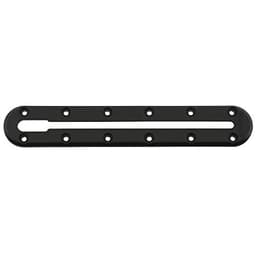
3/8" tall. The lowest way to put a mounting point on a deck you walk on.
Published specs
| Dimensions (8") | 1 3/4" wide × 3/8" tall × 10 3/4" long (8" usable track) |
|---|---|
| Dimensions (1") | 1 3/4" wide × 3/8" tall (1" usable track) |
| Material | Corrosion-proof high-strength composite |
| Design | Top-load |
| Included | 438 Gear-Head Adapter, rod holders and accessories not included |
| Mounting hardware | Manufacturer does not publish this |
Our score, broken out
- Fit standard7.0
- Mounting9.0
- Build8.5
- Value8.5
What it gets right
- At 3/8" tall it is genuinely low, which matters on a sit-on-top deck you stand on, drag a crate across, or strap a boat down over.
- Composite rather than metal, so there is nothing to corrode where a stainless screw meets the track in salt water.
- Sold in a 1" piece as well as an 8", so you can put a single mounting point exactly where you want it without committing a whole length of deck.
What it gets wrong
- Scotty publishes it as a top-load design used through the 438 Gear-Head adapter, so budget for two parts rather than one.
- The 8" version is 10 3/4" long overall for 8" of usable track — measure the space you have, not the usable figure.
- Scotty does not publish hole spacing or what mounting hardware is in the box, so you cannot check either before it arrives.
Who should skip it
Skip it if you want one track that accepts anybody’s hardware. That is the 1/2" standard, and this is not it.
#2 · Scotty gear on any track
Scotty 438 Gear-Head Track Adapter
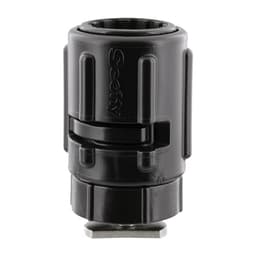
The part that makes a track you already own accept post-mount Scotty gear.
Published specs
| Function | Slides into a track and locks post-mounted Scotty rod holders and accessories |
|---|---|
| Track fit | Designed to fit all kayak track systems |
| Adjustment | Twist to unlock and reposition |
| Drilling | None — no permanent mounting holes |
| Material | Manufacturer does not publish this |
| Dimensions | Manufacturer does not publish this |
Our score, broken out
- Fit standard9.0
- Mounting9.5
- Build8.0
- Value7.5
What it gets right
- It is the single part that connects a track to the Scotty post fitting, which is what the 230 Powerlock and the rest of Scotty's range mount on.
- The twist-to-reposition action means you move a rod holder mid-session without a tool, which is the whole reason to have a track rather than a bolted mount.
- Nothing gets drilled. On a second-hand hull that is the difference between a reversible decision and a permanent one.
What it gets wrong
- It is a third purchase on top of the track and the holder, and the headline price of any one of the three understates what the setup costs.
- Scotty publishes no material and no dimensions for it, so you cannot check clearance against a crate or a seat back before you buy.
Who should skip it
Skip it if you do not own Scotty post-mount gear. It is an adapter, not a mount — on its own it holds nothing.
#3 · Buying into one mount system
RAILBLAZA Rod Holder II & StarPort Combo
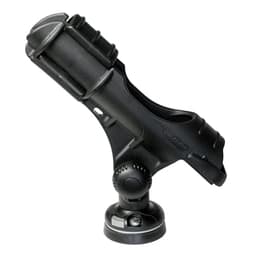
Base and holder together — the honest entry price for RAILBLAZA.
Published specs
| Contents | Rod Holder II plus a StarPort mounting base |
|---|---|
| Base | Accepts any RAILBLAZA StarPort accessory, slide-locking |
| Base material | UV-stabilized fiberglass-reinforced plastic |
| Base weight | 0.21 lb |
| Mounting | Deck mount or flush mount; stainless hardware, gasket and cap included |
| Warranty | RAILBLAZA lifetime warranty, exceptions apply |
Our score, broken out
- Hold8.5
- Ecosystem8.0
- Install6.5
- Value7.0
What it gets right
- Bought together, the base and the holder cost less than the two separately, and the base is the part that unlocks everything else RAILBLAZA makes.
- The slide lock is the best of the three systems to use one-handed, which matters when the other hand has a rod or a paddle in it.
- A lifetime warranty on a deck fitting that lives in sun and salt is a real claim, and RAILBLAZA publishes it.
What it gets wrong
- It is a commitment. StarPort accessories fit StarPort bases, so the first base decides which catalog you shop from for years.
- A deck mount means drilling, and on a used hull you cannot always reach behind the deck to put a nut on the bolt.
- The bare StarPort base is frequently on back-order on its own, which is part of why the combo is the sane way to buy in.
Who should skip it
Skip it if you want one rod holder and nothing else, ever. A clamp-on Scotty with its own deck bracket does that for less and asks nothing of the rest of the boat.
#4 · Most used boats
YakAttack GTSL90 GearTrac
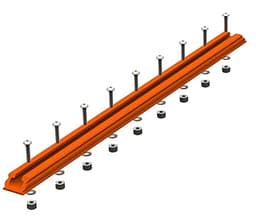
Takes standard 1/2" track hardware, and arrives drilled with fasteners.
Published specs
| Track width | 0.90" |
|---|---|
| Hole spacing | 1-3/4" |
| Lengths | 4", 8", 12" or 16" |
| Hardware fit | Compatible with 1/2" wide track hardware |
| Material | Polymer, specified for harsh marine environments |
| Duty | Light to medium duty applications |
| Included | Track, drilled, with hardware |
| Known exception | Not intended for the RAM Mounts Quick Release Track Base |
Our score, broken out
- Fit standard9.5
- Mounting8.0
- Build8.0
- Value8.5
What it gets right
- The 1/2" track-hardware standard is what most kayak accessory mounts are built around, so this is the track that leaves your options open rather than tying you to one brand.
- It ships drilled and with the fasteners in the box, which on a used boat means you are not standing in a hardware aisle guessing at machine screw lengths.
- Four published lengths, so a single fish-finder mount gets the 4" and a fore-and-aft slider gets the 16" — you are not paying for track you will never use.
What it gets wrong
- YakAttack rates it for light to medium duty and describes it as similar in size and shape to its aluminum GT90, so the heaviest loads are a different product.
- YakAttack publishes one explicit exception — it is not intended for the RAM Mounts Quick Release Track Base — which is exactly the sort of thing you find out after drilling.
- The FullBack backing plate that makes installation easier is published as an optional extra, not part of the kit.
Who should skip it
Skip it if the boat already has a factory track, or if the only thing you will ever hang on it is one Scotty rod holder. In that second case the low-profile Scotty track plus its adapter is the cheaper pair of parts, and it sits closer to the deck.
#5 · A boat with a track
YakAttack RotoGrip Paddle Holder
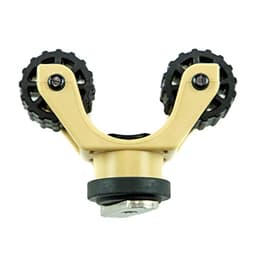
Soft rollers that take the shaft one-handed, 2.25 inches tall, on any common track. The tidiest answer if the boat already has a rail.
Published specs
| Mounting | GearTrac, MightyMount and most other kayak track systems |
|---|---|
| Height | 2.25" |
| Grip | Soft rollers tensioned to hold the shaft |
| Sold as | Single unit (a 2-pack is also sold) |
| Origin | Made in the USA |
Our score, broken out
- Grip8.5
- Mounting8.0
- Reach9.0
- Value7.0
What it gets right
- Rollers rather than a snap fit, so the paddle goes in and comes out one-handed — which is the whole point when the other hand is holding a rod.
- Track mounted, so on a boat with a factory rail it costs no holes and it slides to wherever your reach actually is.
- A published 2.25-inch height keeps it below the line where a holder starts catching your stroke.
What it gets wrong
- Sold individually at this listing. A paddle really wants two holders, which doubles the cost.
- No track, no deal: on a bare deck you are adding a track, its holes and its cost first.
- Rollers hold by tension rather than by capture. It is a stowage device, not a tie-down for rough water.
Who should skip it
Skip it if your boat has no accessory track and you do not want to add one. The two-screw holder does the same job for less.
FAQ
Questions people actually ask
Is Scotty or RAILBLAZA better for a kayak?
Scotty is cheaper to get into and far easier to find parts for; RAILBLAZA is nicer to use and better documented. A Scotty low-profile track plus a 438 gear-head adapter is the least expensive working mounting point of the three systems here, and Scotty's post pattern is widely copied so generic parts exist.
RAILBLAZA's StarPort uses a slide lock that is the best of the three one-handed, publishes the base as UV-stabilized fiberglass-reinforced plastic, and carries a lifetime warranty with exceptions. The trade is a thinner third-party catalog and a base that is often on back-order by itself, which is why the base-and-holder combo is the sensible way in.
Can you mix Scotty, RAILBLAZA and YakAttack on one kayak?
Yes, and plenty of rigged boats do. A track is a mechanical slot, and adapters exist across brands — Scotty's 438 gear-head track adapter exists specifically so Scotty accessories mount on a track rather than a post.
The practical rule is to commit to a track rather than to a brand. Fit the track, then buy whichever adapter suits the accessory you actually want. Mixing a StarPort next to a GearTrac on the same deck causes no problems.
What is the cheapest way to add a rod holder to a kayak?
A Scotty track and a gear-head adapter, or a clamp-on side-deck bracket if you would rather not drill at all. The track-and-adapter route is the cheapest permanent mounting point among these three systems, and short track lengths exist for decks with little flat area.
Before buying anything, check the hull. Many used fishing kayaks already have flush rod holder tubes molded into the deck, which makes the purchase unnecessary.
What is a 1 inch Screwball and why does it matter?
It is YakAttack's 1 inch ball mounting interface, and it matters because a large number of third-party accessories — phone holders, camera arms, fish finder mounts — are built around a 1 inch ball.
That makes a GearTrac deck the least likely of the three systems to dead-end: the track is YakAttack's, but the things you hang off it do not have to be. The trade is price, and a ball joint has more to work loose than a socket does.
Do you have to drill a kayak to fit a mount?
Usually, for a deck mount — and the real constraint is not the hole, it is whether you can reach behind the deck to put a nut and backing washer on the bolt. On many sealed sit-on-top decks you cannot.
There are routes around it: clamp-on gunwale and side-deck brackets need no hole at all, and well nuts or rivets work where there is no access. Check the hull first, too: factory tracks, threaded inserts and existing flush tubes all change the answer.
We have not paddled with any of this gear. Everything above comes from published specifications, cited manuals and live retailer prices. Here is exactly how we pick.
Sources
Read next
Related on Drift & Dime
Outfitting
The best kayak gear tracks and accessory railsTracks and rails compared on the hardware standard they accept, not the marketing.
Fishing Rigging
The best budget kayak rod holdersHolders compared on locking ring, published bolt pattern and mounting.
Outfitting
The best kayak cup holdersCup holders on mounting system and what is actually included.
Paddles
The best kayak paddle holdersPaddle clips and track holders on grip, mounting and published fit.
Fishing Rigging
Rigging a used fishing kayakSealing inherited holes, reusing bolt patterns, and no-drill rigging.