PFDs & Safety
Onyx MoveVent Dynamic review
Buy it if you paddle a boat with a seat back, which is most kayaks. The mesh lower-back panel is the one feature that stops a PFD fighting your seat, and nothing else at this price has it. The catch: Onyx does not publish a buoyancy figure.
Disclosure: we earn a commission if you buy through the links on this page, at no extra cost to you. It does not change which products we pick or how we rank them. How this site is funded.
The short answer
Quick picks
Ranked for the person outfitting a used boat: what it costs, what it does, and who should skip it. 4 picks.
| # | Product | Best for | Our score | Price |
|---|---|---|---|---|
| 1 |  Onyx MoveVent DynamicMesh back panel clears a kayak seat, which is the whole job. | Most used boats | 8.4 | $73.57View on Amazon |
| 2 |  Onyx MoveVent CurveThe ventilated one. Buy it if your problem is heat, not fit. | Hot, still water | 8.3 | $69.25View on Amazon |
| 3 |  Stohlquist Fit16 lb of published buoyancy and a 30–52" range on one jacket. | Sharing one vest | 8.2 | $49.99View on Amazon |
| 4 |  Onyx A/M-2422.5 lb inflated — and explicitly not approved for whitewater. | Flat water, warm days | 8.0 | $124.99View on Amazon |
The verdict, first
If you paddle a kayak with a seat back, buy the MoveVent Dynamic. It is USCG approved, it has a mesh lower-back panel instead of foam, and that single design choice is the difference between a vest you wear all day and a vest that shoves you forward in the seat for three hours.
Buy the Curve instead if you want a women’s cut — it is the same vest with a different torso shape. Buy the Stohlquist Fit if the budget is tighter, and accept more foam against your back. Buy the Onyx A/M-24 if you will not wear foam at all, which is a real and honest reason to spend more.
The one thing we hold against it: Onyx does not publish a buoyancy figure for it, so you cannot compare it numerically with the vests that do.
What it is
A Type III-style foam paddling vest sold specifically for paddle sports, with segmented foam panels, a nylon ripstop shell, shoulder and side adjustment, neoprene shoulder pads, an expandable zippered pocket with mesh drainage, and SOLAS-grade reflective tape. It is USCG approved and Transport Canada approved, and it is sold across three sizes covering a published 28 to 56 inch chest range.
It is also, by a wide margin, the vest most used-kayak buyers end up in, which is why it is worth a page of its own rather than a line in a roundup.
The mesh back panel is the whole product
Nearly every complaint about kayak life jackets traces back to one geometric problem, and this vest is built around solving it.
A kayak seat has a back that comes up to somewhere around your lower ribs. A general-purpose boating vest has solid foam down its entire back. Put the two together and the foam lands exactly where the seat back is, which pushes you forward out of the seat, rides the vest up your spine, and makes an hour feel like three.
The MoveVent Dynamic puts mesh there instead. The flotation foam is carried higher on the back and around the front, and the lower-back area is open. The seat back touches your back rather than a slab of foam, so nothing fights anything.
That is not a comfort nicety. It is the reason this vest gets worn — and a PFD that gets worn is worth infinitely more than a better-rated one in the hatch, which is the point the Coast Guard makes about wear rates far more forcefully than we need to.
The spec Onyx will not print
Here is the honest weakness, and it is a real one.
Onyx publishes approval, chest ranges, shell material, pocket design and reflective grade. It does not publish a buoyancy figure in pounds for the MoveVent Dynamic.
USCG approval means it meets the minimum flotation requirement for its category, so this is not a safety gap. It is a comparison gap: when a rival vest publishes its flotation per size and this one does not, you cannot put the two side by side on the number that most directly describes what a life jacket does. We say the same thing about any product that omits a figure — a published spec you can check beats a reassuring sentence, every time.
In practice, for a kayak on inland water, approval plus a correct fit is the thing that matters, and fit is a free decision you make at purchase. The figures that are published, by vest, are compared on the budget life jacket roundup.
How it compares to the obvious alternatives
| Spec | MoveVent Dynamic | MoveVent Curve | Stohlquist Fit |
|---|---|---|---|
| Approval | USCG and Transport Canada | USCG | USCG |
| Lower back | Mesh panel | Mesh panel | Foam, cut shorter |
| Cut | Unisex | Women’s | Unisex |
| Published chest range | 28–56" across three sizes | Published per size | Published per size |
| Published buoyancy | Not published | Not published | Not published |
| Expandable, mesh drainage | Expandable | Yes | |
| Whistle included | Yes | Varies by listing | Varies by listing |
The row that decides between the Dynamic and the Curve is cut, not performance. The row that decides between either MoveVent and the Stohlquist Fit is the lower back: if your boat has a tall seat back, the mesh is worth the difference, and if it does not, the Fit is a perfectly good vest for less.
Sizing, and the one thing to check before you order
Three sizes covering 28 to 56 inches is broad coverage and coarse granularity, and that combination has one specific failure mode: landing at the very top of a size band.
A vest sold in five sizes lets you pick the nearer one. This one makes you choose between loose and tight more often. Loose is the dangerous direction — a PFD that can ride up slides over your ears in the water, which is exactly when you need it to stay put.
So measure your chest over the clothing you actually paddle in, and if you are at the top of a band, consider the next size up and cinch it down rather than squeezing into the smaller one. The lift test and the full fitting sequence are on how to fit a kayak PFD, and it takes two minutes.
If your chest is at the upper end of that range, the oversize vests are a genuinely different product rather than a bigger version of this one, and we cover them on PFDs for bigger paddlers.
The adjustment, and why it matters more than the foam
Shoulder adjusters plus side adjusters is more than the cheapest approved vests give you, and it is the feature that turns a size into a fit.
The sides are what stop the vest rotating and riding. The shoulders are what set how high it sits, which decides whether the collar catches the back of your neck when you look up — a thing you do constantly in a kayak and almost never in a boat. Neoprene shoulder pads then stop those straps digging in under load.
A vest you can adjust in two planes will fit a range of bodies well. A vest with side straps only fits one body well and everybody else approximately.
The pocket is better than it sounds
One expandable zippered pocket with mesh drainage, and it is the single most used feature on the vest after the flotation.
It is where the phone goes — in a pouch — and where keys and a snack live. The mesh drainage matters because a sealed pocket on a paddling vest fills with water and stays full, which turns a pocket into a small heavy bag.
Why the phone belongs there rather than in a hatch: in the one situation where you need to call someone, you are in the water next to an upturned boat and the hatch is unreachable. The rest of the phone decision is on what to do with your phone on a kayak.
The whistle, and the legal bit
A whistle is included, which is quietly useful because a sound-producing device is separately required on most waters — the vest arrives having solved two requirements rather than one.
Attach it to the vest, not to the boat. A signal device in the hatch of a kayak you are no longer sitting in is a signal device that is not helping anybody. The full requirement list, including what changes after dark and by state, is on are life jackets required on kayaks.
Living with it: sun, salt and storage
Foam vests do not wear out from use. They wear out from being left out.
UV is what kills the shell fabric and degrades the webbing, so the vest wants to live indoors between trips rather than in the boat under a cover. Salt wants rinsing off, and the vest wants drying in shade rather than full sun, hung rather than folded — folded foam takes a set and a creased panel is a panel that sits badly.
The one real inspection point on a used vest: squeeze the foam panels. Foam that has gone hard, crumbly or compressed has lost flotation, and no amount of good condition elsewhere makes up for it. That is the same check we recommend on any second-hand PFD, and it is the reason a hand-me-down vest is the one piece of used kit worth being fussy about.
Who should not buy it
Anyone who will not wear foam. If the honest truth is that a foam vest means an unworn vest, buy the inflatable. The Onyx A/M-24 is a genuinely different trade — less bulk, more maintenance, and rules about where it is appropriate. That argument is on inflatable versus foam.
Anyone wanting a women’s cut. Buy the Curve, or read the women’s life jacket roundup for the vests with published flotation per size.
Anglers who want pockets. This vest has one. A fishing-specific vest has several, plus rod-holder loops and tool attachment points, which is a real difference if you fish from the boat.
Anyone at the very top of a size band. Three broad sizes is the one place this vest is beaten by rivals sold in five.
What we would buy
The MoveVent Dynamic, in the size that fits over your paddling layers, with the whistle clipped to it and the phone in the pocket.
It is not the most sophisticated vest on the market and it does not publish the figure we would most like to see. What it does is solve the specific reason kayakers take life jackets off, at a price that makes buying one a non-decision on a used boat — and a worn vest beats an unworn one every single time.
In full
Every pick, in detail
Specs below are the manufacturer's published figures, cited per product. Where a maker does not publish a number, the row says so rather than guessing at it.
#1 · Most used boats
Onyx MoveVent Dynamic
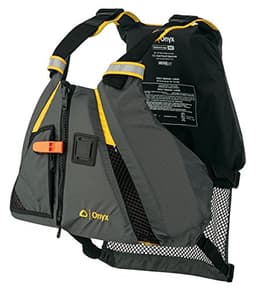
Mesh back panel clears a kayak seat, which is the whole job.
Published specs
| Approval | USCG approved; Transport Canada approved |
|---|---|
| Chest range | 28–56" across three sizes |
| Shell | Nylon ripstop outer shell |
| Back panel | Mesh, to sit above a kayak seat back |
| Expandable zippered pocket with mesh drainage | |
| Reflective | SOLAS grade |
| Buoyancy | Manufacturer does not publish this |
Our score, broken out
- Fit range7.5
- Mobility9.0
- Ventilation8.5
- Value8.5
What it gets right
- The lower-back mesh is the feature that matters on a sit-in kayak — solid foam there fights the seat back and pushes you forward all day.
- Shoulder and side adjustment plus neoprene shoulder pads, which is more adjustment than the cheapest approved vests offer.
- A whistle is included, and a sound-producing device is separately required by the USCG on most waters.
What it gets wrong
- Onyx does not publish a buoyancy figure, so you cannot compare it numerically against vests that do.
- Three broad sizes rather than fine-grained sizing — the fit is good, not tailored.
Who should skip it
Skip it if your chest is at the very top of a size band. The three-size split means you land between sizes more often than with a vest sold in five, and a loose PFD rides up over your ears in the water.
#2 · Hot, still water
Onyx MoveVent Curve
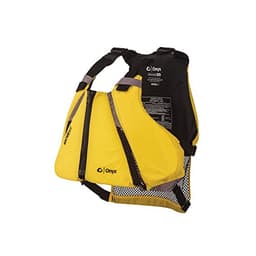
The ventilated one. Buy it if your problem is heat, not fit.
Published specs
| Approval | USCG approved |
|---|---|
| Design | Curved, body-hugging panel layout with neoprene shoulders |
| Ventilation | Vented front and back panels |
| Buoyancy | Manufacturer does not publish this |
Our score, broken out
- Fit range7.0
- Mobility8.5
- Ventilation9.0
- Value9.0
What it gets right
- Sits closer to the body than the Dynamic, so it moves less when you rotate through a stroke.
- Consistently the cheaper of the two Onyx paddle vests at list price.
What it gets wrong
- Less pocket capacity than the Dynamic.
- No published buoyancy figure here either.
Who should skip it
Skip it if you fish from the boat. There is nowhere useful to put pliers, and you will end up buying the Dynamic or the fishing vest anyway.
#3 · Sharing one vest
Stohlquist Fit
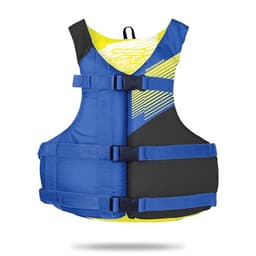
16 lb of published buoyancy and a 30–52" range on one jacket.
Published specs
| Approval | USCG approved Type III |
|---|---|
| Buoyancy | 16 lb (Universal); 18 lb (Oversize) |
| Chest range | 30–52" (Universal); 48–60" (Oversize) |
| Weight | 1.6 lb |
| Shell | 200-denier nylon outer shell and liner |
| Flotation | Polyethylene foam |
Our score, broken out
- Fit range9.5
- Mobility8.0
- Ventilation7.0
- Value8.0
What it gets right
- Stohlquist publishes the buoyancy figure, which most budget vests do not. 16 lb is comfortably above the 15.5 lb Type III minimum.
- A single Universal jacket covers 30–52", so one vest genuinely fits most adults who might borrow your boat.
- Sculpted front and back foam panels rather than one slab, so it does not fight a seat back.
What it gets wrong
- Front-entry three-buckle design takes longer to put on than a side-entry vest.
- Pocket layout is not published, so plan to carry a whistle on a lanyard rather than in the jacket.
Who should skip it
Skip it if you want a vest that is easy to shrug on and off at the ramp. Three buckles is three buckles, every single time.
#4 · Flat water, warm days
Onyx A/M-24
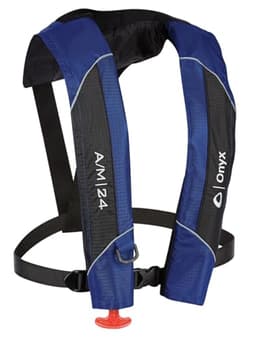
22.5 lb inflated — and explicitly not approved for whitewater.
Published specs
| Approval | USCG approved Type V with Type III performance |
|---|---|
| Buoyancy | 22.5 lb when fully inflated |
| User limits | Over 16 years of age and over 80 lb |
| Chest range | 30–52", universal |
| Inflation | Water-activated or pull cord; convertible to manual only; oral backup tube |
| Shell | 200D nylon ripstop and 200D nylon oxford |
| Not approved for | Personal watercraft, whitewater paddling, water skiing, kneeboarding or similar towed activities |
Our score, broken out
- Fit range8.0
- Mobility9.5
- Ventilation9.5
- Value6.0
What it gets right
- 22.5 lb inflated is more buoyancy than any foam vest on this page, and Onyx publishes the number.
- Almost nothing on your torso until it fires, which is why people who refuse to wear a PFD will actually wear this one.
What it gets wrong
- It only works if it inflates. That means a cylinder to check, a bobbin to replace, and a jacket to re-arm after every deployment.
- It does nothing at all for an unconscious paddler until it fires.
Who should skip it
Skip it for whitewater — Onyx's own published limitations exclude it — and skip it for anyone under 16 or under 80 lb, which is also in the approval. On moving water, wear foam.
FAQ
Questions people actually ask
Is the Onyx MoveVent Dynamic good for kayaking?
Yes, and the reason is specific: it has a mesh lower-back panel instead of foam, so the kayak's seat back touches your back rather than a slab of flotation. Solid-backed boating vests fight a kayak seat, push you forward and ride up, which is the main reason people take them off.
It is USCG and Transport Canada approved, has shoulder and side adjustment, a draining zippered pocket and SOLAS-grade reflective tape, and it includes a whistle — which separately satisfies the sound-signal requirement on most waters.
How much flotation does the Onyx MoveVent Dynamic have?
Onyx does not publish a buoyancy figure in pounds for it. USCG approval means it meets the minimum flotation requirement for its category, so this is a comparison gap rather than a safety gap — but it does mean you cannot put it side by side with vests that print their flotation per size.
For a kayak on inland water, approval plus a correct fit is what matters in practice, and fit is free to get right at purchase.
What is the difference between the Onyx MoveVent Dynamic and the Curve?
Cut, not performance. The Curve is the women's-cut version of the same vest, shaped differently through the torso; the Dynamic is the unisex version. Both use the mesh lower-back panel that makes the design work on a kayak.
Pick on fit. Neither publishes a buoyancy figure, so there is no numerical reason to prefer one over the other.
What size Onyx MoveVent Dynamic should I buy?
Measure your chest over the clothing you actually paddle in, and check it against the published 28 to 56 inch range across the three sizes.
The weakness of three broad sizes is landing at the top of a band. If that is you, take the larger size and cinch it down rather than squeezing into the smaller one — a loose PFD rides up over your ears in the water, which is the failure that matters. Do the lift test before you use it.
Should I buy the MoveVent Dynamic or an inflatable PFD?
Buy the foam vest unless the honest answer is that you will not wear one. A worn vest beats a better-rated unworn one every time.
If foam means it stays in the hatch, the inflatable is the right purchase despite costing more — the Onyx A/M-24 trades bulk for maintenance, and there are conditions where an inflatable is the wrong choice. That comparison is on the inflatable versus foam page.
We have not paddled with any of this gear. Everything above comes from published specifications, cited manuals and live retailer prices. Here is exactly how we pick.
Sources
Read next
Related on Drift & Dime
PFDs & Safety
The best budget kayak life jacketsSix approved vests ranked on fit, mesh back panels and published buoyancy figures.
PFDs & Safety
How to fit a kayak PFDThe strap order, the lift test, and what to do when you fall between sizes.
PFDs & Safety
Inflatable versus foam kayak PFDsMore buoyancy, less bulk, and published limits that exclude moving water.
PFDs & Safety
The best women's kayak life jacketsWomen's-cut PFDs compared on published flotation, entry style and fit.
PFDs & Safety
Are life jackets required on kayaks?The federal rule, what 'readily accessible' means on a kayak, and where wear is mandatory.