Racks & Transport
Yakima versus Thule for carrying a kayak
Both make good racks and the kayak carriers are closer than the brand loyalty suggests. What separates them is what each publishes and what each includes.
Disclosure: we earn a commission if you buy through the links on this page, at no extra cost to you. It does not change which products we pick or how we rank them. How this site is funded.

The short answer
Quick picks
Ranked for the person outfitting a used boat: what it costs, what it does, and who should skip it. 3 picks.
| # | Product | Best for | Our score | Price |
|---|---|---|---|---|
| 1 | 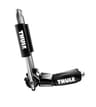 Thule Hull-a-Port ProA 75 lb folding J-cradle that also converts to a two-boat stacker, fully assembled, and it folds flat when empty. Thule Hull-a-Port ProA 75 lb folding J-cradle that also converts to a two-boat stacker, fully assembled, and it folds flat when empty. | The same job with a published number | 8.1 | $158.95View on Amazon |
| 2 |  Yakima JayLowA folding J-cradle that converts to a vertical stacker for two boats, with straps and bow and stern lines in the box. Yakima JayLowA folding J-cradle that converts to a vertical stacker for two boats, with straps and bow and stern lines in the box. | One boat on edge, or two if you fold it | 7.8 | $248.95View on Amazon |
| 3 |  Malone J-Pro275 lb on a J-cradle. Frees half the bar for everything else. Malone J-Pro275 lb on a J-cradle. Frees half the bar for everything else. | One boat, tall load | 7.5 | $125.95View on Amazon |
The question behind the question
“Yakima or Thule” is usually asked about crossbars — the whole system that goes on the car. For a kayak, the answer barely depends on the brand at all, because both companies make good bars and almost every kayak carrier on the market fits both.
The decision that matters is the carrier: a J-cradle, a saddle, or a stacker. Get that wrong and it does not matter whose name is on it. We settle that choice on J-rack versus saddle, and this page assumes you have decided you want a J-cradle and are choosing between the two obvious ones.
So this is a narrow comparison: the Yakima JayLow against the Thule Hull-a-Port Pro, with Malone’s J-Pro2 as the value reference, because on a used-kayak budget that third option changes the argument.
How we compared them
Four criteria, weighted equally and published on how we pick:
- Capacity. The published load rating, and whether there is one at all.
- Flexibility. How many boats and how many positions.
- Included kit. Straps, end lines, locks — the things that turn a list price into a real price.
- Value. Against each other and against the budget alternative.
The published numbers
| Spec | Thule Hull-a-Port Pro | Yakima JayLow | Malone J-Pro2 |
|---|---|---|---|
| Published load capacity | 75 lb | Not published on the listing | 75 lb |
| Boats carried | One on edge, or two as a stacker | One in J position, or two vertically | One on edge |
| Straps included | Yes, with buckle bumpers | Yes, heavy duty | Yes |
| Bow and stern lines | Included, for one boat | Included | Included |
| Locks | Sold separately | Sold separately | Not offered |
| Folds flat | Yes | Folds down | Fixed |
One line in that table does the most work, and it is the capacity row.
Thule publishes a number; Yakima does not
Thule states 75 lb for the Hull-a-Port Pro. Yakima’s JayLow listing publishes carrying modes, an adjustment mechanism and included hardware, but no load rating.
That is not proof the Yakima is weaker — it is a comparable product from a company that has been making racks since 1979, and it almost certainly carries any kayak this site is about. But on a part holding a boat above a highway, a published rating is the thing you can check your loaded fishing kayak against, and one of these two lets you do that.
It matters most if your boat is heavy. A rigged fishing sit-on-top can run 70 to 100 lb with a seat and crate in it, which is at or past the 75 lb figure Thule and Malone both publish. If that is your boat, the rack rating is a real constraint and not a formality — and so is the roof rating on your car, which we cover on kayak racks for an SUV.
Where the Yakima wins
The cam lever. Yakima publishes an integrated lever that sets the upright position, which means you can change the angle of the cradle on the car, with the boat beside you, rather than picking a geometry in a shop and living with it.
That is genuinely useful in two situations: a wide hull that does not sit properly in a narrow J, and a two-boat trip where folding the uprights vertical turns the carrier into a stacker. Both are things you discover in a parking lot rather than at purchase.
The JayLow also includes bow and stern tie-downs outright. On a category where end lines are usually a separate purchase — the argument on the bow and stern tie-down roundup — that is real money in the box.
Where the Thule wins
Three things, and the first is the published capacity already covered.
It folds flat. Thule publishes a fold-flat design, so when the boat is not on the car the carrier lies down on the bars. That means less wind noise, less drag and a lower profile in a parking garage — and it is the reason a rack stays on a car all season instead of being taken off and lost in a garage.
Buckle bumpers. A small published detail on the straps that stops a metal buckle tapping a painted roof for the whole drive. Anyone who has heard that noise at 60 mph understands the value.
Fully assembled out of the box. Thule states it; on a part you fit in a driveway on the morning of a trip, that is worth something.
Straps are where the real risk sits
Both carriers include straps, and both are better than the rack itself at hiding the thing that actually goes wrong.
Cam straps age in sunlight. Webbing that has faded has lost strength, and the failure is not dramatic — it is a strap that stretches under load on the highway until the boat has moved six inches. Replacing straps every few seasons costs very little and is the single cheapest safety habit in kayak transport.
The published figures worth comparing are on the straps rather than the cradles: our strap roundup covers what the numbers mean on the tie-down strap roundup.
The third option that undercuts both
Malone’s J-Pro2 publishes the same 75 lb rating as the Thule, includes straps and bow and stern lines, and costs substantially less than either of these.
What you give up is the folding and converting. The Malone is a fixed J-cradle: one boat, one position, no stacker mode, no cam lever. If you carry one kayak and always will, that is not a loss — and it is why the Malone is the pick on the budget roof rack roundup rather than either of the products on this page.
The honest framing on a site about used boats: a rack that costs more than a third of what you paid for the kayak deserves a specific reason. Two boats, or a rack that folds flat and stays on the car, are both legitimate reasons. Brand preference is not.
Do they fit your bars?
Almost certainly, and this is the fear that drives the brand question in the first place.
Thule publishes a universal mounting design stated to fit all types of load bars. Yakima’s JayLow is sold for crossbars generally rather than for Yakima bars only. In practice both fit round, square, aero and factory bars, sometimes with an included adapter.
What does not cross over is the lock cylinder. Thule’s One Key system and Yakima’s SKS cores are proprietary, and both are sold separately. If you already own one brand’s locks and want one key for everything, that is the single legitimate brand-loyalty argument in this whole comparison.
The other thing to check is bar spread rather than bar brand. Crossbars too close together leave both ends of the boat cantilevered, which is covered on the two-kayak rack roundup.
Both brands make saddles too
Worth saying, because this page is a J-cradle comparison and a J-cradle may not be what you want.
Yakima and Thule both sell saddle-style carriers that hold the hull flat — Yakima's DeckHand and HandRoll, Thule's DockGlide and Hullavator among them. Saddles let you slide a boat on from the rear rather than lifting it over a cradle arm, which is the single biggest practical difference in this whole category. We rank the loading-assist versions on kayak racks for an SUV.
The reason to choose a J-cradle over a saddle is bar space. Carrying the boat on edge uses roughly half the width, which leaves room for a second kayak, a bike or a box. If you do not need that space, a saddle is easier to live with regardless of brand.
Wind noise, drag and leaving it on
An empty J-cradle is two hooks sticking up into the airflow. That costs noise and fuel every day you drive without a boat, which for most people is most days.
It is the strongest practical argument for the Thule here: it publishes a fold-flat design, so the carrier lies down on the bars when empty. The Yakima folds down as well. A fixed cradle like the Malone does not, which is the hidden running cost of the cheapest option.
The other option is taking the carrier off between trips, which everyone intends to do and nobody keeps doing. Assume the rack lives on the car and choose accordingly.
Buying either one used
Both brands hold value and both turn up second-hand, which on a used-boat budget is worth considering.
Check three things. That the hardware is complete — the mounting bolts and bar clamps are model-specific and expensive to replace. That the straps are included and not sun-rotted, because webbing that has faded has lost strength. And that the plastic is not chalky, which is the same UV damage we look for on a hull.
What you cannot check is history. A rack that has been dropped or over-tightened may be deformed in ways that are hard to see, which is why buying used makes more sense on a simple fixed cradle than on a folding one with a mechanism.
Loading: the thing neither brand fixes
Both of these are J-cradles, and a J-cradle is the hardest carrier to load alone. The boat has to go up and over the cradle arm, on edge, above the bar.
On a low car that is fine. On a tall SUV it is the single most common reason a cradle ends up unused in a garage, which is why the SUV page on this site recommends saddles and loaders instead. No amount of brand choice changes that geometry.
If you are buying a J-cradle specifically because it frees up bar space for a second boat or a bike, that is the right reason and both of these do it well. If you are buying one because it is what came up first in search, read the saddle argument before you spend.
What the rack does not decide
Two things outrank the carrier choice entirely, and it is worth naming them before spending on either brand.
Your crossbars and their spread. A carrier is only as good as what it clamps to, and bars set too close together leave both ends of the hull cantilevered regardless of whose cradle is on them.
The car's roof rating. Every vehicle publishes a dynamic load limit, and it has to cover the bars, the carrier and the boat together. It is almost always lower than people assume, and it does not change because you bought a premium rack.
What we would buy
If you want a published rating and a rack that lives on the car, the Thule Hull-a-Port Pro. 75 lb published, folds flat, straps with buckle bumpers, assembled out of the box.
If you carry two boats often, or your hull is awkward in a fixed J, the Yakima JayLow. The cam lever earns its place, and the end lines are included.
If you carry one boat and the budget is the point, the Malone J-Pro2: the same published 75 lb, the same included straps and lines, for less money and fewer features.
And if you load alone off a tall vehicle, buy none of the three. A saddle and a loader is the right answer, and that is a different page.
In full
Every pick, in detail
Specs below are the manufacturer's published figures, cited per product. Where a maker does not publish a number, the row says so rather than guessing at it.
#1 · The same job with a published number
Thule Hull-a-Port Pro
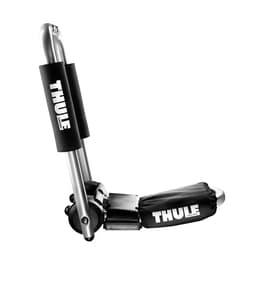
A 75 lb folding J-cradle that also converts to a two-boat stacker, fully assembled, and it folds flat when empty.
Published specs
| Load capacity | 75 lb |
|---|---|
| Carries | Up to two kayaks; converts from J-cradle to stacker |
| Fit | Universal mounting design, stated to fit all types of load bars |
| Included | Load straps with buckle bumpers, plus bow and stern tie-downs for one boat |
| Storage | Folds flat when not in use; fully assembled out of the box |
| Locks | Thule One Key System cylinders, sold separately |
Our score, broken out
- Capacity8.5
- Flexibility8.5
- Included kit8.0
- Value7.5
What it gets right
- It publishes a load capacity, which its closest Yakima rival does not on the same listing. On a rack, that is the number that matters.
- Folds flat on the bars when empty, so the car is not carrying two upright hooks and their wind noise all week.
- Buckle bumpers on the straps are a small thing that stops a metal buckle tapping a painted roof all the way to the lake.
What it gets wrong
- End lines are included for one boat only, so a two-kayak trip needs another set.
- Same J-cradle loading problem as any cradle: the boat goes on edge, above the bar, which is the hardest way to load alone.
- Locks sold separately, same as the Yakima.
Who should skip it
Skip it if you want the easiest solo load rather than the most boats per bar. Saddles win that comparison every time.
#2 · One boat on edge, or two if you fold it
Yakima JayLow
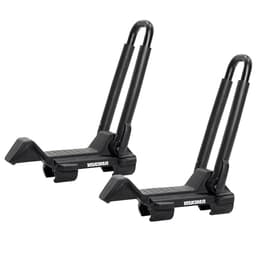
A folding J-cradle that converts to a vertical stacker for two boats, with straps and bow and stern lines in the box.
Published specs
| Carries | One kayak in J position, or two kayaks vertically |
|---|---|
| Adjustment | Integrated cam lever sets the upright position |
| Included | Heavy-duty straps plus bow and stern tie-downs |
| Load capacity | Manufacturer does not publish a figure on this listing |
| Locks | Not included |
Our score, broken out
- Capacity6.5
- Flexibility9.0
- Included kit9.0
- Value6.5
What it gets right
- The cam lever is the real feature: you can change the upright angle on the car rather than choosing a fixed geometry in a shop.
- Straps and end lines are in the box, which on a category where bow and stern lines are a separate purchase is worth real money.
- Two boats vertically is the same trick a dedicated stacker does, so one purchase covers both use cases.
What it gets wrong
- No published load capacity on this listing, which is the number that should decide a rack purchase. Thule publishes 75 lb for its equivalent.
- J-cradles put the boat on edge, which means lifting it higher than a saddle does. On a tall vehicle that is the loading problem we cover elsewhere.
- Locks are extra, and on a rack that stays on a car in a parking lot that is not a trivial omission.
Who should skip it
Skip it if you load alone off a tall SUV. A saddle you slide the boat onto beats any J-cradle for that.
#3 · One boat, tall load
Malone J-Pro2
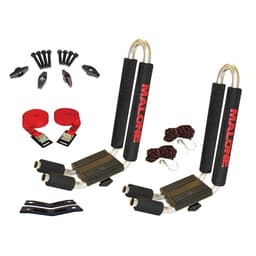
75 lb on a J-cradle. Frees half the bar for everything else.
Published specs
| Capacity | 75 lb, single kayak |
|---|---|
| Style | J-cradle |
| Requires | Crossbars |
| Included | Tie-down straps |
Our score, broken out
- Capacity9.0
- Fit range6.5
- Ease of loading6.5
- Value8.0
What it gets right
- 75 lb single-boat capacity is well clear of what a recreational kayak weighs, including a wet one.
- The J shape uses half the bar width, so a bike or a cargo box can share the roof.
What it gets wrong
- You lift the boat higher than with a saddle — awkward on an SUV, and awkward alone.
- Increases the vehicle's overall height. People do hit garage doors.
Who should skip it
Skip it if you load solo off a tall vehicle. The extra lift height is the single most common reason a J-cradle ends up in a garage unused. A SeaWing saddle keeps the boat flat and low.
FAQ
Questions people actually ask
Is Yakima or Thule better for kayaks?
For a kayak they are closer than the brand debate suggests, and both fit essentially any crossbar. The meaningful difference between the two closest J-cradles is what each publishes: Thule states 75 lb for the Hull-a-Port Pro, while Yakima's JayLow listing publishes carrying modes and included hardware but no load rating.
Yakima's cam lever lets you change the cradle angle on the car, which suits wide hulls and two-boat trips. Thule folds flat when empty, which suits a rack that lives on the car.
Do Yakima kayak racks fit Thule bars?
Generally yes. Thule publishes a universal mounting design stated to fit all types of load bars, and Yakima's J-cradle is sold for crossbars rather than for its own bars only. Round, square, aero and factory bars are all normally covered, sometimes with an included adapter.
What does not cross over is locks: Thule's One Key and Yakima's SKS cores are proprietary and both are sold separately. Owning one brand's keys already is the one real brand-loyalty argument here.
How much weight can a J-cradle kayak rack hold?
Thule publishes 75 lb for the Hull-a-Port Pro and Malone publishes 75 lb for the J-Pro2. Yakima does not publish a figure on the JayLow listing.
Weigh your boat with the seat and crate in before assuming it fits. A rigged fishing sit-on-top can run 70 to 100 lb, which is at or past that 75 lb figure — and the car's own roof rating applies on top of it.
Is an expensive kayak rack worth it over a cheap one?
Only for a specific reason. Malone's J-Pro2 publishes the same 75 lb rating as the Thule and includes straps and end lines for considerably less money.
What the pricier racks add is folding flat, converting to a two-boat stacker, and adjustable geometry. Those are real features if you carry two boats or leave the rack on the car year-round. Brand preference on its own is not a reason.
We have not paddled with any of this gear. Everything above comes from published specifications, cited manuals and live retailer prices. Here is exactly how we pick.
Sources
Read next
Related on Drift & Dime
Racks & Transport
The best budget kayak roof racksRacks ranked on published load capacity and whether you can load solo.
Racks & Transport
Kayak J-rack versus saddleOn edge or flat: roof space, loading height and hull support compared.
Racks & Transport
The best kayak roof rack for two kayaksStacker vs two cradles vs two saddles on published ratings and bar width.
Racks & Transport
The best kayak bow and stern tie-downsBow and stern line kits and hood loops, and what to anchor them to.